Isaiah 35
De Heilige Schrift, Petrus Canisiusvertaling, 1939 · Tap a verse to see its cross-references.
1Dan zal de steppe juichen met de woestijn, En de wildernis jubelen en bloeien; 2Zij zal tieren welig als lelies, Jubelen, juichen en zingen. Dan valt haar de pracht van de Libanon ten deel, De luister van Karmel en Sjaron: Ze zullen de glorie van Jahweh aanschouwen, De heerlijkheid van onzen God. 3Maakt dan de slappe handen krachtig, Stevigt de knikkende knieën; 4Zegt tot de harten in angst: Houdt moed, hebt geen vrees! Ziet, hier is uw God; Hij komt, om de wraak te voltrekken! God zal vergelden; Zelf zal Hij komen, om u te verlossen! 5Dan worden de ogen der blinden ontsloten, En de oren der doven gaan open; 6De lamme springt op als een hert, De tong van den stomme zal juichen! Zelfs in de steppe borrelen de wateren omhoog, En de beken in de woestijn; 7De gloeiende bodem wordt een plas, Het dorre land een fontein. En op de plek, waar de jakhalzen liggen, En de struisvogels wonen, Schiet het riet met de biezen omhoog, 8Een gebaande weg zal er zijn! Een heilige weg zal hij heten, Geen onreine zal hem begaan; Alleen zijn volk hem bewandelen, Geen goddeloze er zwerven. 9Geen leeuwen zullen er zijn, Wilde dieren komen er niet, en treft men er niet; Maar die verlost zijn, zullen hem begaan, 10Die door Jahweh bevrijd zijn, keren er op terug. Zij komen in Sion onder gejubel, Het hoofd met eeuwige vreugde gekroond; Overstelpt van vreugde en blijdschap: Verdwenen zijn kommer en zuchten!
Did you know?
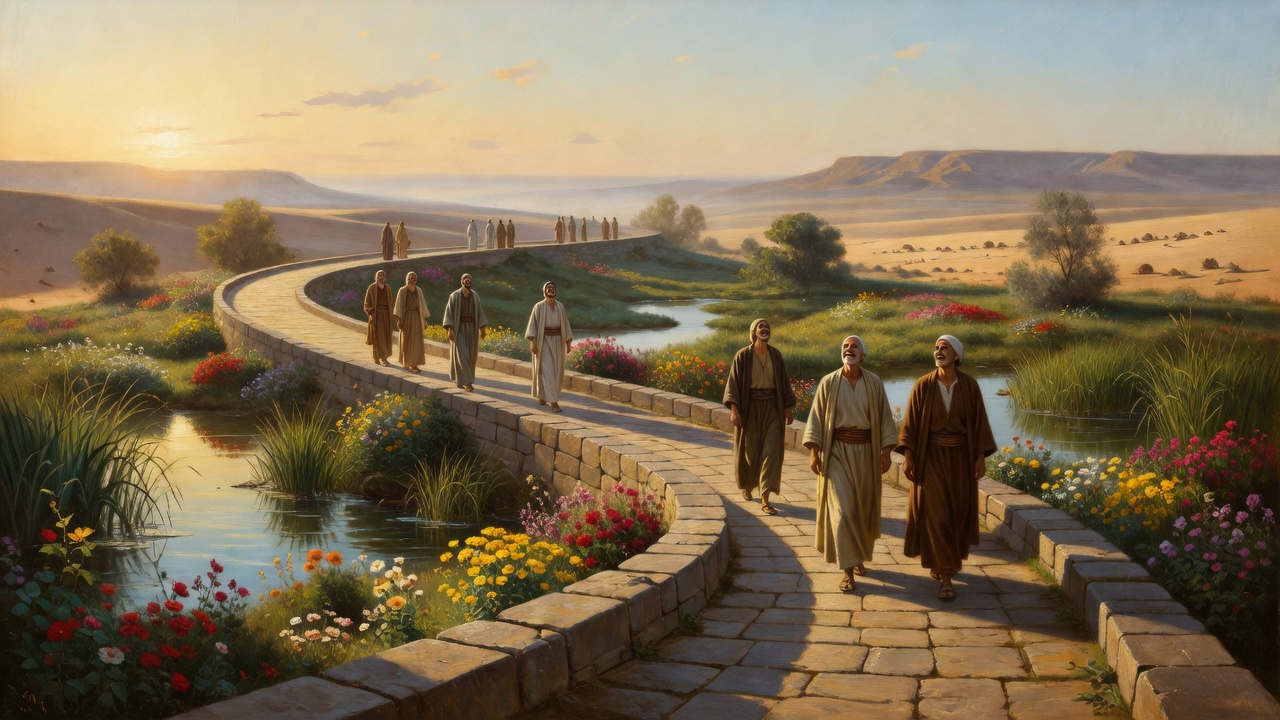
The Transformation of the Desert and the Way of Holiness
- The prophetic poetry of this chapter contrasts barren wilderness with regions celebrated in the ancient Levant for lush vegetation and majesty: the lofty, forested mountains of Lebanon and the fertile coastal plain of Sharon. The prophecy envisions the desert blooming with the splendor and fertility traditionally associated with these flourishing landscapes.Sources: Lebanon · Saron · the Bible text itself
- The chapter culminates in a depiction of the redeemed journeying along a dedicated highway called the Way of Holiness toward Mount Zion, the fortified southeastern hill of Jerusalem where King David had established his citadel. This road is portrayed as completely safe from predatory beasts, allowing travelers to return home with singing and joy.Sources: Zion · the Bible text itself
Notes written with AI assistance from open sources (Theographic Bible Metadata, CC BY-SA 4.0; Easton’s Bible Dictionary, public domain) and reviewed before publishing.
Places in this chapter
- Lebanon · 33.540, 35.584 · verse 2
- Mount Carmel · 32.672, 35.023 · verse 2
- Sharon · Today: Sharon Plain · 32.400, 34.883 · verse 2
- Way of Holiness · Today: within 10 km of Jerusalem · 31.777, 35.234 · verse 8
- Zion · Today: Jerusalem · 31.777, 35.234 · verse 10
Only places identified with high confidence are shown (90% or more according to the scholarly sources compiled by OpenBible). Period map: DARE (Digital Atlas of the Roman Empire), CC BY 4.0; modern map: © OpenStreetMap contributors; places: OpenBible.info (CC BY 4.0).
Credits and license for this translation
De Heilige Schrift, Petrus Canisiusvertaling, 1939
The Holy Bible in Dutch, Petrus Canisius translation, 1939
Public Domain
Language: Nederlandse taal (Dutch)
Eerste uitgave: Het Spectrum, Utrecht, Brussel, 1939
De Petrus Canisiusvertaling is een Nederlandse rooms-katholieke bijbelvertaling, waarvan de eerste complete uitgave verscheen in 1939. De volledige naam luidt: "De Heilige Schrift, vertaling uit de grondtekst met aantekeningen, in opdracht van de Apologetische Vereniging 'Petrus Canisius' ondernomen met goedkeuring van de hoogwaardige bisschoppen van Nederland". De Petrus Canisiusvertaling is de eerste Nederlandse katholieke vertaling die gebaseerd is op de grondteksten in hun oorspronkelijke taal. Andere vertalingen gingen uit van de Vulgaat. Het taalgebruik van de uitgave is naar hedendaagse normen licht archaïsch te noemen, maar nog steeds vlot verstaanbaar.
Verantwoording in verband met de auteursrechten
In verband met de auteursrechten is contact opgenomen met de oorspronkelijke uitgever (1), de Katholieke Vereniging voor Oecume (2) en de Katholieke Bijbelstichting (3) en werden geen bezwaren gevonden tegen deze publicatie. Rekening houdend met de wettelijke termijnen, kan deze uitgave beschouwd worden als vrij van auteursrechten.
First publication: Het Spectrum, Utrecht, Brussel, 1939
The translation "Petrus Canisius" is a dutch roman catholic bible translation, that was first published in 1939. Its full title is "The Holy Scripture, translation of the original texts with annotations, commissioned by the Apologetical Society 'Petrus Canisius' and executed with the approval of the most reverend bishops of the Netherlands". The translation "Petrus Canisius" is the first dutch catholic translation that was based on the scripture texts in their original language. Other translations were based on the Vulgate. The language of this edition is to current standards moderately archaic, but still easily understood.
Accountability in relation to copyright
Concerning the copyright contacts have been made with the original publisher (1), the Katholieke Vereniging voor Oecumene (Catholic Society for Ecumenism) (2) and the Katholieke Bijbelstichting (Catholic Bible Foundation) (3) and no objections have been found against this publication. Taking into account the legal terms, this edition can be considered to be in the public domain.
UITGEVERIJ UNIEBOEK|HET SPECTRUM BV, HOUTEN, THE NETHERLANDS
KATHOLIEKE VERENIGING VOOR OECUMENE, 'S HERTOGENBOSCH, THE NETHERLANDS
KBS, HOEVEN, THE NETHERLANDS
2024-08-06
Source: http://ebible.org/nld1939/ · eBible.org