Esther 7
De Heilige Schrift, Petrus Canisiusvertaling, 1939 · Tap a verse to see its cross-references.
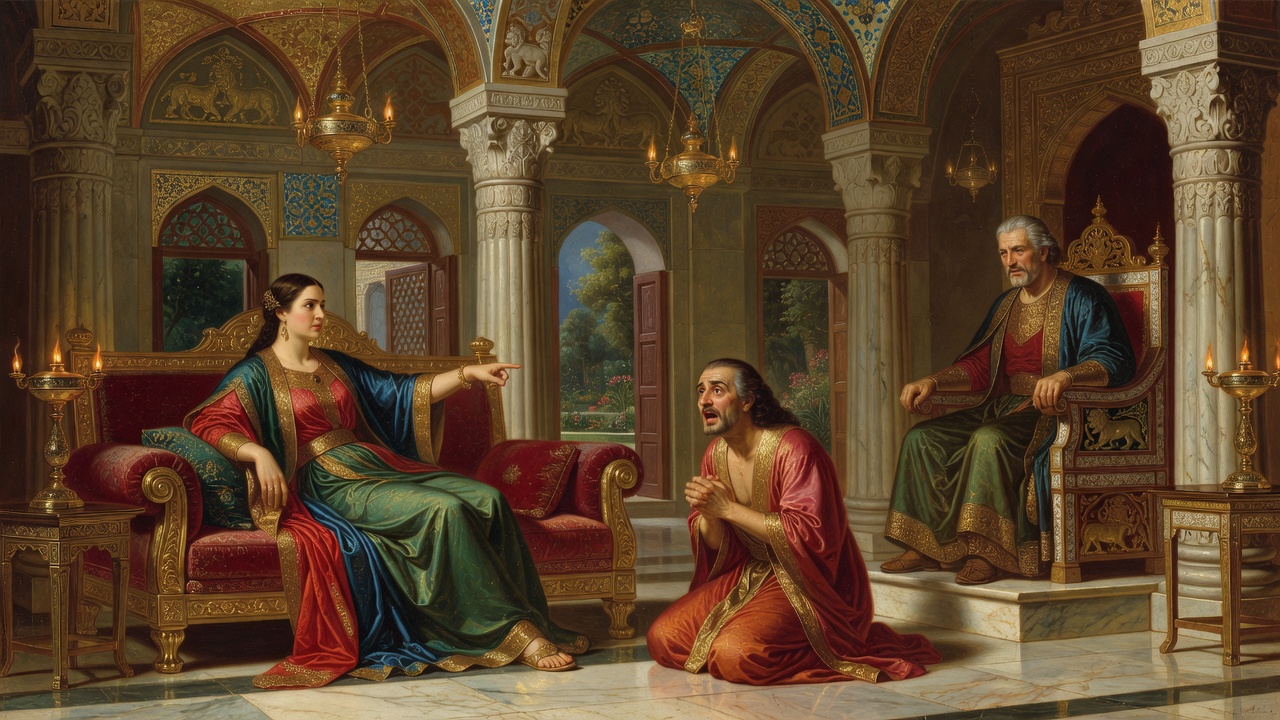
1En weer gingen de koning en Haman ter maaltijd bij koningin Ester. 2Ook de tweede dag vroeg de koning bij het drinken van de wijn aan Ester: Wat is uw verlangen, koningin Ester; het wordt ingewilligd. Al wat ge vraagt, al was het ook de helft van mijn rijk, het zal u worden gegeven. 3Toen sprak koningin Ester: Als ik genade heb gevonden bij den koning, en het den koning behaagt, dan spare hij. op mijn verzoek en mijn bede, mijn leven en dat van mijn volk. 4Want ik en mijn volk zijn verkocht, om gedood te worden, verdelgd en uitgeroeid. Waren we nog als slaven en slavinnen verkocht, ik zou. hebben gezwegen; want dan was de ramp niet groot genoeg, om den koning erover lastig te vallen. 5Toen vroeg koning Achasjwerosj aan koningin Ester: Wie en waar is die man, die zo iets heeft durven bestaan? 6Ester antwoordde: Die belager en vijand is Haman, die lelijke booswicht daar! En van schrik kromp Haman ineen voor de blik van den koning en de koningin. 7Woedend stond de koning van tafel op, en liep de tuin in van het paleis. Maar Haman bleef bij koningin Ester, om haar voor zijn leven te smeken; want hij begreep, dat bij den koning zijn ondergang vaststond. 8Toen de koning daarop uit de tuin van het paleis naar de eetzaal terugkeerde, vond hij Haman op het rustbed, waarop Ester lag. En de koning riep uit: Wat, nu de koningin in mijn eigen huis nog geweld aandoen! Nauwelijks was dit woord den koning over de lippen, of men bedekte Hamans gelaat. 9En Charbona, een van de dienstdoende kamerlingen zei tot den koning: Zie, er staat juist bij het huis van Haman een paal, vijftig el hoog, welke Haman heeft laten maken voor Mordokai, die in ‘s konings belang heeft gesproken. En de koning beval: Hangt hem daaraan op. 10Zo werd Haman opgehangen aan de paal, die hij voor Mordokai had opgericht. Toen eerst bedaarde de woede van den koning.
Did you know?
Esther Exposes Haman's Plot
- At the second banquet of wine, Queen Esther revealed that she and her people had been condemned to total annihilation. When the king demanded to know who would devise such a scheme, she directly denounced Haman, the king's high-ranking official, as the wicked adversary.Sources: the Bible text itself · Esther · Haman
- When King Ahasuerus returned from the palace garden in fury, he found Haman falling upon the couch where Esther was reclining to plead for his life. The king interpreted this breach as an attempt to assault the queen, and attendants immediately covered Haman's face.Sources: the Bible text itself · Ahasuerus
- Harbonah, one of the royal eunuchs, informed the king that Haman had built a gallows fifty cubits high at his house for Mordecai, the man who had previously uncovered a plot to save the king's life. Ahasuerus immediately ordered Haman to be executed on the very structure he had prepared.Sources: the Bible text itself · Mordecai · Harbonah
Notes written with AI assistance from open sources (Theographic Bible Metadata, CC BY-SA 4.0; Easton’s Bible Dictionary, public domain) and reviewed before publishing.
Credits and license for this translation
De Heilige Schrift, Petrus Canisiusvertaling, 1939
The Holy Bible in Dutch, Petrus Canisius translation, 1939
Public Domain
Language: Nederlandse taal (Dutch)
Eerste uitgave: Het Spectrum, Utrecht, Brussel, 1939
De Petrus Canisiusvertaling is een Nederlandse rooms-katholieke bijbelvertaling, waarvan de eerste complete uitgave verscheen in 1939. De volledige naam luidt: "De Heilige Schrift, vertaling uit de grondtekst met aantekeningen, in opdracht van de Apologetische Vereniging 'Petrus Canisius' ondernomen met goedkeuring van de hoogwaardige bisschoppen van Nederland". De Petrus Canisiusvertaling is de eerste Nederlandse katholieke vertaling die gebaseerd is op de grondteksten in hun oorspronkelijke taal. Andere vertalingen gingen uit van de Vulgaat. Het taalgebruik van de uitgave is naar hedendaagse normen licht archaïsch te noemen, maar nog steeds vlot verstaanbaar.
Verantwoording in verband met de auteursrechten
In verband met de auteursrechten is contact opgenomen met de oorspronkelijke uitgever (1), de Katholieke Vereniging voor Oecume (2) en de Katholieke Bijbelstichting (3) en werden geen bezwaren gevonden tegen deze publicatie. Rekening houdend met de wettelijke termijnen, kan deze uitgave beschouwd worden als vrij van auteursrechten.
First publication: Het Spectrum, Utrecht, Brussel, 1939
The translation "Petrus Canisius" is a dutch roman catholic bible translation, that was first published in 1939. Its full title is "The Holy Scripture, translation of the original texts with annotations, commissioned by the Apologetical Society 'Petrus Canisius' and executed with the approval of the most reverend bishops of the Netherlands". The translation "Petrus Canisius" is the first dutch catholic translation that was based on the scripture texts in their original language. Other translations were based on the Vulgate. The language of this edition is to current standards moderately archaic, but still easily understood.
Accountability in relation to copyright
Concerning the copyright contacts have been made with the original publisher (1), the Katholieke Vereniging voor Oecumene (Catholic Society for Ecumenism) (2) and the Katholieke Bijbelstichting (Catholic Bible Foundation) (3) and no objections have been found against this publication. Taking into account the legal terms, this edition can be considered to be in the public domain.
UITGEVERIJ UNIEBOEK|HET SPECTRUM BV, HOUTEN, THE NETHERLANDS
KATHOLIEKE VERENIGING VOOR OECUMENE, 'S HERTOGENBOSCH, THE NETHERLANDS
KBS, HOEVEN, THE NETHERLANDS
2024-08-06
Source: http://ebible.org/nld1939/ · eBible.org