1 Chronicles 20
De Heilige Schrift, Petrus Canisiusvertaling, 1939 · Tap a verse to see its cross-references.
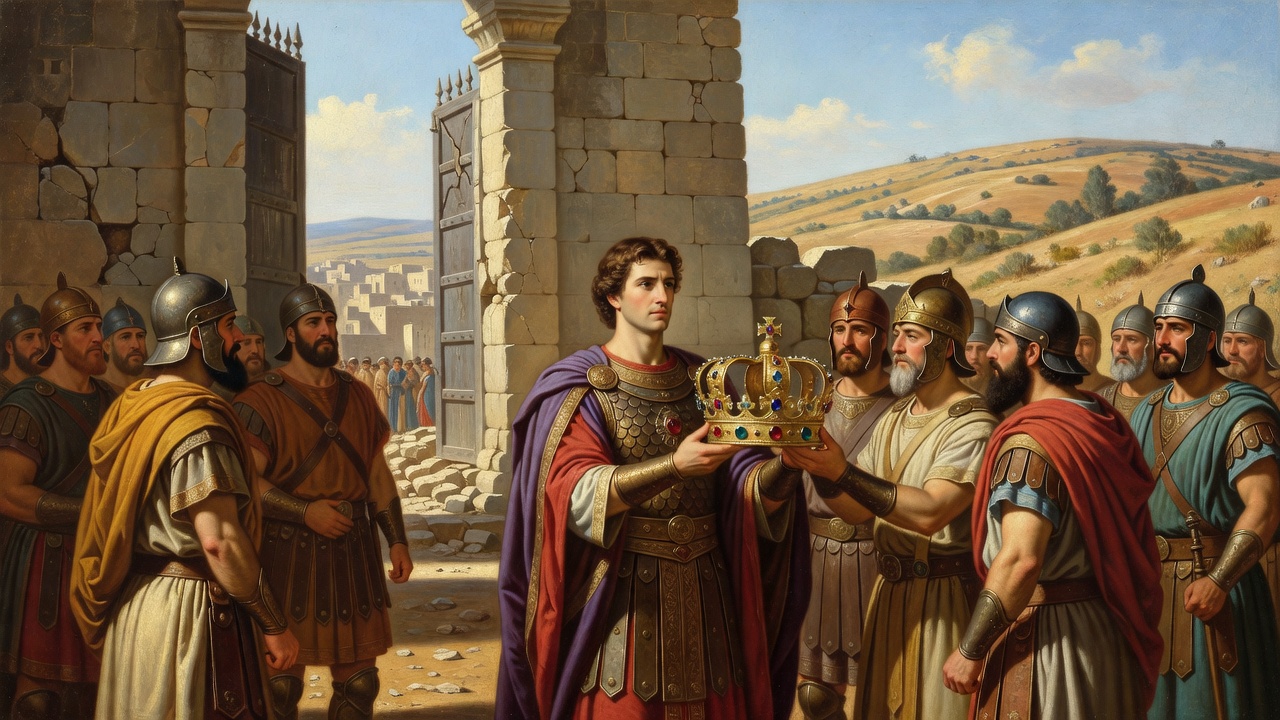
1Bij de jaarwisseling, de tijd, waarop de koningen gewoonlijk te velde trekken, bracht Joab de legermacht in het veld. Hij verwoestte het land der Ammonieten, rukte op, en sloeg het beleg rond Rabba; David zelf was echter in Jerusalem achtergebleven. Toen Joab Rabba veroverd en met de grond gelijk had gemaakt, 2nam David Milkom de kroon van het hoofd, die een talent aan goud woog, en waarin een kostbare steen zat, en droeg hem voortaan zelf; bovendien sleepte hij een ontzaglijke buit uit de stad. 3Ook haar burgers voerde hij weg; hij gebruikte ze aan de zaag, de ijzeren houwelen en de bijlen. Zo deed David met alle steden der Ammonieten. Daarna keerde David met heel het leger naar Jerusalem terug. 4Later kwam het in Gézer tot een gevecht met de Filistijnen. Bij die gelegenheid versloeg Sibbekai, de Choesjatiet, een zekeren Sipai, die tot de Refaïeten behoorde. Zo werden ze onderworpen. 5Toen de strijd met de Filistijnen weer losbarstte, versloeg Elchanan, de zoon van Jaïr, een zekeren Lachmi, een broer van Goliat uit Gat, ofschoon de schacht van zijn lans gelijk een weversboom was. 6En toen er weer oorlog uitbrak in Gat, was er een reus, die zes vingers en zes tenen had, in het geheel dus vier en twintig. Ook hij behoorde tot de Refaïeten. 7Toen hij Israël uitlachte, sloeg Jehonatan, de zoon van Sjimi, den broer van David, hem neer. 8Deze waren allen Refaïeten; zij vielen door de hand van David en zijn manschappen.
Did you know?
The Conquest of Rabbah and the Fall of Giants
- Rabbah was the chief city of the Ammonites, located among the hills east of the Jordan River. Joab led David's army to lay siege to the fortified city in the spring, which was the customary time of year for military campaigns.Sources: Rabbah · Joab · the Bible text itself
- The Philistine city of Gath, renowned in biblical accounts as the hometown of Goliath, was linked to several formidable warriors. The text describes multiple battles where David's men defeated descendants of Rapha, including Lahmi and an unnamed warrior with twenty-four digits.Sources: Gath · Goliath · the giant in Gath · the Bible text itself
Notes written with AI assistance from open sources (Theographic Bible Metadata, CC BY-SA 4.0; Easton’s Bible Dictionary, public domain) and reviewed before publishing.
Places in this chapter
- Ammon · 31.955, 35.934 · verses 1, 3
- Jerusalem · 31.777, 35.234 · verses 1, 3
- Rabbah · Today: Amman · 31.955, 35.934 · verses 1, 2, 3
- Gezer · Today: Tel Gezer · 31.859, 34.919 · verse 4
Only places identified with high confidence are shown (90% or more according to the scholarly sources compiled by OpenBible). Period map: DARE (Digital Atlas of the Roman Empire), CC BY 4.0; modern map: © OpenStreetMap contributors; places: OpenBible.info (CC BY 4.0).
Credits and license for this translation
De Heilige Schrift, Petrus Canisiusvertaling, 1939
The Holy Bible in Dutch, Petrus Canisius translation, 1939
Public Domain
Language: Nederlandse taal (Dutch)
Eerste uitgave: Het Spectrum, Utrecht, Brussel, 1939
De Petrus Canisiusvertaling is een Nederlandse rooms-katholieke bijbelvertaling, waarvan de eerste complete uitgave verscheen in 1939. De volledige naam luidt: "De Heilige Schrift, vertaling uit de grondtekst met aantekeningen, in opdracht van de Apologetische Vereniging 'Petrus Canisius' ondernomen met goedkeuring van de hoogwaardige bisschoppen van Nederland". De Petrus Canisiusvertaling is de eerste Nederlandse katholieke vertaling die gebaseerd is op de grondteksten in hun oorspronkelijke taal. Andere vertalingen gingen uit van de Vulgaat. Het taalgebruik van de uitgave is naar hedendaagse normen licht archaïsch te noemen, maar nog steeds vlot verstaanbaar.
Verantwoording in verband met de auteursrechten
In verband met de auteursrechten is contact opgenomen met de oorspronkelijke uitgever (1), de Katholieke Vereniging voor Oecume (2) en de Katholieke Bijbelstichting (3) en werden geen bezwaren gevonden tegen deze publicatie. Rekening houdend met de wettelijke termijnen, kan deze uitgave beschouwd worden als vrij van auteursrechten.
First publication: Het Spectrum, Utrecht, Brussel, 1939
The translation "Petrus Canisius" is a dutch roman catholic bible translation, that was first published in 1939. Its full title is "The Holy Scripture, translation of the original texts with annotations, commissioned by the Apologetical Society 'Petrus Canisius' and executed with the approval of the most reverend bishops of the Netherlands". The translation "Petrus Canisius" is the first dutch catholic translation that was based on the scripture texts in their original language. Other translations were based on the Vulgate. The language of this edition is to current standards moderately archaic, but still easily understood.
Accountability in relation to copyright
Concerning the copyright contacts have been made with the original publisher (1), the Katholieke Vereniging voor Oecumene (Catholic Society for Ecumenism) (2) and the Katholieke Bijbelstichting (Catholic Bible Foundation) (3) and no objections have been found against this publication. Taking into account the legal terms, this edition can be considered to be in the public domain.
UITGEVERIJ UNIEBOEK|HET SPECTRUM BV, HOUTEN, THE NETHERLANDS
KATHOLIEKE VERENIGING VOOR OECUMENE, 'S HERTOGENBOSCH, THE NETHERLANDS
KBS, HOEVEN, THE NETHERLANDS
2024-08-06
Source: http://ebible.org/nld1939/ · eBible.org