Luke 6
Biblica® Ochiw Thuolo Motingʼo Loko Manyien™ · Tap a verse to see its cross-references.
Ruodh Sabato
1Chiengʼ Sabato moro, Yesu noyudo kadho e kind puothe mag ngano mochiek, kendo jopuonjrene nochako jako wi ngano moko mochiek, negidunyogi e lwetegi mi, gichamo ngano. 2Jo-Farisai moko nopenjo niya, “Angʼo momiyo utimo gima chik ok oyiego chiengʼ Sabato?”
3Yesu nodwokogi niya, “Pok ne usomo gima Daudi notimo kaachiel gi jogo mane ni kode ka kech ne kayogi? 4Donge nodonjo e od Nyasaye, kendo nokawo makati ma nosepwodhi moket tenge ma chik ok oyiene ngʼato angʼata mondo ocham makmana jodolo. Kendo nochiwo moko ne jogo mane ni kode.” 5Eka Yesu nowachonegi niya, “Wuod Dhano en Ruodh Sabato.”
6Chiengʼ Sabato machielo nodhi ei sinagogi kendo nopuonjo, to ngʼato ne ni kanyo ma lwete korachwich notal. 7Jo-Farisai kod jopuonj chik ne dwaro yo ma digiyudgo ketho kuom Yesu. Kuom mano ne gingʼiyogo machiegni, mondo gine ka dochang ngʼatno chiengʼ Sabato. 8To Yesu nongʼeyo gima negiparo eka nowacho ni ngʼatno mane lwete otal niya, “Aa malo kendo chungi e nyim ji duto.” Kamano noa malo mi ochungo kanyono.
9Eka Yesu nowachonegi niya, “Apenjou, ere gima chikwa oyie mondo otim chiengʼ Sabato, timo maber koso timo marach, reso ngima koso ketho ngima ngʼato?”
10Norangogi duto, to eka nowachone ngʼatno niya, “Rie lweti.” Notimo kamano, kendo lwete nochango chuth. 11To negikecho kendo negichako wuoyo ngʼato gi ngʼato kuom gino ma digitim ni Yesu.
Jopuonjre apar gariyo
12Chiengʼ moro achiel Yesu nowuok modhi e bath got moro mondo olem kendo nobedo otieno duto kolamo Nyasaye. 13Kane okinyi ochopo, noluongo jopuonjre ire kendo noyiero apar gariyo kuomgi, mane owalo obedo joote:
14Simon (mane omiyo nying ni Petro); gi owadgi Andrea,
Jakobo,
Johana,
Filipo,
Bartholomayo,
15Mathayo,
Thoma,
Jakobo wuod Alfayo,
Simon mane iluongo ni ja-Zilote,
16Juda wuod Jakobo,
gi Judas Iskariot, mane olokore obedo jandhok.
Gweth gi kwongʼ
17Nolor kodgi piny kendo nochungo kama opie. Oganda maduongʼ mar jopuonjrene ne ni kanyo kod ji mangʼeny moa kuonde duto mag Judea, moa Jerusalem, kendo moa e dho nam mar Turo gi Sidon, 18mane obiro mondo giwinje kendo ochang midekregi. Jogo mane jochiende thago nochangi, 19to ji duto notemo mondo omule, nikech teko ne aa kuome mochangogi duto.
20Kane ongʼiyo jopuonjrene, nowacho niya,
“Ogwedhu un jogo modhier,
nimar pinyruoth Nyasaye en maru.
21Ogwedhu un joma kech kayo sani,
nimar unuyiengʼ.
Ogwedhu un muywak sani,
nimar ununyier.
22Un joma ogwedhi ka ji mon kodu,
ka gikwedou kendo giyanyou,
kendo giketho nyingu,
nikech Wuod Dhano.
23“Beduru mamor e ndalono kendo chikreuru ka uil, nikech poku duongʼ e polo. Nimar mano e kaka kweregi notimo ne jonabi.
24“To okwongʼu un jo-mwandu,
nimar useyudo poku.
25Okwongʼu un joma yiengʼ maber e kindeni,
nimar unudeny.
Okwongʼu un jogo manyiero sani,
nimar ubiro kuyo kendo ywak.
26Okwongʼu ka ji duto wuoyo maber kuomu,
nimar mano e kaka kweregi notimone jonabi ma jo-miriambo.
Hero wasigu
27“Anto awachonu un joma winja kama: Heruru wasiku, timuru maber ni jomamon kodu. 28Gwedhuru joma kwongʼou lamuru ni joma sandou. 29Ka ngʼato othalo lembi konchiel, to lokne komachielo bende. Ka ngʼato okawo kotini, kik itame kawo lawi mar akor. 30Miuru ji duto makwayou, to ka ngʼato okawo giri moro, to kik idwar ni mondo oduoknigo. 31Timuru ne ji mamoko mana kaka duher mondo gin bende gitimnu.
32“Ka uhero joma oherou kende, to en ohala mane muyudo? Kata mana joricho bende ohero mana joma oherogi. 33To ka utimo maber ni joma timonu maber, to en ohala mane ma uyudo? Kata mana joricho timo kamano. 34To ka uholo mana joma un gi adier ni biro dwokonu, en ohala manade ma uyudo? Kata mana joricho holo mana joricho ka gigeno ni ibiro chulogi duto. 35To heruru wasiku, timnegiuru maber, kendo holgiuru ka ok ugeno ni ubiro yudo gimoro bangʼe. Eka poku biro bedo maduongʼ kendo ubiro bedo yawuot Nyasaye Man Malo Moloyo, nikech ongʼwon gi jogo ma ok dewe kendo jomaricho. 36Beduru mangʼwon, mana kaka Wuonu ngʼwon.
Ngʼado bura ne jomoko
37“Kik ungʼad ne ji bura, eka ok nongʼadnu bura. Kik uwuo kuom ngʼato marach, to ok bi wuo kuomu. Weuru ne ji richogi, to ibiro weyonu richou. 38Chiwuru, to ibiro chiwonu. Ubiro yudo rapim maber, moiki kendo motiel mapongʼ thich, kendo oo oko. Nimar rapim mupimogo ema ibiro pimnugo un bende.”
39Nogoyonegi ngeroni niya, “Ngʼat ma muofu bende nyalo telo ni ngʼama muofu machielo? Donge giduto ji ariyogo di gilingʼre ei bugo? 40Japuonjre ok duongʼ moloyo japuonjne, to ngʼato ka ngʼato motiegi chuth biro bedo machal gi japuonjne.
41“Angʼo momiyo ineno ngʼinjo mar buch yath manie wangʼ wadu to pilni maduongʼ mar yath manie wangʼi iwuon to ok idew? 42Ere kaka diwach ne owadu ni; owadwa, yie mondo agolni ngʼinjo mar buch yath manie wangʼi, ka in iwuon ok inyal neno pilni maduongʼ mar yath manie wangʼi iwuon? In ngʼat mawuondoreni, mokwongo gol pilni maduongʼ mar yath manie wangʼi iwuon oko, eka ibiro neno maler mar golo ngʼinjo mar buch yath manie wangʼ wadu oko.
Yath gi olembene
43“Onge yath maber manyago olemo maricho, kata yath marach manyago olemo maber. 44Yath ka yath ingʼeyo kod olembe owuon. Ji ok pon olemb ngʼowu kuom yiende mag kudho, kata olemb mzabibu bende ok pon kuom otanglo. 45Ngʼat maber golo gik mabeyo mawuok kuom ber mokano e chunye, to ngʼat marach golo gik maricho mawuok kuom rach mokano e chunye. Nimar gik mopongʼo chuny ngʼato ema wuok e dho ngʼato.
Jagedo mariek kod mofuwo
46“Angʼo momiyo uluonga ni, ‘Ruoth, Ruoth,’ to ok utim gima awacho? 47Abiro nyisou kaka ngʼat mabiro ira, mawinjo wachna kendo timo chalo. 48Ochalo gi ngʼat manogero ot, mane okunyo bur matut nyaka e lwanda kendo noketoe mise, kane koth ochwe ma pi opongʼo piny, apaka mogingore nogoyo odno to ne ok onyal yienge, nikech nogere motegno. 49To jal mawinjo wechena to ok otimgi chalo gi ngʼat mane ogero ot ewi lowo maonge gi mise. E kindeno ma apaka mogingore nogoyo odno, nogore piny kendo nokethore chuth.”
Did you know?
The Sabbath, the Twelve, and the Plain
- On a Sabbath, as Jesus passed through the grainfields, his disciples picked heads of grain, rubbed them in their hands, and ate them, and some Pharisees called this unlawful. Jesus recalled that David and his hungry companions ate consecrated bread from the house of God, bread lawful only for the priests, and said that the Son of Man is Lord of the Sabbath. On another Sabbath he restored a man’s withered right hand in the synagogue while scribes and Pharisees watched for a reason to accuse him; a chronology dates both episodes to AD 28.Sources: the Bible text itself · Corn on the Sabbath · Healing a Withered Hand
- After spending the night in prayer on the mountain, Jesus called his disciples and chose twelve, whom he designated apostles. Among them were Simon, whom he named Peter, and Peter’s brother Andrew, fishermen from Bethsaida on the western coast of the Sea of Galilee, and Matthew, a tax collector at Capernaum who had formerly been known as Levi.Sources: the Bible text itself · Simon Peter · Andrew · Matthew
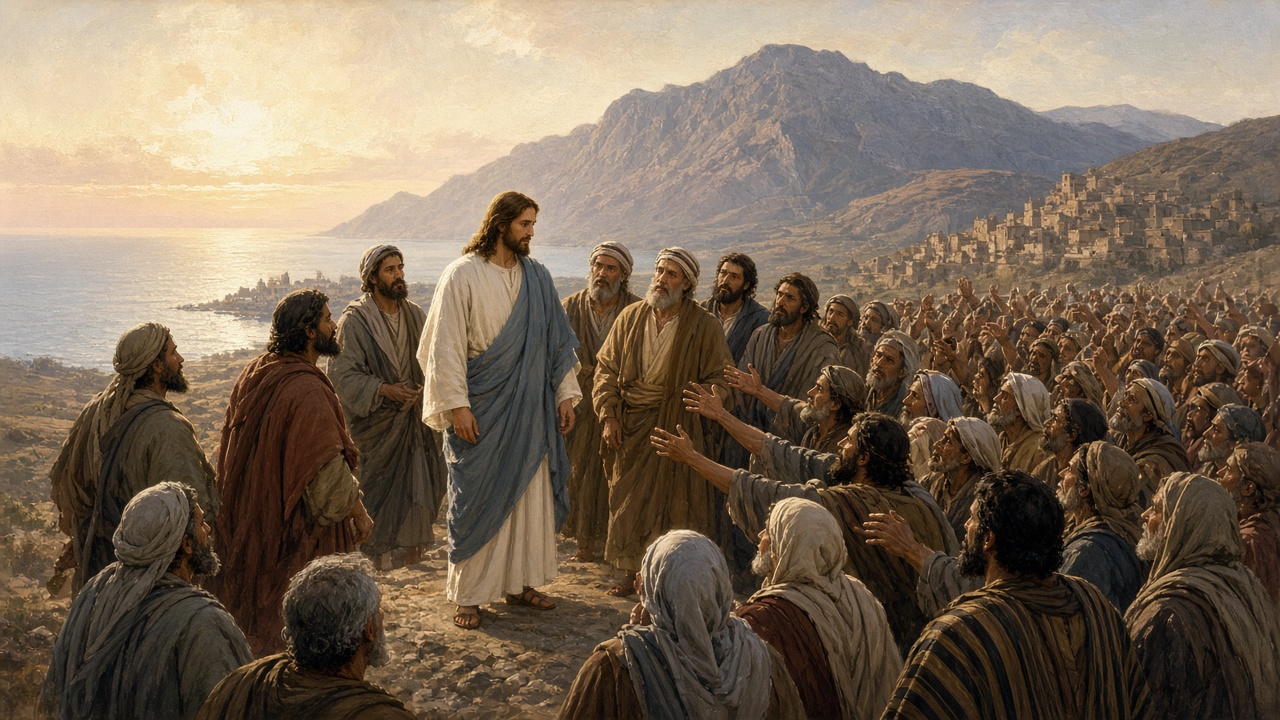
- Jesus came down with them and stood on a level place, where people from Judea, Jerusalem, and the sea coast of Tyre and Sidon had gathered to hear him and to be healed. Tyre and Sidon were ancient Phoenician cities on the Mediterranean; Sidon, the older city, lay about twenty-five miles north of Tyre. A chronology dates this teaching to AD 28 and titles it the Sermon on the Mount, though the narrative places Jesus on level ground after he came down from the mountain.Sources: the Bible text itself · Tyre · Sidon · Sermon on the Mount
Notes written with AI assistance from open sources (Theographic Bible Metadata, CC BY-SA 4.0; Easton’s Bible Dictionary, public domain) and reviewed before publishing.
Places in this chapter
- Jerusalem · 31.777, 35.234 · verse 17
- Judea · Today: Judea 1 · 31.777, 35.234 · verse 17
- Sidon · Today: Sandikli archaeological site in Sidon · 33.561, 35.372 · verse 17
- Tyre · 33.271, 35.196 · verse 17
Only places identified with high confidence are shown (90% or more according to the scholarly sources compiled by OpenBible). Period map: DARE (Digital Atlas of the Roman Empire), CC BY 4.0; modern map: © OpenStreetMap contributors; places: OpenBible.info (CC BY 4.0).
Credits and license for this translation
Biblica® Ochiw Thuolo Motingʼo Loko Manyien™
Dholuo: Biblica® Ochiw Thuolo Motingʼo Loko Manyien™ (Bible)
copyright © 2020 Biblica, Inc.
Language: Dholuo
Translation by: Biblica, Inc.
Biblica® Open New Luo Translation™
Copyright © 1980, 2002, 2003, 2020 by Biblica, Inc.
Used with permission. All rights reserved worldwide.
“Biblica” is a trademark registered in the United States Patent and Trademark Office by Biblica, Inc. Used with permission.
All content on open.bible is made available under a Creative Commons Attribution-ShareAlike 4.0 License ( http://creativecommons.org/licenses/by-sa/4.0/ ).
You are free to:
Share — copy and redistribute the material in any medium or format
Adapt — remix, transform, and build upon the material for any purpose, even commercially
Under the following conditions:
Attribution — You must attribute the work as follows: “Original work available for free at www.biblica.com and open.bible” Attribution statements in derivative works should not in any way suggest that we endorse you or your use of this work.
ShareAlike — If you remix, transform, or build upon the material, you must distribute your contributions under the same license as the original.
Use of trademarks: Biblica® is a trademark registered in the United States Patent and Trademark Office by Biblica, Inc. and may not be included on any derivative works. Unaltered content from open.bible must include the Biblica® trademark when distributed to others. If you alter the content in any way, you must remove the Biblica® trademark before distributing your work.
This translation is made available to you under the terms of the
Creative Commons Attribution Share-Alike license 4.0.
You have permission to share and redistribute this Bible translation in any format and to make reasonable revisions and adaptations of this translation, provided that:
You include the above copyright and source information.
If you make any changes to the text, you must indicate that you did so in a way that makes it clear that the original licensor is not necessarily endorsing your changes.
If you redistribute this text, you must distribute your contributions under the same license as the original.
Pictures included with Scriptures and other documents on this site are licensed just for use with those Scriptures and documents.
For other uses, please contact the respective copyright owners.
Note that in addition to the rules above, revising and adapting God's Word involves a great responsibility to be true to God's Word. See Revelation 22:18-19.
2025-05-10
Source: http://ebible.org/luo/ · eBible.org