Matthew 3
Habo nalolene bi gahenge lo winigo ogo · Tap a verse to see its cross-references.
Baboraya biaga Yonehanda bi mana lamialu henego ogo
1Ani binidangi baboraya biaga Yonehanda Yudiani dindi ko yobi wali agali nahaga wiagoria howa ibalu mana lamialu hene. 2Ibugua lamialu lalu, Ngode Datagaliwabenaga Handame Holene kaware ngagonigo tígua ko birimigonaga mini beregedalimu. Yonehanda, Tígua ko birimigonaga mini beregedalimu, lene.|src="LEAR 52.tif" size="2" ref="(3.2)" 3Ngode Datagaliwabe mana latagi haga Aisaiahanda ala mbiwia halu lalu,
Dindi ko yobi wali agali nahaga ngagoria howa mbiralime ga̱lalu,
Anduane Homogo ibilo hariga ba hole manda bialu halimu.
Hariga ogoni tigabiore ba halimu, lenego
lalu bi ogoni Yone mitangi bialu lenego gilibu nga.
4Yone ibu nogo kamele irinime aga wabinigo karulowa nogo dongoneme mandibu wuwa hene. Ibugua pagayabi mone taranaga ibanebi naga hene. 5Wali agali Yarusaleme howabi Yudia dindi bibahende winigo uruniha howabi Iba Yodana peagoria dindi bibahende wiagoha howabi Yone hearia íbu ngoai haga bini. 6Ibuwa tigua ko biyaru la pani hayagola Yonehanda Iba Yodanaha ti baboraya bini.
7Perisi agalirubi Sadiusi agalirubi dewali Yonehanda ti baboraya bilo ibalu hearia de hondowa Yone ibugua tihondo lalu, Tí ko nogombi ale kamigo Ngode Datagaliwabehanda pani áyuore wia holebirago nane yo poleberami lalu tí aiwa langiyabe. 8Tígua ko bialu harimigo wahalu mini beregedai kamigonaga irane walia hole lowa mana bayale bialu halimu. 9Tígua, Inanaga mamali Abarahama hene, laramiligome pani nolene ngagoria nane yo pialu poleberama, lo mitangi nabilimu. I̱na bi mbira langerogo hale hadaba. Ngode Datagaliwabehanda ege to̱le̱ o ngaruni mo yuwa Abarahamanaga aguanene bu hinu helabehe kagoni laro. 10Ira karu teneha dibule ayu mo yu íbu nga. Ira lini bayale nadaga karu bibahende dibai howa ira dedagoria dolebira. 11Tígua ko birimigonaga mini beregedarimigo walia hole i̱na tí ibame baboraya biruli. Maha mbirali ibulebirago ibugua Ngode Datagaliwabe Dininimebi ira hungu ale biragomebi tí baboraya bia holebira. Ibu i̱ emene ko̱ kogobi ndo ibu daliga timbuniore kago i̱na ibunaga ge habe gamu mo ya holene nakarulape kogoni. 12Ibugua ladi ale mini widinaga lini aeanela dambialu mo tale bilo mbirale baraga hagane nama taboli ale yu ka. Tale biai howa ibugua widi lini do hagane andaha do hole wuwa aeane biaru ira hundia nabiaga daabo kagoria delolebira, lalu Yonehanda lamini. ... widinaga lini aeanela dambialu mo tale bilo mbirale baraga hagane nama taboli ale yu ka.|src="HK63D.tif" size="2" ref="(3.12)"
Yonehanda Yasu baboraya bia henego ogo
13Horo uruningi Yasu ibu Galili howa Iba Yodana peagoha ibalu ibu Yonehanda baboraya bilo lowa Yone hearia ibini. 14Ibiyagola Yonehanda Yasu mini wia dai buwa baboraya nabule lelo ibuhondo lalu, Í̠na i̱ baboraya bia holene ngago áyu ani ndo i̱na í̠ baboraya bia holiya i̱ kogoria ibirida, lene.
15Ani layagola Yasuhanda ladai bialu lalu, Áyu aniore bibelo. Mana ogoni bialu howa Ngode Datagaliwabehanda ani bulene nga ledago biaiore holeberaba, lene. Ani layagola Yonehanda, Anidago baboraya bia haro, lene.
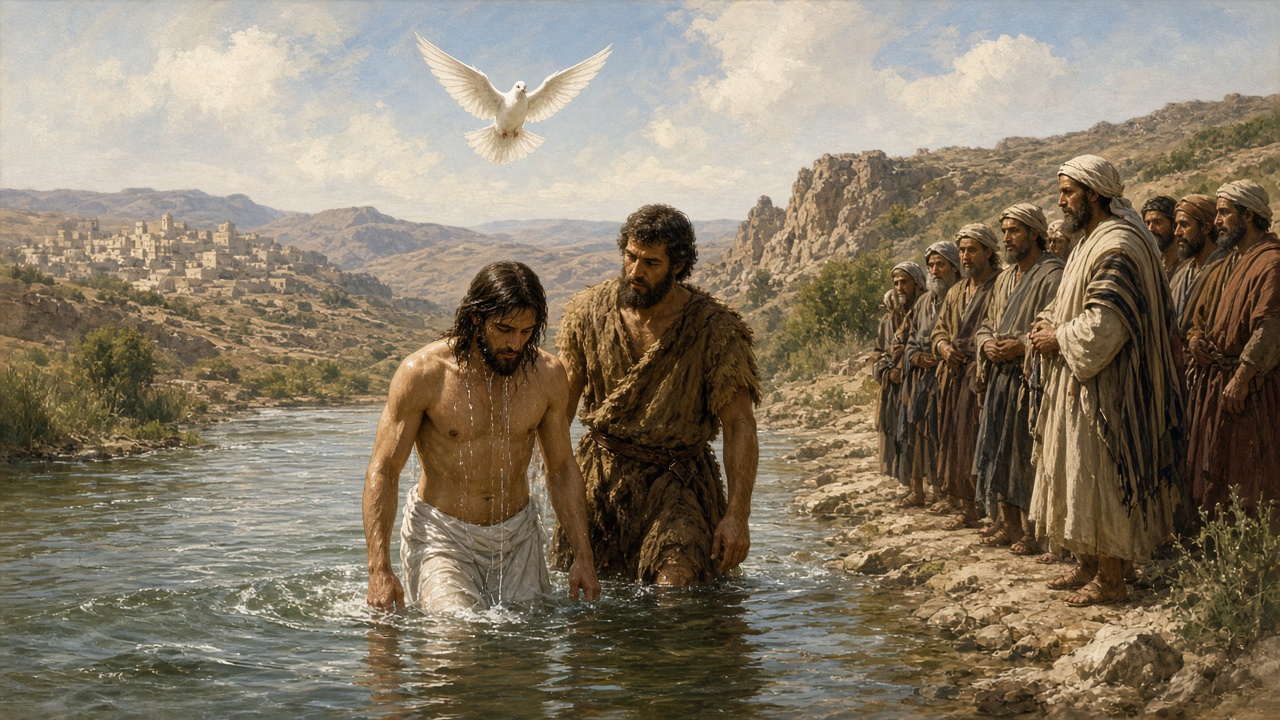
16Yonehanda Yasu baboraya bia hayagola Yasu ibaha howa heyiyagola hari daliga buduwa Ngode Datagaliwabe Dinini ega malibu ale dalipe halu Yasuni íbu birayagola de hendene. 17Ani biyagola dahuliya andagaha howa bi mbira ladali halu lalu, I̱ Igini i̱ gubaliniore ho kogo ogoni. Ibuhondo turu timbuni ho kogoni, lene.
Did you know?
Repentance and Baptism at the Jordan
- Matthew identifies John the Baptist as the one spoken of through the prophet Isaiah: a voice calling in the wilderness, “Prepare the way for the Lord.” Easton's Bible Dictionary (1897) records that John’s mission was the subject of prophecy, citing this passage, Isaiah 40:3, and Malachi 3:1, and that he was of priestly descent—his father Zacharias a priest of the course of Abia, and his mother Elisabeth of the daughters of Aaron. A chronology dates both the beginning of John’s ministry and his baptism of Jesus to AD 26.Sources: the Bible text itself · John the Baptist · John the Baptist Begins Ministry · John Baptizes Jesus
- John came preaching in the wilderness of Judea, and people went out to him from Jerusalem, all Judea, and the whole region around the Jordan, confessing their sins and being baptized in the Jordan River. Easton's Bible Dictionary (1897) notes that under the Romans, in the time of Christ, Judea denoted the southernmost of the three divisions of Palestine, as distinguished from Galilee and Samaria, and included the territories of Judah, Benjamin, Dan, Simeon, and part of Ephraim. Jesus came from Galilee—called Galil by the Jews—to the Jordan to be baptized by John.Sources: the Bible text itself · Judea · Galilee
- John warned the Pharisees and Sadducees not to rely on the claim, “We have Abraham as our father,” saying that God could raise up children for Abraham from the stones. Easton's Bible Dictionary (1897) explains the name Abraham as “father of a multitude” and describes him as the son of Terah, named before his older brothers because he was the heir of the promises.Sources: the Bible text itself · Abraham
Notes written with AI assistance from open sources (Theographic Bible Metadata, CC BY-SA 4.0; Easton’s Bible Dictionary, public domain) and reviewed before publishing.
Places in this chapter
- Judea · Today: Judea 1 · 31.777, 35.234 · verses 1, 5
- Jerusalem · 31.777, 35.234 · verse 5
- Jordan · Today: Jordan River · 31.761, 35.558 · verses 5, 6, 13
- Galilee · 32.760, 35.527 · verse 13
Only places identified with high confidence are shown (90% or more according to the scholarly sources compiled by OpenBible). Period map: DARE (Digital Atlas of the Roman Empire), CC BY 4.0; modern map: © OpenStreetMap contributors; places: OpenBible.info (CC BY 4.0).
Credits and license for this translation
Habo nalolene bi gahenge lo winigo ogo
The Holy Bible with Deuterocanon in the Huli Language of Papua New Guinea
Buk Baibel long tokples Huli long Niugini
Copyright © 1983, 1991, 2002 Bible Society of Papua New Guinea
℗ Faith Comes by Hearing
Language: Huli
Translation by: Bible Society of Papua New Guinea
This translation is made available to you under the terms of the
Creative Commons Attribution-Noncommercial-No Derivatives license 4.0.
You may share and redistribute this Bible translation or extracts from it in any format, provided that:
You include the above copyright and source information.
You do not sell this work for a profit.
You do not change any of the words or punctuation of the Scriptures.
Pictures included with Scriptures and other documents on this site are licensed just for use with those Scriptures and documents.
For other uses, please contact the respective copyright owners.
2014-12-11
Source: http://png.bible/hui/ · eBible.org