Judges 17
Habo nalolene bi gahenge lo winigo ogo · Tap a verse to see its cross-references.
Maiga ibugua bi pupu wulenaga mbirale gime wabu helenego ogo
1Eberaimi hameiginiru dalu hari barebare wiagoha agali mbira mini Maiga hene. 2Ibugua ibu ai̱yahondo lalu, Mbiralime í̠naga muni siliba daosini mbirani handari mbira (1,100) mo page biyangi í̠na ha halu Anduane Homogo ibugua pageali ogoni bo homelelo lalu larigola i̱na bi ogoni hale harugoni. Ai muni ogoni i̱na mirugo o yu kogonigo de handa, lene.
Ani layagola ibu ai̱yahanda lalu, I̱ igini-o Anduane Homogohanda í̠ mo bayale helo laro, lene. 3Ani layagola Maigahanda ibu ai̱yanaga muni siliba biaru miadai bini. Miadai biyagola ibu ai̱yahanda lamialu lalu, I̱na ha halu bi larugome i̱ iginini ibira nahelo muni ogo Anduane Homogo ibuninagaore lalu loma bialu ibunihondo mero. Ani berogo ai i̱na muni ogo mbirale bi pupu wulenaga wabiaga mbira kagome wabilo muni ogoni ibuhondo mulebero. Ibugua mbirale mbira irame wabuwa mbirale ogoni silibame para hadambi helo. Ani bialu mende siliba degeme bilo mulebero, lene. 4Ani lowa Maiga ai̱yahanda muni siliba Maiga ibugua miadai biyaru aria handari kira (200) agali mbirale silibame wabiaga heagohondo mini. Agali ogoni ibugua bi pupu wiaga mbira irame wabuwa silibame paraho dambi hene. Ani bialu mendego siliba degemeore wabini. Ani wabuwa tigua bi pupu wiaga ogonilabo Maiga andagaha mo ngelene.
5Maiga ibuni daluha bi pupu wiaga anda mbira bu helene. Ani bu helowa loma binigo mo miaga agalinaga aga mini ebodi mbira wabu wialu mbirale marubi pupu wulenaga wabuwa bi pupu wiaga anda ogoniha ngelene. Ani bialu ibuni igini mbira bi pupu wiaga anda ogoniha ibunaga loma binigo mo miaga helo dabo helene. 6Ogoningi Isaraele dindiha kini mbira nahe wini. Wali agali bibahende hearume tini hame leadagua bigibigi bialu haga hene.
7Ogoningi igiri daliahe mbira Libai aria Yuda dindiha Bedeleheme tano wiagoha hene. 8Ani howa ibu Bedeleheme wahalu ibu holene dindi gahenge mbira taya bima pene. Pialu Eberaimi hameigini dalu hari barebare wiagoha pialu Maiga anda heagoria tagira pene. 9Ani pu hearia Maigahanda ibuhondo hale halu lalu, Í̠ agoha howa ibiribe, lene. Ani layagola Libaiali biago ibugua ladai bialu lalu, I̱ Libaiali Yuda dindiha Bedeleheme tano howa íbu kogoni. I̱ dindi gahenge mbira i̱ni holene taya bero, lene.
10Ani layagola Maigahanda ibuhondo lamialu lalu, Í̠ i̱la oali habiya. Í̠ i̱naga mini mandaru talebu ngiaga mbira howa i̱naga loma binigo mo miaga agali habelo hameledo. Í̠na mali mbirani biabe ogoni beregonaga yolo muni siliba pira (10) ngialu aga tomobi i̱na ngialu buliya, lene. 11Ani laya handala igiri ogoni ibu Maigahanda bi layagoni karulape lowa ibu Maigala mandagi hene. Ani howa ibu Maiga iginiore haradagua bini. 12Maigahanda igiri daliahe ogoni ibunaga loma binigo mo miaga helene. Ani helayagola ibu Maiga andaga hene. 13Ani heagola Maigahanda lalu, Ai Libaiali mbira ogoni i̱naga loma binigo mo miaga i̱la kabagome Anduane Homogohanda i̱ dalu mo bayale hai holobada lo manda bidogoni, lene.
Did you know?
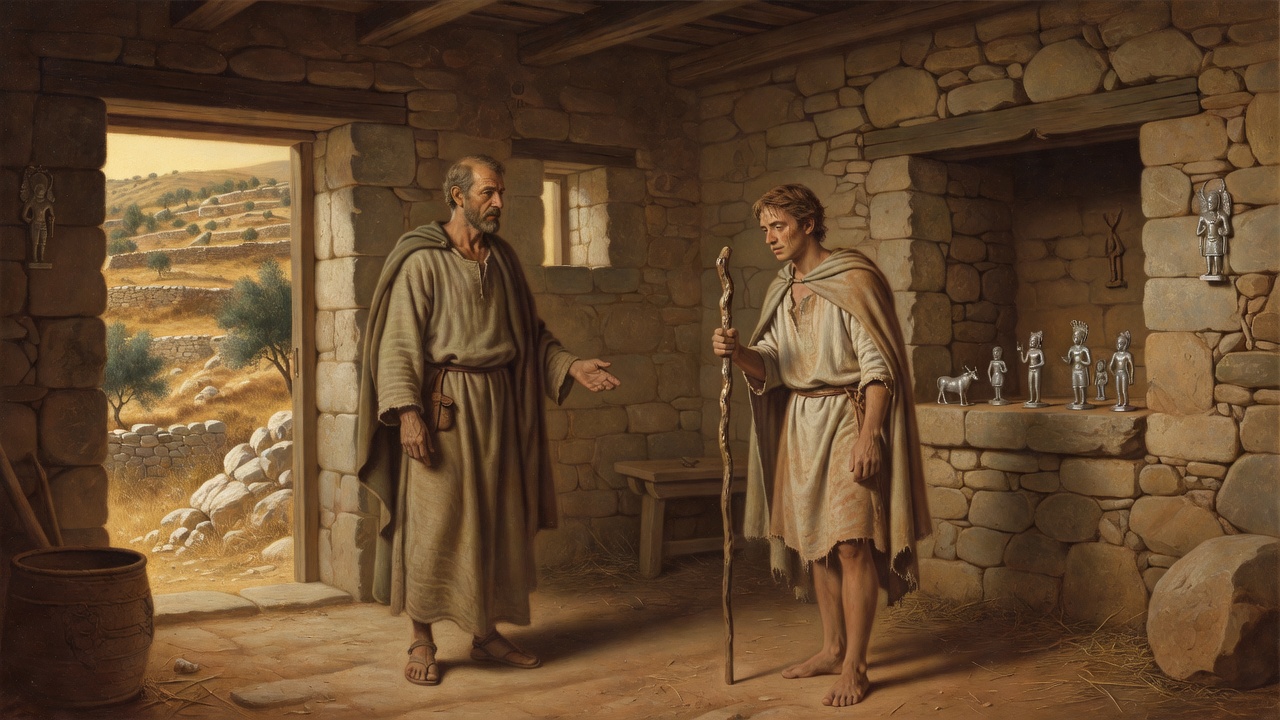
Micah's Domestic Shrine
- Micah, a man from the hill country of Ephraim, set up a private shrine containing carved and cast silver images, an ephod, and household idols. He initially ordained one of his own sons as his priest before hiring a traveling Levite to manage his shrine.Sources: the Bible text itself · Micah
- The narrative notes that there was no king in Israel during those days and everyone did what was right in their own eyes. This account serves to illustrate the lawlessness and religious confusion of the period before the monarchy.Sources: the Bible text itself · Micah
- A wandering Levite from Bethlehem in Judah agreed to serve as Micah's priest in exchange for food, clothing, and an annual wage of ten shekels of silver.Sources: the Bible text itself
Notes written with AI assistance from open sources (Theographic Bible Metadata, CC BY-SA 4.0; Easton’s Bible Dictionary, public domain) and reviewed before publishing.
Places in this chapter
Only places identified with high confidence are shown (90% or more according to the scholarly sources compiled by OpenBible). Period map: DARE (Digital Atlas of the Roman Empire), CC BY 4.0; modern map: © OpenStreetMap contributors; places: OpenBible.info (CC BY 4.0).
Credits and license for this translation
Habo nalolene bi gahenge lo winigo ogo
The Holy Bible with Deuterocanon in the Huli Language of Papua New Guinea
Buk Baibel long tokples Huli long Niugini
Copyright © 1983, 1991, 2002 Bible Society of Papua New Guinea
℗ Faith Comes by Hearing
Language: Huli
Translation by: Bible Society of Papua New Guinea
This translation is made available to you under the terms of the
Creative Commons Attribution-Noncommercial-No Derivatives license 4.0.
You may share and redistribute this Bible translation or extracts from it in any format, provided that:
You include the above copyright and source information.
You do not sell this work for a profit.
You do not change any of the words or punctuation of the Scriptures.
Pictures included with Scriptures and other documents on this site are licensed just for use with those Scriptures and documents.
For other uses, please contact the respective copyright owners.
2014-12-11
Source: http://png.bible/hui/ · eBible.org