Genesis 32
Hset Hadròeh · Tap a verse to see its cross-references.
1Jacôp lam deh trong, i ƀình plình da Boc Plình glàm haq. 2Jò Jacôp hnoq wì aih, haq doe: Kô raq traiq da Boc Plình! Aih ìq haq majah yiniq ka jang aih la Mahana-im.
3Jacôp thê mangai lam adroe hu glàm Êsau daq rađeh, qnang oe ta Si-êro, nòe aih la taneh da Êđôm; 4Pì anoe ka Êsau, craq au qmang kô: Jacôp mangai hapŏng ìh, i doe qmang kô: Au khoe oe tahnim Laƀan trùh hì kô; 5Au i bàc ƀo, lùa, trìu, hapŏng calô, hapŏng cadrì, manòeq kô au thê wì kô trùh dèh ta wì craq, đòeq au hujah canòm đeh kan tamèt enh ngèa craq au.
6Wì aih hlài anoe ka Jacôp: Nhèn khoe trùh ta Êsau daq ìh, manòeq kô haq qnang lam tacô glàm ìh, i pôn hrinh ngai tiaq haq. 7Jacôp crè rai mangò pi cajaq, haq lah deh ƀài mangai ma tiaq haq xam ƀài trìu ƀo lŏcđa loh baiq calùh, rai doe: 8Tàng joq Êsau loq trùh canàt jêh mòeq ta baiq calùh kô, aih èh calùh matau jah claih. 9Khoe aih Jacôp waiq khàn: Waiq Boc Plình da Apraham kan cadraq au! Boc plình da Ysac baq au, aih la Jêhowa! Ìh i thê au drah hlài dèh gùng, nòe hadròng au, aih èh ìh au am ka au xôq ramot. 10Au ùh tajì ka ƀài kan alàng xam kan ùh tablòq manoh cliac ìh ma khoe patô am ka hapŏng ìh; majah qmang aih adroe ka au pùh pagat cròng diac Jôđan, au i dèh mòeq toq long dùi raq, yàng hì kô au khoe i baiq traiq lình kô. 11Au waiq Boc Plình dŏng au claih ka tì kŏng Êsau, daq au, majah qmang aih au yùq haq loq trùh jêh hloe xam miq xam kon. 12Mahaq ìh khoe doe: Joq qnàng Au broq ka ìh jah tàu tìa, rai broq ka xinoe ìh jah bàc tìah ka braih diac raxìqa, ih èh wì pi qnì broq qmang leq hu rèn, majah qmang aih haq bàc hrìn.
13Haq kùi ta aih mang aih, yŏc ƀài dahwèq ma i dèh ta tì kŏng đòeq broq mòeq ramènh hu dèch am ka Êsau, daq rađeh, 14aih la baiq hrinh bubi cadrì xam baiq jàt bubi calô; baiq hrinh toq trìu kan xam baiq jàt trìu calô 15piq jàt lŏcđa cadrì i kon qnang ùq, pôn jàt toq ƀo cadrì xam mòeq jàt toq ƀo calô, baiq jàt toq lùa cadrì xam mòeq jàt toq lùa kon. 16Khoe aih, haq am tang calùh deh ka tang ngai hapŏng rai tanap: Pì lam adroe ka au rai qnung ƀài calùh kô adreo ka calùh tau. 17Haq tanap ka mangai ma qnung calùh adroe rameh: Jò Êsau, daq au hnoq, haq bòch ìh: Ìh oe ti cabô, lam taleq kô, ƀài calùh ma lam adroe ka ìh qmat da cabô? 18aih doe rameh: Da Jacôp, mangai hapŏng wì craq, kô ramènh dèch ka Êsau, craq au; hacô cla haq qnang tiaq atìq ka nhèn, 19Jacôp hanoh tanap qmang aih ka mangai ma tiaq calùh ma baiq, mangai ma piq, xam dìq dŏng ka ƀài mangai tiaq ƀài calùh aih, èh haq doe: Jò glàm Êsau, pì hmàng baì ƀàu aih. 20rai doe tam qmang kô: Jacôp hapŏng wì craq qnang tiaq atìq ka nhèn. Majah qmang aih cla haq hèm: Au aràng ƀài ramènh kô adroe dèch ka Êsau dôq haq rangep ka nòehòeq, atìq aih jò au glàm haq broq braiq haq loq lem manoh đìh au qmòh. 21Qmang aih, ƀài ramènh kô lam adroe cla haq, mang aih haq kùi deh ta traiq.
22Mang aih, Jacôp cadrat enh kùi, qnung dèh wa mai, baiq ngai hapŏng xam mòeq jàt mòeq toq kon cwa thòng diac Jaboc, 23Haq qnung wì pùh tŏc pah tau ka thòng diac aih, xam dìq dŏng ƀài kùng hang cla haq.
Jacôp tabàt ka ƀình plình …
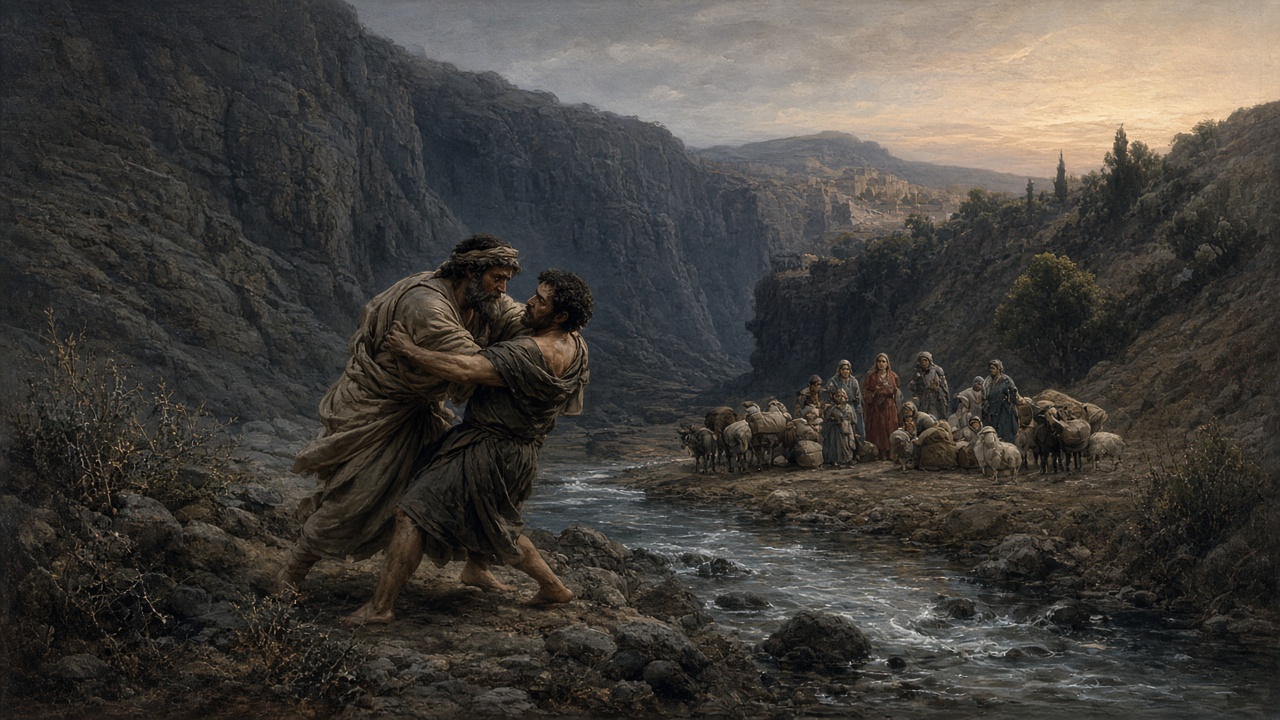
24Qmang aih! Cla Jacôp oe dèh mòeq ngai, aih i mòeq ngai tabàt ka haq trùh badrèh qngah. 25Jò mangai aih hnoq đeh pi blêq, hi tùc jang caxènh cabŏng Jacôp, caxènh cabŏng hi tabloch jò qnang tabàt. 26Mangai aih doe: Trŏc khoe badrèh qngah; hêq, caqnaih au lam. Mahaq Jacôp tèu: Au ùh caqnaih ìh lam taleq, tàng joq ìh ùh am ka au xôq ramot. 27Mangai aih bòch: Yiniq ìh aih cleq?. Padreo bàu: Yiniq au Jacôp. 28Mangai aih doe: Yiniq ìh pi oe xài Jacôp hòm, mahaq yiniq ìh la Isorali, majah qmang aih ìh i tabàt ka Boc Plình xam kon mangai; ìh dìq jah blêq. 29Jacôp doe: Anoe ka au loq đeh ka yiniq ìh diq. Mangai aih tèu: Hagleq ìh majah bòch da au yiniq?. Khoe èh mangai aih waiq am xôq ramot ka Jacôp ta aih. 30Jacôp yiniq ka ajang aih la Phêni-ên, majah qmang aih haq doe: Au khoe hnoq Boc Plình tangèa hadrò ka au, èh mahuaq yiang au khoe jah dèch. 31Jò cwa ta Phêni-ên hnoq mahì khoe tŏc, haq lam loh ka ngwen jo. 32Taiq aih, trùh ta manòeq mangai Isorali ùh kaq hngwen poeh qnah ta caxènh cabŏng; majah qmang aih mangai aih i tùc caxènh cabŏng Jacôp, ten ajang hngwen poeh.
Did you know?
At the Jabbok, on the Way to Esau
- Mahanaim means “two camps.” Jacob gave that name to the place near the Jabbok, beyond the Jordan, when the angels of God met him and he said, “This is the camp of God.” There he also divided his people, flocks, herds, and camels into two camps, hoping one might escape if Esau attacked the other.Sources: Mahanaim · the Bible text itself
- The Jabbok, whose name is explained as “a pouring out, or a wrestling,” is a stream east of the Jordan. It joins the Jordan about midway between the Sea of Galilee and the Dead Sea, after a course of about 65 miles through a wild, deep ravine. At its ford Jacob sent his two wives, two maidservants, eleven sons, and all he owned across, then remained alone and wrestled with a man until daybreak.Sources: Jabbok · the Bible text itself
- Jacob sent messengers to Esau in the land of Seir, the country of Edom, calling him lord and himself a servant. Seir is a mountainous region along the east side of the Arabah, from the southeastern end of the Dead Sea toward Akabah, the eastern branch of the Red Sea; the Edomites occupied it, and it was allotted to Esau’s descendants. Esau, the firstborn twin and a hunter, had sold his birthright for red lentil stew and was also called Edom, “red,” while Jacob—whose name means “one who follows on another’s heels,” or “supplanter”—had conspired with his mother to deceive Isaac.Sources: the Bible text itself · Seir · Esau (Edom) · Jacob (Israel)
Notes written with AI assistance from open sources (Theographic Bible Metadata, CC BY-SA 4.0; Easton’s Bible Dictionary, public domain) and reviewed before publishing.
Places in this chapter
- Edom · 30.746, 35.604 · verse 3
- Jordan · Today: Jordan River · 31.761, 35.558 · verse 10
- Jabbok · Today: Zarqa River · 32.115, 35.543 · verse 22
Only places identified with high confidence are shown (90% or more according to the scholarly sources compiled by OpenBible). Period map: DARE (Digital Atlas of the Roman Empire), CC BY 4.0; modern map: © OpenStreetMap contributors; places: OpenBible.info (CC BY 4.0).
Credits and license for this translation
Hset Hadròeh
The New Testament in the Hre language of Vietnam, translated by Baq Thi
Copyright © 2024 Baq Thi
Language: (Hre)
This translation is made available to you under the terms of the
Creative Commons Attribution Share-Alike license 4.0.
You have permission to share and redistribute this Bible translation in any format and to make reasonable revisions and adaptations of this translation, provided that:
You include the above copyright and source information.
If you make any changes to the text, you must indicate that you did so in a way that makes it clear that the original licensor is not necessarily endorsing your changes.
If you redistribute this text, you must distribute your contributions under the same license as the original.
Pictures included with Scriptures and other documents on this site are licensed just for use with those Scriptures and documents.
For other uses, please contact the respective copyright owners.
Note that in addition to the rules above, revising and adapting God's Word involves a great responsibility to be true to God's Word. See Revelation 22:18-19.
2026-07-18
Source: http://ebible.org/hrebt/ · eBible.org