Genesis 28
Hset Hadròeh · Tap a verse to see its cross-references.
Jacôp loh lam …
1Qmang aih Ysac creo ka Jacôp mùt, waiq xôq ramot am khoe aih tanap “Kon apaq yŏc kon cadrì Cana-an, 2Mahaq, kon hlài tagùng Phađan-Aram, trùh hnim Ƀêtu-ên, boc ngoaiq kon, èh yŏc moèq ngai kon cadrì da Laƀan dùch kon đòeq broq mai. 3Waiq Boc Plình I cwìang Rìm trong am xôq ramot ka kon, broq ka kon chèch lòe ma bàc đòeq wìa mòeq diac kàn i bàc adrech mangai. 4Waiq Boc Plình am ka kon xam xinoe da kon xôq ramot lem da Apraham, đòeq gùng kon ma khoe oe jah broq kùng hang da kon, aih la gùng haq ma khoe am ka Apraham! 5Khoe aih Ysac thê Jacôp lam tagùng Phađan-Aram, trùh hnim Laƀan kon calô Ƀetu-ên, haq aih mangai Aram daq da Rêƀêca; miq wa Jacôp xam Êsau.
Êsau yŏc kon cadrì da Ich ma-ên…
6Êsau hnoq Apraham khoe waiq am xôq ramot ka Jacôp rai thê haq lam tagùng Phađan-Aram đòeq hu yŏc mai; jò qnang waiq am xôq ramot i tanap: apaq yŏc kon cadrì Cana-an broq mai 7èh hnoq Jacôp khoe iu tiaq bàu wa baq miq lam tagùng Phađan-Aram. 8Aih haq loq ƀài kon cadrì Cana-an ùh troq ka manoh Ysac baq rađeh; 9aih haq hi lam hnim Ich ma-ên (enh gùng ka baiq toq mai haq ma khoe i) yŏc tam Mahalac, aih la kon cadrì da Ich ma-ên, xau nuiq da Apraham, oh da Nêbajôt.
Apô hnoq ta Bêtên …
10Jacôp enh Bê-e Sêba hu lam trùh ta Charan, 11trùh mòeq nòe aih, mat mahì khoe clìh, haq hi kùi. Haq yŏc mòeq toq hmo hu angèn gàu, èh hi kùi ajang aih; 12haq apô hnoq mòeq toq gòng paqnàng enh taneh gàu trùh ta qmòe ta trŏc, ƀài bình plình da Boc Plình tŏc loh ta gòng aih. 13Chuaq Jêhowa yòng oe enh gàu gòng doe ka Jacôp “Au raq Jêhowa Boc Plình da Apraham kan cadraq ìh, hadai Boc Plình da Ysac. Au am ka ìh xam xinoe ìh taneh ìh ma qnang kùi kô. 14Xinoe ìh jah bàc tìah ka blo ta taneh, prai loh trùh ta ƀè mahì tŏc, ƀè mahì clìh, ƀè qma ƀè qngeo, rìm ka xinoe ta crŏng taneh dìq canòm ka ìh xinoe ìh men jah xôq ramot. 15Hacô au oe ti ìh, ìh lam taleq au tiaq wèq ban ta aih.
16Jacôp hi rìu, haq doe “Joq qnàng Chuaq Jêhowa qnang oe tacô mahaq au ùh qnì!” 17Haq loh ka crè rai doe “Kô joq nòe jìang ka ramòt qnàng! Kô joq hnim da Boc Plình, joq qmŏc qmang da plình. 18Haq rìu sroeh yŏc hmo đeh ma đòeq angèn gàu, paqnàng broq jrang, pùc dàu ta bui jrang aih; 19èh haq yiniq ka nòe aih la Ƀêtên; jò ma adroe nèh yinq jang ta aih la Luxo. 20Jacôp waiq rameh “Tàng joq Boc Plình oe ti au, wèq ban jò au lam trong, am ƀênh hu acaq, am eo hu caxùnh. 21èh tàng joq au jah hlài catèm trùh hnim baq au, aih èh Chuaq Jêhowa broq Boc Plình au. 22Hmo ma khoe paqnàng broq jrang kô èh jah wìa hnim kùh waiq Boc Plình, èh au hi dèch ka Ìh mòeq phàn mòeq jàt rìm ta kùng hang Ìh ma am ka au.
Did you know?
Jacob's Journey and Dream at Bethel
- Isaac sent Jacob from Beersheba to Paddan-aram to take a wife from the daughters of Laban, his mother Rebekah's brother, rather than from the Canaanite women. Paddan-aram, called the plain of Aram, is commonly regarded as the Mesopotamian district around Haran, where Laban lived; Haran, also called the city of Nahor, was where Abraham stayed after leaving Ur until his father Terah died.Sources: the Bible text itself · Paddan-aram · Haran · Laban
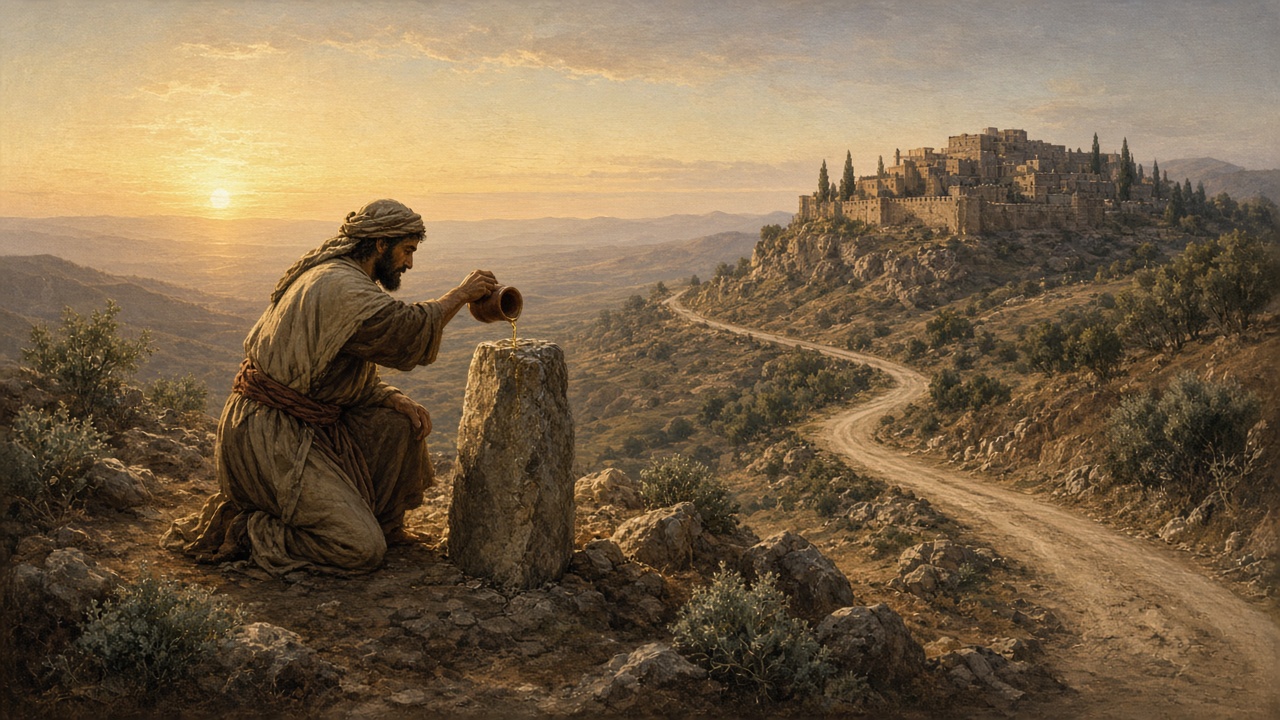
- The place where Jacob dreamed, set up as a pillar the stone he had put under his head, and poured oil on it was the royal Canaanite city of Luz; he renamed it Bethel. Easton's Bible Dictionary (1897) locates Bethel in central Palestine, about ten miles north of Jerusalem, and notes that the name was at first apparently given to a sanctuary in the neighborhood of Luz, and was not given to the city itself until after the tribe of Ephraim conquered it.Sources: the Bible text itself · Luz · Bethel (of Palestine)
- When Esau learned that Isaac had blessed Jacob and ordered him not to marry a Canaanite woman, he went to Ishmael and married Mahalath, sister of Nebaioth and daughter of Abraham's son Ishmael, in addition to the wives he already had. Easton's Bible Dictionary (1897) also calls her Bashemath and notes that Esau's three wives receive different names in the Edomite genealogy of Genesis 36 from those given in the narrative of Genesis 26 and 28.Sources: the Bible text itself · Bashemath
Notes written with AI assistance from open sources (Theographic Bible Metadata, CC BY-SA 4.0; Easton’s Bible Dictionary, public domain) and reviewed before publishing.
Places in this chapter
- Canaan · 32.767, 35.333 · verses 1, 6, 8
- Haran · Today: Harran · 36.864, 39.033 · verse 10
- Luz · Today: Beitin · 31.923, 35.241 · verse 19
Only places identified with high confidence are shown (90% or more according to the scholarly sources compiled by OpenBible). Period map: DARE (Digital Atlas of the Roman Empire), CC BY 4.0; modern map: © OpenStreetMap contributors; places: OpenBible.info (CC BY 4.0).
Credits and license for this translation
Hset Hadròeh
The New Testament in the Hre language of Vietnam, translated by Baq Thi
Copyright © 2024 Baq Thi
Language: (Hre)
This translation is made available to you under the terms of the
Creative Commons Attribution Share-Alike license 4.0.
You have permission to share and redistribute this Bible translation in any format and to make reasonable revisions and adaptations of this translation, provided that:
You include the above copyright and source information.
If you make any changes to the text, you must indicate that you did so in a way that makes it clear that the original licensor is not necessarily endorsing your changes.
If you redistribute this text, you must distribute your contributions under the same license as the original.
Pictures included with Scriptures and other documents on this site are licensed just for use with those Scriptures and documents.
For other uses, please contact the respective copyright owners.
Note that in addition to the rules above, revising and adapting God's Word involves a great responsibility to be true to God's Word. See Revelation 22:18-19.
2026-07-18
Source: http://ebible.org/hrebt/ · eBible.org