Exodus 27
Hset Hadròeh · Tap a verse to see its cross-references.
Prang dèch ramènh bùh...
1Ìh hadai broq mòeq toq prang tadreo xi long sitim, hìn buàng, padam hagat dang yôh, padam hagat dang gat, dang haqnhèq piq hagat. 2Ajang pôn toq mùm prang tadreo broq haki ngèa loh tagùng rai glom đùng. 3Ƀài dahwèq khop khip da prang tadreo aih broq xi đùng: abôq tah loc, canoch, padrì diac, grao xŏc jam, xam dòt tah ngia ùnh dìq broq xi đùng. 4Broq ka prang tadreo mòeq toq lìap haqnac ngia ùnh xi taliac đùng; roc nòe mùm haq broq pôn toq gwiang xi đùng; 5Khoe aih đòeq lìap aih enh qneq ka haqmai da pang tadreo, taqne lò ƀè haqnhèq da prang tadreo. 6Hanoh raxoh long tanòng tòng prang tadreo xi long sitm, lom đùng. 7Khoe èh trôp qmùt ta gwiang, jò tòng lam, tanòng aih ep oe baiq ƀè prang tadreo.
8Prang tadreo ep broq xi long ban, enh dalam rahuàng, broq wop qmang ka au khoe patô ka ìh ta bui wang.
Hamlang da hnim kùh waiq đò.
9Ìh ep broq baiq toq hamlang ka hnim kùh waiq đò. Enh qma ka hamlang i prình xi bai lan ma habuàt, dang yôh mòeq hrinh hagat, 10xam baiq jàt toq jrang xam baiq jàt toq jo jrang xi đùng èh glêh xam long tanang haq aih broq xi ƀac. 11Enh pah qngeo hanoh qmang aih; prình xi bai dang yôh mòeq hrinh hagat, baiq jàt toq jrang xam jo jrang xi đùng; glêh xam long tanang haq broq xi ƀac. 12Roc ti haqmai da hamlang enh ƀè mat mahì clìh ep i mòeq blah bai prình yôh padam jàt hagat, mòeq jàt toq jrang xam mòeq jàt toq jo jrang. 13Dang gat da hamlang enh ngèa, aih la ƀè mat mahì tŏc, i moeq blah bai prình yôh padam jàt hagat. 14Enh qma i bai prình yôh mòeq jàt padam hagat, piq toq jrang xam piq toq jo jrang. 15Enh ƀè qngeo i bai prình yôh mòeq jàt padam hagat, piq toq jrang xam piq toq jo jrang. 16Qmang da hamlang i mòeq blah bai prình yôh baiq jàt hagat broq xi bai lan habuàt, atênh enh brai nget, gòh ngùi, gòh yrùng, i thèu, xam pôn toq jrang xam pôn toq jo jrang. 17Dìq dŏng ƀài jrang dudanh ka hamlang jah tadùng ka dabau xi long tanang ƀac; glêh jrang aih broq xi ƀac, jo jrang aih xi đùng. 18Dang yôh da hamlang yôh jah mòeq hrinh hagat, dang gat, rìm ƀè, padam jàt hagat, dang haqnhèq padam hagat; bai prình broq xi bai lan ma habuàt, jo jrang aih broq xi đùng. 19Dìq dŏng ƀài dahwèq padon đòeq ka bìac kùh waiq ta hnim kùh waiq đò, xam long tanàp da hnim kùh waiq đò hloe xam long tanàp da hamlang, dìq broq xi đùng.
Dàu bùh đen
20Thê mangai Isorali aràng ka ìh dàu ôliu ma lem, đòeq bùh dôq đen jah qngah hloe hloe. 21Tanòe traiq taglàm, enh gùng ka bai prình, enh ngèa ka hom tajao, Arôn xam wì kon calô haq ep padon dôq enh ngèa Chuaq Jêhowa đen jah cheo qngah hloe hloe enh dixèq trùh disroq. Aih raq ranenh moeq đòe am ka mangai Isorali ep wèq.
Did you know?
The bronze altar, the courtyard, and the lamps
- This chapter calls for a square altar of acacia wood, five cubits long, five cubits wide, and three cubits high, with a horn on each of its four corners, the horns of one piece, and the altar overlaid with bronze. It was to be built hollow, of boards, with a bronze-mesh grate set beneath a ledge so that the mesh came halfway up, and with poles of acacia wood overlaid with bronze, inserted into rings so the altar could be carried. All its utensils—pots for removing ashes, shovels, sprinkling bowls, meat forks, and firepans—were to be bronze, and the altar was to be made just as shown on the mountain.Sources: the Bible text itself
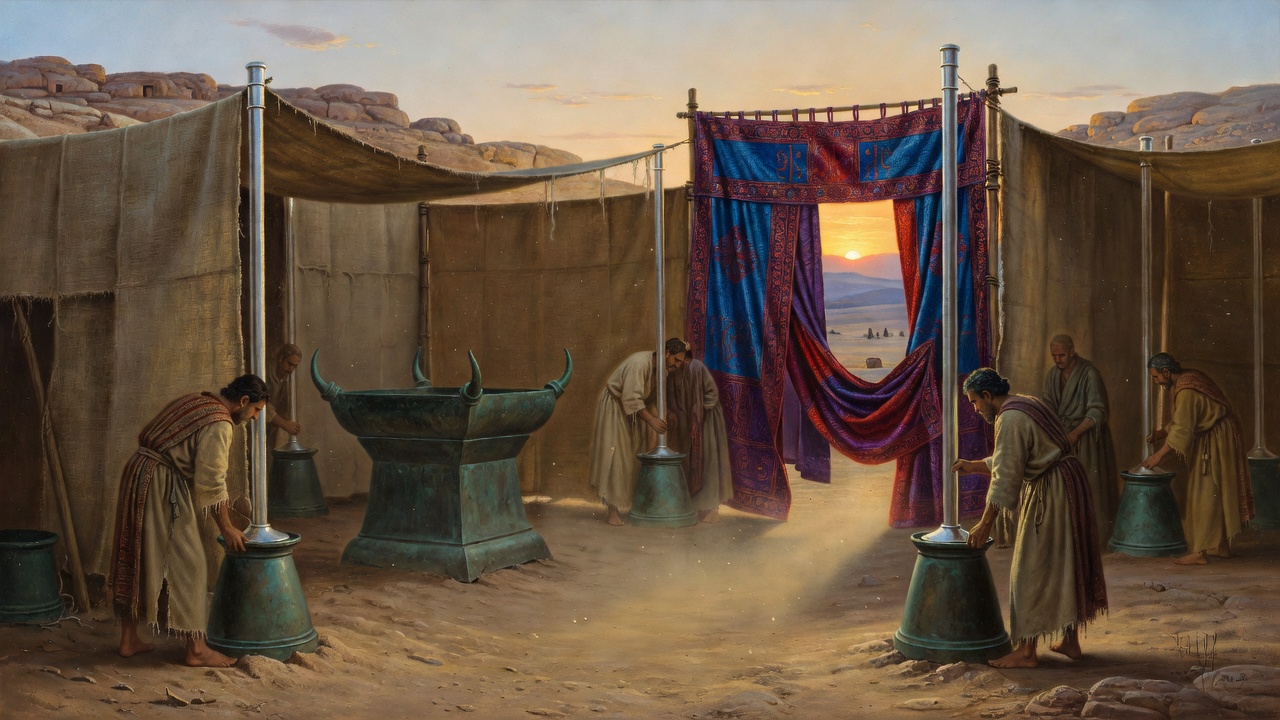
- The courtyard of the tabernacle was to be a hundred cubits long and fifty cubits wide, with curtains of finely spun linen five cubits high. The south and north sides, each a hundred cubits long, were to have twenty posts and twenty bronze bases, with silver hooks and bands; the west side, fifty cubits wide, was to have ten posts and ten bases. The east side, toward the sunrise, was also fifty cubits wide, with a twenty-cubit gate curtain embroidered with blue, purple, and scarlet yarn and finely spun linen, on four posts, and with curtains of fifteen cubits on either side.Sources: the Bible text itself
- The Israelites were to bring pure oil of pressed olives for the light, so that the lamps would keep burning continually. In the Tent of Meeting, outside the veil in front of the Testimony, Aaron and his sons were to tend the lamps before the LORD from evening until morning, a permanent statute for the Israelites for the generations to come. Aaron, eldest son of Amram and Jochebed, was born in Egypt three years before his brother Moses, and by Elisheba, daughter of Amminadab of the house of Judah, whom he married, he had four sons: Nadab, Abihu, Eleazar, and Ithamar.Sources: the Bible text itself · Aaron
Notes written with AI assistance from open sources (Theographic Bible Metadata, CC BY-SA 4.0; Easton’s Bible Dictionary, public domain) and reviewed before publishing.
Credits and license for this translation
Hset Hadròeh
The New Testament in the Hre language of Vietnam, translated by Baq Thi
Copyright © 2024 Baq Thi
Language: (Hre)
This translation is made available to you under the terms of the
Creative Commons Attribution Share-Alike license 4.0.
You have permission to share and redistribute this Bible translation in any format and to make reasonable revisions and adaptations of this translation, provided that:
You include the above copyright and source information.
If you make any changes to the text, you must indicate that you did so in a way that makes it clear that the original licensor is not necessarily endorsing your changes.
If you redistribute this text, you must distribute your contributions under the same license as the original.
Pictures included with Scriptures and other documents on this site are licensed just for use with those Scriptures and documents.
For other uses, please contact the respective copyright owners.
Note that in addition to the rules above, revising and adapting God's Word involves a great responsibility to be true to God's Word. See Revelation 22:18-19.
2026-07-18
Source: http://ebible.org/hrebt/ · eBible.org