Acts 20
Hset Hadròeh · Tap a verse to see its cross-references.
Phaulô oe ta Maxêđoan
1Jò kan manhài khoe jah hatinh, Phaulô creo ka ƀài mangai tiaq hŏc trùh, khoe ka pariaq oh daq, haq hangah ka wì đoèq lam tagùng Maxêđoan. 2Haq lam jàp gùng aih, haq anoe bàc trong đòeq pariaq mangai lùi; khoe aih haq lam ta diac Gorec, 3oe ta aih piq khê. Taiq mangai Juđa khoe hatình chaq trong hu jêh đac haq jò haq bu tŏc boang lam ta Syri, aih ìq haq majah hi wìh trong Maxê đoan đoèq hu hlài. 4Sôbate, kon da Biru, mangai gùng Berê, lam ti haq, i tam Aritac xam Sacunđu mangai gùng Têsalônica, Gai-ut, gùng Đecbo xam Timôthê, Tichico xam Trôphim dìq gùng Asi. 5Wì kô lam adroe, gòm nhèn ta Trô-ach. 6Atìq ka hì ramènh acaq ƀênh ùh wàt blo, nhèn tŏc boang enh Philip, padam hì atìq nhèn glàm dabau ta Trô-ach, èh nhèn oe ta aih tapèh hì.
Phaulô ta Trô-ach
7Hì baxèm tagàu tuàng, nhèn tagop dabau đòeq goh ƀênh, Phaulô ep lam hì da èh, dài haq majah hatùang ka oh daq rai hnài hloe trùh qne mang, 8I bàc toq đen talàu nòe nhèn ma qnang tagop dabau. 9I mòeq ngai radam yiniq haq Ôtic, hangui ajang trong qmŏc, Phaulô hnài xòe hêq haq aih loh ka gù kùi, jò kùi pi hmàng haq taclìh enh làu piq, wì loh dèch hnoq haq khoe cachìt. 10Mahaq, Phaulô cadiang loh chinh deh chac ta mangai aih, yŏc tì kwat chac haq rai doe: “Apaq lèt, mahua oe raq tachac. 11Phaulô tŏc hlài taqnhèq, goh acaq ƀênh; rai anoe hnài hòm trùh qngah men lam. 12Mangai radam oe rìh, wì tòng ahlài haq ta hnim, yiniq aih broq ka wì jah alòng haraya.
Phaulô trùh ta Milê
13Ƀài nhèn hòm, chônh lam adroe, tŏc boang lam ta Asôt, aih nòe nhèn ma hu glàm Phaulô; haq khoe taqmroq deh qmang aih, majah qmang aih haq enh lam jènh. 14Nhèn glàm Phaulô ta Asôt, khoe aih haq tŏc boang ti nhèn, hadai nhèn trùh ta Mitilen. 15Khoe enh aih, tiaq trong diac raxìq, sroq eh nhèn trùh tajang ka pleo Chi-ô. Hì atìq hòm nhèn padòh mùt ta plaì Samôt, mòeq hì hòm hi trùh ta Milê. 16Phaulô khoe dì deh ta manoh, haq chônh lam adroe ta Êphêsô, mahaq ùh padài ta aih yùq loq trò ta cròng Asi. Haq haqnan lam waq ka trùh ta Jêrusalem tem ramènh Hì padam jàt.
17Yàng aih, Phaulô thê wì ma oe ta Milê lam ta Êphêsô akhen ka wì gucraq broq gàu Tagop Hadròeh lam glàm haq. 18Jò wì aih khoe trùh tagop ti haq, haq anoe “Enh jò au baxèm trùh ta Asi, au acaq oe qmang leq qne pì, oh daq loq. 19Au qnoh rađeh dìq jaq haqneq hu patìh ka Chuaq, loh bàc diac mat, bàc yàng mangai Juđa khoe qnhro ngan rai chaq trong jêh đac au. 20Oh daq loq, au ùh lòm ra-òeq đòeq anoe ka oh daq loq trong leq ma lem ka pì, ùh lòm cadoc qmòe toq xit cleq, èh hòm pì loq au khoe hnài taqne nòe mangai bàc, ùh meh enh hnim kô trùh hnim tau, 21hnài ka mangai Juđa xam mangai Gorec kan loq raxach đòeq hu wìh hlài ta Boc Plình, xam kan lùi enh dalam ka Chuaq Jesus Christ aih Chuaq bèn.
22Manòeq kô Yiang Hadròeh khoe panan, thê au lam ta Jêrusalem, qnhòq qnì i yiniq cleq trùh ka au ta aih èh, 23Moèq yiniq raq Yiang Hadròeh khoe anoe ka au loq: enh phôq kô trùh phôq tau, kaxi datoeq xam kan nanxa khoe gòm đòeq au. 24Mahaq au ùh i adênh ka rađeh, toq ran broq qmang leq au cadàu magêh dèh ka trong, broq gêh yiniq Chuaq Jesus ma khoe thê au, lam panhìn Bàu lem aih kan am dech da Boc Plình. 25Manoèq kô, taqne oh daq au ma khoe trùh anoe hnài diac Boc Plình, kô èh pi i cabô oe hnoq hadrò au hòm. 26Aih ìq raq, dài hì kô au majah doe dìq ka mahim oh daq au pi pòq. 27Majah qmang aih au ùh lòm i ra-òeq đòeq anoe ka oh daq jah loq manoh da Boc Plình ma enh. 28Oh daq ep wèq rađeh, èh wèq hloe xam ƀài Yiang Hadròeh ma khoe dèch oh daq broq mangai wèq, đoèq ban Tagop Hadròeh da Boc Plình haq ma khoe rot deh xi mahim cla. 29Au loq khoe ka au loh lam kô èh, i koq yiang ngang dù mùt taqne pì, haq ùh i adênh ka oh daq. 30Taqne oh daq hòm imangai yòng tapoch bàu patah, àu padô mangai tiaq hŏc cadàu tiaq wì haq. 31Qmang aih, drah loq hamang, hmàng hlài khoe piq hanam rìm hì rìm mang au loh diac mat đòeq hu pariaq rìm ngai oh daq. 32Manòeq kô au jao oh daq dìq ta tì kŏng Boc Plình ta kan loq waq haq ma am dech ka bèn, aih jao oh daq ka Mangai broq ka oh daq jah cajap rai am kùng hang ka oh daq pajùm ti mangai jah hadròeh. 33Au ùh i lòm daiq ka ƀac, wang, eo yôh cabô. 34Cla pì oh daq loq, baiq toq capiang tì kô khoe broq loh dahwèq ka cla au xam ƀài bua au. 35Au khoe hnài yôt, oh daq ep panim ka abroq qmang aih, đòeq hu wiang tabàih ka mangai hamoq, rai hmàng hlài ka bàu Chuaq Jesus i doe: hnhu am aih i xôq ramot ùh hnau ka hnhu yŏc.
36Khoe ka capoch qmang aih, Phaulô hacùn cràng waiq khàn pajùm ti wì. 37Mangai leq mangai meh hmoe đeh hra, rai kwat ranŏng Phaulô rai hìp haq, 38wì mangò pi cajaq jò tàng haq doe: kô èh oh daq pi hnoq hadrò rađeh hòm. Khoe aih, wì qnoh haq tŏc boang.
Did you know?
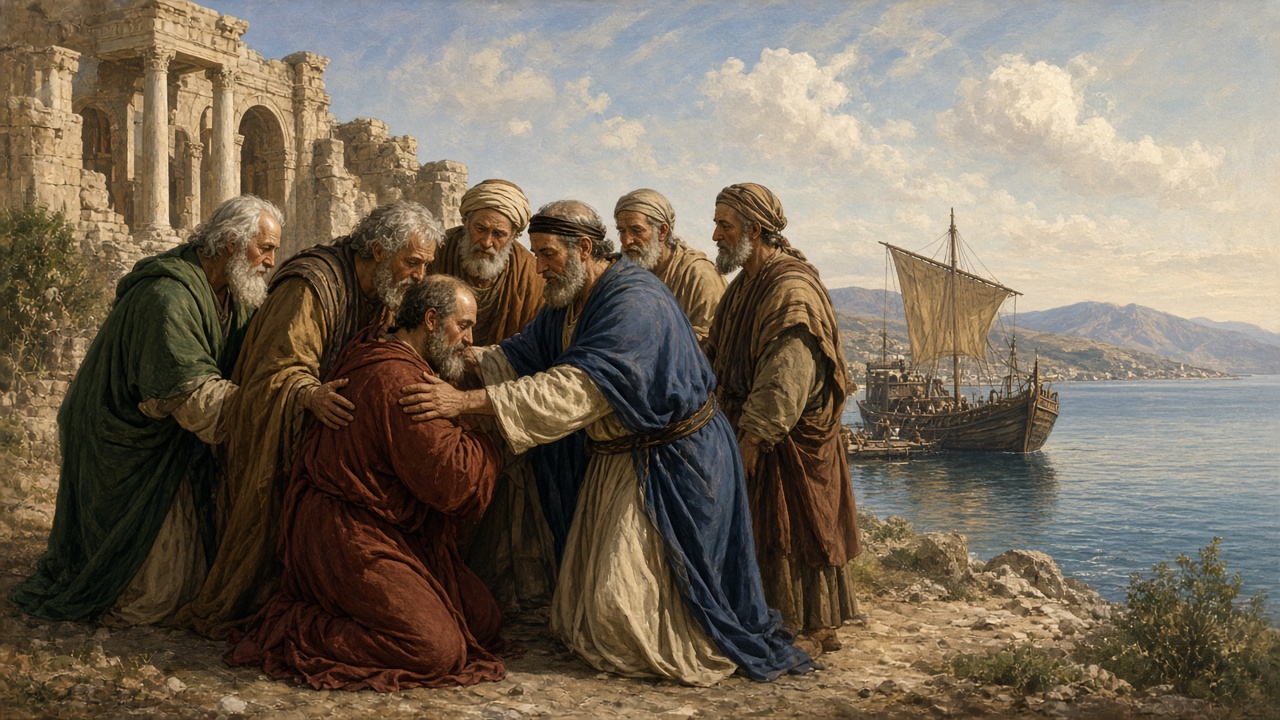
Farewell on the way to Jerusalem
- Leaving Troas, Paul sent his companions ahead by ship and walked to Assos along the Roman road. Assos was a seaport of Proconsular Asia in Mysia, on the north shore of the Gulf of Adramyttium; the walk was about 20 miles, the sea route about 30, and the island of Lesbos lay about 7 miles offshore.Sources: the Bible text itself · Assos
- Paul sailed past Ephesus to avoid spending time in the province of Asia—the Roman province in western Asia Minor, with Ephesus as its capital—because he hoped, if possible, to reach Jerusalem by the day of Pentecost. He stopped at Miletus, a seaport and the ancient capital of Ionia about 36 miles south of Ephesus, and summoned the elders of the Ephesian church.Sources: the Bible text itself · Asia · Miletus
- Seven men traveled with him: Sopater of Berea, Aristarchus and Secundus of Thessalonica, Gaius of Derbe, Timothy, and Tychicus and Trophimus from Asia. Aristarchus of Thessalonica later shared Paul’s imprisonment in Rome, and Trophimus, an Ephesian, accompanied him on this part of the journey and was with him in Jerusalem.Sources: the Bible text itself · Aristarchus · Trophimus
Notes written with AI assistance from open sources (Theographic Bible Metadata, CC BY-SA 4.0; Easton’s Bible Dictionary, public domain) and reviewed before publishing.
Places in this chapter
- Macedonia · 41.600, 22.540 · verses 1, 3, 6
- Greece · 37.972, 23.727 · verse 2
- Syria · Today: Syria 2 · 33.511, 36.306 · verse 3
- Asia · 38.400, 28.300 · verses 4, 16, 18
- Berea · Today: Veria · 40.518, 22.200 · verse 4
- Thessalonica · Today: Thessaloniki · 40.638, 22.946 · verse 4
- Troas · Today: Alexandria Troas · 39.752, 26.159 · verses 5, 6
- Philippi · 41.012, 24.285 · verse 6
- Assos · 39.491, 26.337 · verses 13, 14
- Mitylene · Today: ancient theater at Mitylene · 39.110, 26.547 · verse 14
- Chios · 38.373, 26.137 · verse 15
- Miletus · 37.531, 27.276 · verses 15, 17
- Samos · 37.750, 26.833 · verse 15
- Trogyllium · Today: Cape Mycale · 37.659, 27.003 · verse 15
- Ephesus · 37.939, 27.341 · verses 16, 17
- Jerusalem · 31.777, 35.234 · verses 16, 22
Only places identified with high confidence are shown (90% or more according to the scholarly sources compiled by OpenBible). Period map: DARE (Digital Atlas of the Roman Empire), CC BY 4.0; modern map: © OpenStreetMap contributors; places: OpenBible.info (CC BY 4.0).
Credits and license for this translation
Hset Hadròeh
The New Testament in the Hre language of Vietnam, translated by Baq Thi
Copyright © 2024 Baq Thi
Language: (Hre)
This translation is made available to you under the terms of the
Creative Commons Attribution Share-Alike license 4.0.
You have permission to share and redistribute this Bible translation in any format and to make reasonable revisions and adaptations of this translation, provided that:
You include the above copyright and source information.
If you make any changes to the text, you must indicate that you did so in a way that makes it clear that the original licensor is not necessarily endorsing your changes.
If you redistribute this text, you must distribute your contributions under the same license as the original.
Pictures included with Scriptures and other documents on this site are licensed just for use with those Scriptures and documents.
For other uses, please contact the respective copyright owners.
Note that in addition to the rules above, revising and adapting God's Word involves a great responsibility to be true to God's Word. See Revelation 22:18-19.
2026-07-18
Source: http://ebible.org/hrebt/ · eBible.org