John 3
Parmeswar ke naawa poestak · Tap a verse to see its cross-references.
Jiesoe aur Niekodemas
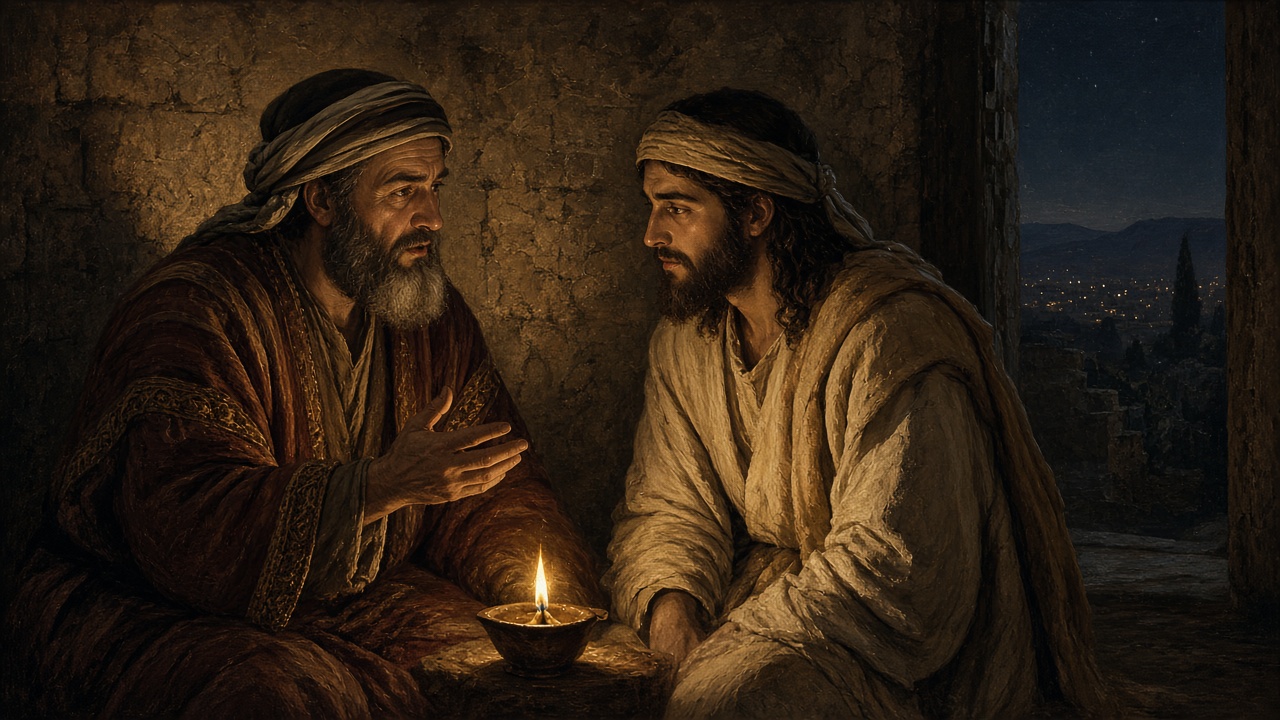
1Ek aadmie raha, okar naam Niekodemas raha. Oe ekgo Fariesie aur Israel ke barkwan me ke raha. 2Ek raat oe gail Jiesoe se batiaai. Oe bolies: „Maastar djie, hamlog tor atjambho kaam dekhlie hai. Ek iensaan etana barka kaam na kar sake hai biena Parmeswar ke saktie se. Ohie se hamlog djaaniela kie Parmeswar toke pathaais hai manai logan ke siekhaawe khaatien.”
3Tab Jiesoe bolies: „Soen, ham tose koetjh bataabe. Khaalie djab ek iensaan ek dafe auro paida hoi, tab oe Parmeswar ke raadj ke biese me samadjh sakie.” 4Tab Niekodemas bolies: „Djab ek iensaan barka hoi gail hai tab kaise oe phien se paida hoi sakiega? Oe thoro aapan maai ke pet me djaaike aur phien se djanam paai sakiega?” 5Tab oe bolies: „Khaalie djab ek iensaan paanie aur Pawietr Aatma me se paida howe hai, tab oe Parmeswar ke raadj me bhaag lei sakiega. 6Iensaan khaalie iensaan ke djalmaai sake hai, bakie Pawietr Aatma ek iensaan ke aatma me naawa djiewan dei sake hai.” 7Aur bolies: „Ka, toe thak hoi gaile djab ham bollie kie toelogke tjaahie ek dafe auro paida howe ke? 8Tjaahe toe hauwa ke aawaadj soene hai, tabbo toe na samadjh sake hai kaaha se aawe hai aur kaaha dja hai. Aisane toe bhie na samadjh sake hai ek iensaan kaise Pawietr Aatma dwaara naawa djiewan paawe hai.”
9Tab Niekodemas poetjhies: „Ie kaise hoi sake hai?” 10Tab oe bolies: „Toe to Israel ke djaatie log khaat ek dharam siekhaawe waala baate. Tab toe kaise ie sab baat na samdjhe hai? 11Ham tose satj bataaila kie ham djaaniela kaun tjiedj ke biese me batiaaila. Ham aapan aakhie se dekhlie hai. Bakie tabbo toelogan hamaar baat na maange hai bieswaas kare. 12Djab ham doenia ke tjiedj kaam me leike toelogke koetjh samdjhaaila, tab toelog na bieswaas kare hai. Tab djab ham toelogse swarag ke tjiedj ke biese me bataabe, tab toelog kaise bieswaas kar sakiehe? 13Koi na swarag me gail hai, khaalie iensaan ke Beta. Aur oe bhie hoewa se oetaral hai. 14Maidaan me Mosas pietar ke saap banwaaike khambha par latkaais raha. Aisane iensaan ke Beta ke bhie oethaawal djaai ke parie. 15Ie rakam har ek djaun okare me bieswaas kare hai, oe hardam ke lieje Parmeswar ke sanghe rahiega.
16Parmeswar doenia ke etana pjaar karies kie oe aapan ekahie Beta deis, djeme har ek djaun okare me bieswaas kare hai, oe Parmeswar se na alag karal djaai, bakie hardam khaatien okare sanghe rahe. 17Pieta Parmeswar aapan Beta doenia me na pathaais hai manai logan ke kasoer dewe ke, bakie oelogke paap me se batjaawe khaatien. 18Dje bieswaas kare hai kie Parmeswar ke Beta okar kasoer aapan oeppar leis hai, Parmeswar oke be-kasoerie maane hai. Bakie dje okare me na bieswaas kare hai, oe sadja laaik hai. Oe to Parmeswar ke ekahie Beta ke oeppar bharosa na karies hai.
19Parmeswar ke andjor doenia me aail hai. Bakie iensaan logan ke auro attjha lagat raha andhiaar me rahe ke. Oelogan to paap-boeraai karat raha. Aisane dekha hai kie oesab sadja laaik hai. 20Djab koi kharaabie kare hai tab oe andjor ke na tjaahe hai aur na khodje hai. Oe dera hai kie okar paap-boeraai andjor me dekhaai djaaiga. 21Bakie dje aapan djiewan Parmeswar ke sattjaai se bietaawe hai, oe andjor khodje hai. Tab okar tjaal-tjalan se dekhaai djaai kie oe Parmeswar me bieswaas kare hai.”
Johaanas dopoe kare waala ke gawaahie Jiesoe ke biese me
22Ekare baad Jiesoe aapan tjela log ke sanghe Joedea diehaat gail. Hoewa par oelog koetjh dien rahie gail aur manai log ke dopoe karat raha. 23Oe tem par Johaanas dopoe kare waala bhie dopoe karat raha. Oe abbe djahal me na raha. Oe aapan kaam Saalem sahar ke nagietj Enon me karat raha. Hoewa dher paanie raha. Aur manai log okare paas bhie aawat raha dopoe karwaawe.
25Tab Johaanas ke tjela log ek doesar aadmie se diel ke safaai ke biese me moeh laraawe lagal. 26Tab oesab Johaanas ke paas gail aur bolies: „Maastar djie, Jordaan nadie ke habara ek aadmie tore sanghe raha aur toe gawaahie deile rahiele kie oe Ke hai. Ab ohoe dopoe kare hai, aur sab koi okare paas dja hai.” 27Tab Johaanas bolies: „Ek manai khaalie oe kaam kar sake hai djaun Parmeswar oke deis hai kare ke. 28Toelog jaad kare hai ham ka bollie rahielie. Ham aane waala Kriest na baatie. Bakie Parmeswar hamke ose pahiele pathaais hai. 29Doelahien doelaha khaatien hai. Aur doelaha ke sanghatia ke okar aawaadj soenat bahoet attjha lage hai. Ohie se ham khoesie baatie djab sab koi okare paas dja hai. 30Manai log ke tjaahie oke hardam auro barka maane ke aur hamke aur nietja.
31Dje oeppar se aail hai, oe sab iensaan se barka hai. Dje dhartie me ke hai, oe khaalie doenia ke kaar-baar ke biese me batia hai. 32Bakie dje swarag me se aail hai, oe bataawe hai djaun tjiedj oe hoewa dekhies aur soenies hai. Tabbo koi na okar baat bieswaas kare hai. 33Aur dje okar baat aapan diel me dhar lewe hai, oe gawaahie dewe hai kie Parmeswar satj hai. 34Parmeswar oke pathaais hai aur okar diel Pawietr Aatma se djaada bharal hai. Oe Parmeswar ke baat bataawe hai. 35Pieta Parmeswar aapan Beta ke bahoet tjaahe hai, aur sab tjiedj okar haath me saupies hai. 36Ohie khaatien dje Parmeswar ke Beta me bieswaas kare hai, oe sada ke lieje Parmeswar ke saathe rahiega. Bakie dje okar Beta ke baat na soene hai, oe Parmeswar ke saath na rahiega. Parmeswar ke goessa hardam okare oeppar rahiega.”
Did you know?
New birth and John's witness
- Nicodemus, whose name means "the people is victor," was a Pharisee and a member of the Sanhedrin. He came to Jesus at night to learn more of his teaching, and the Gospel calls him a leader of the Jews; Jesus addresses him as Israel's teacher.Sources: Nicodemus · the Bible text itself
- After this conversation, Jesus and his disciples went into the Judean countryside, under the Romans the southernmost of the three divisions of Palestine. John was also baptizing at Aenon near Salim, because water was plentiful there; Salim, whose name means "peaceful," lay west of the Jordan. Aenon means "springs," and Easton's Bible Dictionary (1897) places it probably near the upper source of the Wady Far'ah, an open valley full of springs running from Mount Ebal to the Jordan.Sources: the Bible text itself · Judea · Aenon · Salim
- In this chapter John tells his disciples that he is not the Christ but was sent ahead of him, and the narrative notes that he had not yet been thrown into prison. Easton's Bible Dictionary (1897) describes him as the forerunner of Jesus, of priestly descent, and says that his mission was the subject of prophecy.Sources: the Bible text itself · John the Baptist
Notes written with AI assistance from open sources (Theographic Bible Metadata, CC BY-SA 4.0; Easton’s Bible Dictionary, public domain) and reviewed before publishing.
Places in this chapter
- Jerusalem · 31.777, 35.234 · verse 22
- Judea · Today: Judea 1 · 31.777, 35.234 · verse 22
- Jordan · Today: Jordan River · 31.761, 35.558 · verse 26
Only places identified with high confidence are shown (90% or more according to the scholarly sources compiled by OpenBible). Period map: DARE (Digital Atlas of the Roman Empire), CC BY 4.0; modern map: © OpenStreetMap contributors; places: OpenBible.info (CC BY 4.0).
Credits and license for this translation
Parmeswar ke naawa poestak
New Testament in Hindustani, Caribbean (NS:hns:Hindustani, Caribbean)
copyright © 2010 Wycliffe Bible Translators, Inc.
Language: Hindustani, Caribbean
Translation by: Wycliffe Bible Translators, Inc.
Hindustani, Caribbean [hns], Suriname
Copyright Information
© 2010, Wycliffe Bible Translators, Inc. All rights reserved.
This translation text is made available to you under the
terms of the Creative Commons License: Attribution-Noncommercial-No Derivative Works.
( http://creativecommons.org/licenses/by-nc-nd/3.0/ )
In addition, you have permission to port the text to different file formats, as long as you
do not change any of the text or punctuation of the Bible.
You may share, copy, distribute, transmit, and extract portions
or quotations from this work, provided that you include the above copyright
information:
You must give Attribution to the work.
You do not sell this work for a profit.
You do not make any derivative works that change any of the actual words or punctuation of the Scriptures.
Permissions beyond the scope of this license may be
available if you contact
us with your request.
The New Testament
in Hindustani, Caribbean
© 2010, Wycliffe Bible Translators, Inc. All rights reserved.
This translation is made available to you under the terms of the
Creative Commons Attribution-Noncommercial-No Derivatives license 4.0.
You may share and redistribute this Bible translation or extracts from it in any format, provided that:
You include the above copyright and source information.
You do not sell this work for a profit.
You do not change any of the words or punctuation of the Scriptures.
Pictures included with Scriptures and other documents on this site are licensed just for use with those Scriptures and documents.
For other uses, please contact the respective copyright owners.
2014-04-25
Source: http://ebible.org/hnsNT/ · eBible.org