Psalms 149
Tuivang Holy Bible · Tap a verse to see its cross-references.
1Bawipa taw kyihcah lah uh. Bawipa venawh lak thai sa unawh, thlakciimkhqi cunnaak awh am kyihcahnaak laa ce sa lah uh. 2Israel ing amah ak saikung awh zeel seitaw; Zion thlangkhqi ing a mimah a Sangpahrang awh zeel u seh. 3Ang ming ce lam doena kyihcah u seitaw, qaica ingkaw tingtoeng tumding ce tum pe u seh. 4Bawipa taw ak thlang khqik khan awh zeel nawh, dungvoeng na ak awm thlangkhqi ce hulnaak myk sak hy. 5Ve kqihchahnaak awh thlakciimkhqi ing zeel u seitaw a ih hun awhkawng zeelnaak laa sa u seh. 6Cekkhqi am kha awh kyihcahnaak ce awm seitaw, ami kut awh a hu a hai ak hqat zawzi ce pawm u seh, 7thlangphyn a venawh lu lawh aham ingkaw thlangkhqi ce toel aham, 8a sangpahrangkhqi ce khawceh byn nawh, ak thlang bau khqi ce thi khawceh byn aham, 9a mingmih awidengnaak qee ce canhah ce khyn peek aham awm hy. Ve ve ak thlangciim khqi boeih a thangleeknaak na awm hy. Bawipa taw kyihcah lah uh.
Did you know?
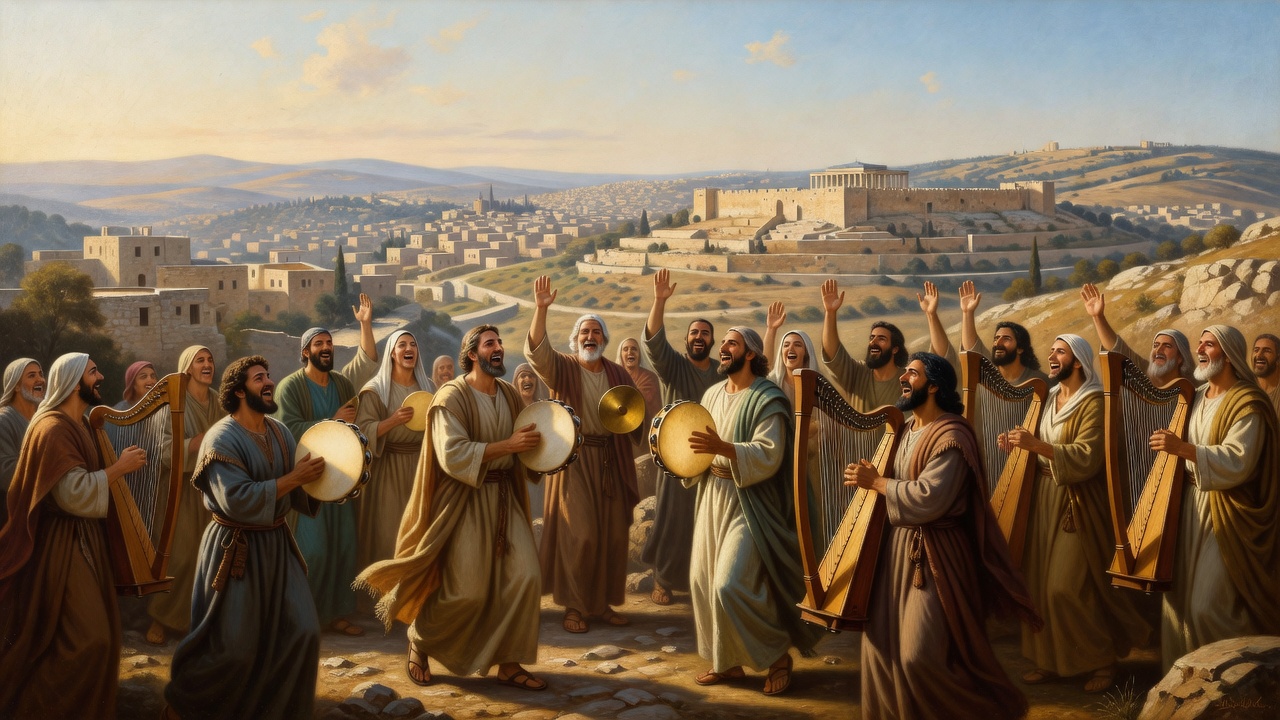
Praise and Victory in Zion
- The reference to the children of Zion points to the people of Jerusalem. Zion was the fortified hill captured by King David from the Jebusites, where he established his citadel and palace, known as the City of David.Sources: Zion · the Bible text itself
- Psalm 149 pairs exuberant temple-style worship—including dancing, tambourines, and harps—with imagery of battle, depicting the faithful with high praises in their mouths and double-edged swords in their hands.Sources: the Bible text itself
Notes written with AI assistance from open sources (Theographic Bible Metadata, CC BY-SA 4.0; Easton’s Bible Dictionary, public domain) and reviewed before publishing.
Places in this chapter
- Zion · Today: Jerusalem · 31.777, 35.234 · verse 2
Only places identified with high confidence are shown (90% or more according to the scholarly sources compiled by OpenBible). Period map: DARE (Digital Atlas of the Roman Empire), CC BY 4.0; modern map: © OpenStreetMap contributors; places: OpenBible.info (CC BY 4.0).
Credits and license for this translation
Tuivang Holy Bible
The Holy Bible in the Tuivang dialect of the Matu Chin language of Myanmar (Burma)
Copyright © 2020 Batupei Christian Fellowtship
Language: Tuivang (Chin, Matu)
Dialect: Tuivang
Copyright applies only in Myanmar. Outside Myanmar, this work is in the Public Domain.
This translation is made available to you under the terms of the
Creative Commons Attribution Share-Alike license 4.0.
You have permission to share and redistribute this Bible translation in any format and to make reasonable revisions and adaptations of this translation, provided that:
You include the above copyright and source information.
If you make any changes to the text, you must indicate that you did so in a way that makes it clear that the original licensor is not necessarily endorsing your changes.
If you redistribute this text, you must distribute your contributions under the same license as the original.
Pictures included with Scriptures and other documents on this site are licensed just for use with those Scriptures and documents.
For other uses, please contact the respective copyright owners.
Note that in addition to the rules above, revising and adapting God's Word involves a great responsibility to be true to God's Word. See Revelation 22:18-19.
2026-07-26
Source: http://ebible.org/hltthb/ · eBible.org