Ezekiel 17
Baibal Olcim · Tap a verse to see its cross-references.
Thahum Thuidoeknah
1BOEIPA ol he kai taengla ha pawk tih, 2“Hlang capa, Israel imkhui te olkael neh voek lamtah thuidoeknah neh thuidoek lah.
3Te vaengah ka Boeipa Yahovah loh he ni a thui. atha len rhoe len tih a phae mul khaw sai. A dii te khaw rhaekva bangla phung. Lebanon la a pawk vaengah lamphai thingsoi ah cu. 4A thingsam soi te a hlaek tih Kanaan kho la a khuen. Te phoeiah thenpom khopuei ah a ten. 5Khohmuen cangti te khaw a loh tih cangti khohmuen ah a tuh. Tairhi te a loh tih tui taengah khawk a sut. 6A duei vaengah misur bangla om tih a sang khaw a toem la cawn. A hlaeng khaw amah taengla ngoi tih a dang ah a yung om van. Te dongah misur bangla om tih amah a saii neh thingsam la cawn. 7Tedae atha pakhat tah a phae a len, len neh om tih a dii khaw phung. Te vaengah misur te anih taengla a yung a hlak tih canglak kah a thingling te suep ham a hlaeng anih taengla a voeih. 8A hlaeng saii ham neh a thaih thaih sak ham, misur bangla a bu om sak ham khohmuen then neh tui taengah muep a phung. 9Ka Boeipa Yahovah loh he ni a thui. Thaihtak ni ti nah.
A yung pat vetih a thaih khaw hul mahpawt nim? A dawn thingsuep te boeih a rhae akhaw rhae mai veh. A yung lamloh a kuel ham khaw pilnam a yet neh bantha a len a kuek moenih. 10A phung dae thaihtak aya he? Anih te khothoeng yilh loh a yawn vaengah rhae rhoe rhae vetih canglak kah a thingdawn pataeng rhae mahpawt nim?,” a ti.
11BOEIPA ol te kai taengla koep ha pawk tih, 12Boekoek imkhui te thui pah laeh. He tla a thui he na ming pawt nim? Babylon manghai loh Jerusalem a paan tih a manghai neh a mangpa rhoek khaw a khuen coeng ke. Amih te a taengah Babylon la a khuen coeng. 13Mangpa tiingan lamkah te a khuen tih a taengah paipi a saii pah. Anih te olcaeng hmuiah kun tih khohmuen thingnu te a loh. 14Tlarhoel ram la om sak tih soekloek pawt ham, a paipi ngaithuen ham neh thoh sak ham a saii. 15Amah ham marhang neh pilnam muep dang ham Egypt la puencawn a tueih neh anih te a tloelh dae thaihtak aya? Te te aka saii te loeih aya? Paipi aka phae khaw loeih aya?
16Kai tah hingnah ni tite ka Boeipa Yahovah kah olphong ni. Manghai khohmuen ah anih te ka manghai sak. A olcaeng a sit tih a taengkah a paipi te a phae dongah Babylon lakli ah duek saeh. 17Caemtloek vaengkah tanglung lun ham neh hinglu muep aka phae la buep a khoeng vaengah Pharaoh loh anih a saii te tatthai tanglue, pilnu hlangping nen moenih. 18Paipi phae ham olcaeng a hnoel van dongah a kut duen cakhaw a cungkuem a saii he loeih mahpawh ne.
19Te dongah ka Boeipa Yahovah loh he ni a thui. Kai he hingnah pawt bangla ka olcaeng a sit tih ka paipi aka hnalval te amah lu ah ni ka thoeng sak eh. 20Anih te ka lawk ka tung pah vetih ka rhalvong dongah man ni. Anih te Babylon la ka khuen vetih a boekoeknah neh kai taengah boe a koek te anih soah lai ka tloek ni. 21A hlangyong, a hlangyong boeih tah a caembong boeih khaw cunghang dongah cungku uh vetih aka sueng rhoek te khohli cungkuem taengla a thaek uh ni. Te vaengah BOEIPA kamah loh ka thui te na ming bitni.
22Ka Boeipa Yahovah loh he ni a thui. Kai loh lamphai thingsang thingsoi lamkah ka loh vetih thingsam lamkah ka phung ni. A dawn mongkawt te ka hlaek vetih tlang sang palek ah ka phung ni. 23Israel tlang sang ah ka phung vaengah a hlaeng cawn vetih a thaih thai ni. Te vaengah aka khuet lamphai la om vetih a soah vaa cungkuem loh kho a sak. A hlaeng hlipkhup kah a hmoi tomah om uh ni. 24Te vaengah khohmuen kah thing boeih loh BOEIPA kamah he m'ming uh ni. Thing sang te ka kunyun sak tih, thing toem te ka sang sak. Thing a thingsup khaw ka koh sak tih thing koh khaw ka saihnim sak. Kai BOEIPA loh ka thui bangla ka saii ni.
Did you know?
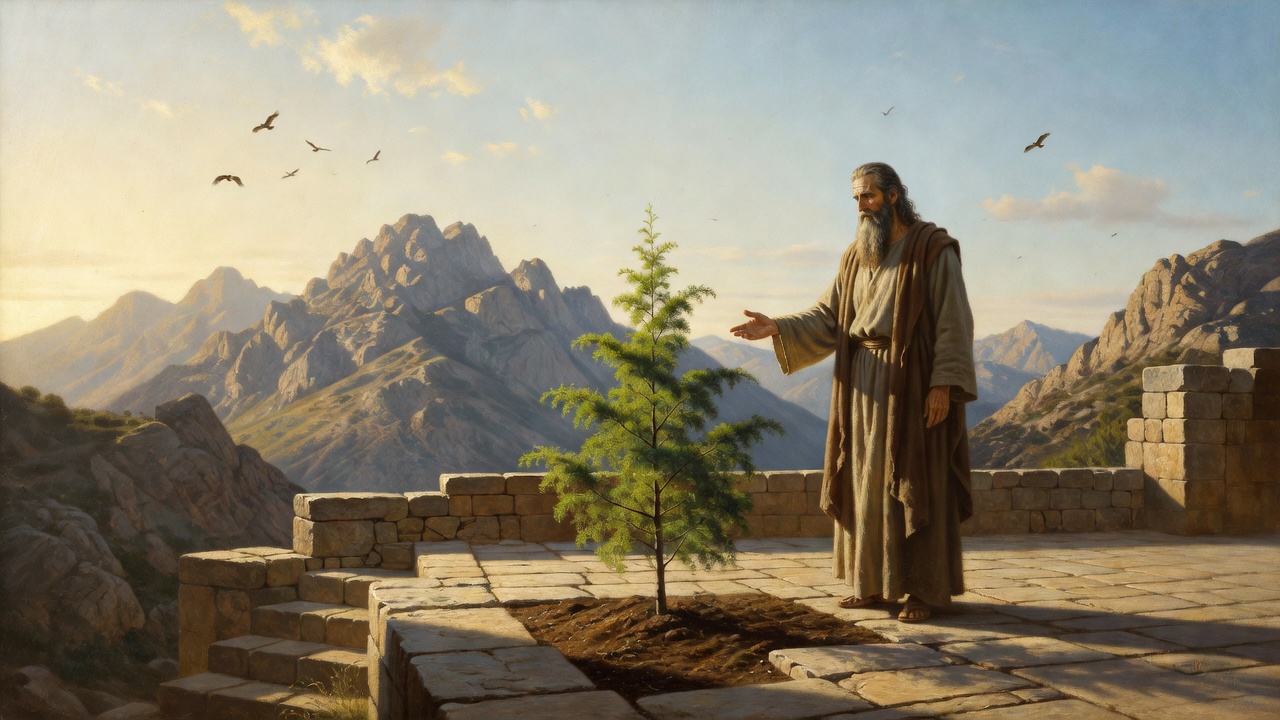
The Parable of the Eagles and the Cedar
- Ezekiel presents a political allegory where the first great eagle represents the king of Babylon, who captured Jerusalem's royal leadership and established a vassal king under a solemn covenant. The second eagle represents Egypt and its Pharaoh, to whom the Judean ruler turned for cavalry and military assistance in defiance of his sworn allegiance.Sources: the Bible text itself · Babylon · Egypt · Pharaoh
- In the prophetic message, breaking a political vassal oath made under Babylon was treated not merely as diplomatic rebellion, but as spiritual treason against God, who regarded the sworn pledge as His own oath.Sources: the Bible text itself
- The chapter concludes with a reversal of human political schemes: God Himself promises to take a tender shoot from the top of the cedar and plant it upon the mountain heights of Israel, where it will grow into a majestic tree offering shelter to birds of every kind.Sources: the Bible text itself
Notes written with AI assistance from open sources (Theographic Bible Metadata, CC BY-SA 4.0; Easton’s Bible Dictionary, public domain) and reviewed before publishing.
Places in this chapter
- Lebanon · 33.540, 35.584 · verse 3
- Canaan · 32.767, 35.333 · verse 4
- Babylon · 32.543, 44.422 · verses 12, 14, 15, 16, 17, 20
- Jerusalem · 31.777, 35.234 · verses 12, 17
- Egypt · 30.129, 31.308 · verse 15
Only places identified with high confidence are shown (90% or more according to the scholarly sources compiled by OpenBible). Period map: DARE (Digital Atlas of the Roman Empire), CC BY 4.0; modern map: © OpenStreetMap contributors; places: OpenBible.info (CC BY 4.0).
Credits and license for this translation
Baibal Olcim
The Holy Bible in the Matupi Chin language of Mynmar. Matupi Chin Standard Bible
Public Domain
Language: Matupi Chin (Chin, Matu)
Published in Mynmar, which is not a signatory to international copyright treaties. Copyright may apply locally in Mynmar, where this is released under a Creative Commons Attribution Share-Alike 4.0 license.
2026-09-21
Source: http://ebible.org/hltmcsb/ · eBible.org