Judges 7
Baibal Olcim · Tap a verse to see its cross-references.
Gideon Caem Te a Coelh
1Te dongah Jerubbaal Gideon neh a taengkah pilnam boeih te a thoh puei tih Hardo sih ah rhaeh uh. Te vaengah Midian rhaehhmuen tah tuikol kah Moreh som tlangpuei ah om van. 2Te phoeiah BOEIPA loh Gideon te, “Midian te amih kut ah kan tloeng ham dongah na taengkah pilnam te yet aih. 'Kamah kut loh kamah he n'khang,’ a ti neh Israel loh kai taengah kohang ve. 3Te dongah pilnam kah a hna ah pang thil lamtah, 'U khaw aka rhih tih aka thuen tah bal mai saeh lamtah Gilead tlang lamloh nong saeh,’ ti nah,” a ti nah.
Te vaengah pilnam khui lamloh hlang thawng kul thawng hnih te bal tih thawng rha la cul uh.
4Tedae Gideon te BOEIPA loh, “Pilnam he yet aih pueng. Amih te tui taengla suntlak puei lamtah nang hamla pahoi ka nuemnai bitni. Te vaengah nang taengah, 'Anih he namah taengah pongpa saeh,’ ka ti hlang te tah namah taengah pongpa saeh. Tedae, 'anih te namah taengah pongpa boel saeh,’ tila nang taengah ka thui hlang boeih te tah pongpa van boel saeh,” a ti nah.
5Te dongah pilnam te tui taengla a suntlak puei.
Te phoeiah Gideon te BOEIPA loh, “Ui kah a laeh bangla tui te a lai neh aka laek boeih neh tui ok ham a khuklu dongah aka cungkueng hlang boeih te amah neh amah hloep khueh,” a ti nah.
6Te vaengah a ka neh a kut aka laek he hlangmi la hlang ya thum lo tih, pilnam hlangrhuel boeih long tah tui ok hamla a khuklu dongah cungkueng uh. 7Te dongah Gideon te BOEIPA loh, “Tui aka laek hlang ya thum neh nang te kan khang vetih Midian te nang kut ah kan paek bitni. A tloe pilnam boeih te tah amah hmuen la rhip cet uh mai saeh,” a ti nah.
8Te dongah pilnam loh a kut dongah lampu neh tuki te a khuen uh. Israel hlang boeih te a dap la rhip a tueih coeng dae hlang ya thum te tah a rhuem pueng. Te vaengah Midian rhaehhmuen he tuikol kungdak kah amah taengah om coeng.
Midian La Longyam a Tueih
9Tekah khoyin ah Gideon te BOEIPA loh, “Thoo, anih te na kut dongah kam paek coeng dongah rhaehhmuen ke suntlak thil laeh. 10Tedae suntlak ham na rhih atah na ca Purah te rhaehhmuen la namah loh suntlak puei. 11A thui uh te na yaak tih, na kut han talong uh phoei daengah ni rhaehhmuen khaw na suntlak thil eh?,” a ti nah.
Te daengah a ca Purah khaw rhaehhmuen kaepvai kah aka bop kah taphung la a suntlak puei.
12Te vaengah Midian neh Amalek khaw, khothoeng ca rhoek boeih khaw kaisih aka hol uh bangla kol ah yalh uh tih amih kah kalauk mah tuipuei tuikaeng kah laivin bangla tae lek pawt la hmoeng. 13Gideon halo vaengah hlang pakhat loh a hui taengah a mang tarha ana doek thui tih, “Mang ka man hatah cangtun vaidam a hluem hluem at loh Midian rhaehhmuen la paluet tih dap khuila kun. Dap te a toh tih a cungku phoeiah a so la a palet thil dongah dap cungku he,” a ti nah.
14A hui long khaw a doo tih, “A hong moenih, Israel tongpa, Joash capa Gideon kah cunghang dae la te, Midian neh rhaehhmuen boeih he Pathen loh anih kut dongah a paek coeng,” a ti nah.
Midian a Tloek
15Mang kawng a saep te Gideon loh a yaak vaegnah tho a thueng. Te phoeiah Israel rhaehhmuen la mael tih, “Midian rhaehhmuen he BOEIPA loh na kut ah m'paek coeng dongah thoo uh laeh,” a ti nah.
16Hlang ya thum te a lu pathum a boel tih amih boeih long te a kut dongah tuki, amrhaeng hoeng neh amrhaeng khui ah hmaithoi te rhip a paek.
17Te phoeiah amih te, “Kai nan hmuh uh vanbangla saii uh van. Tahae ah rhaehhmuen taphung la ka cet pawn ni, te dongah ka saii bangla saii uh. 18Kai loh tuki te ka ueng van neh ka taengkah rhoek boeih long khaw tuki te ueng uh. Nangmih long khaw rhaehhmuen taengvai boeih ah, “BOEIPA ham neh Gideon ham,” ti uh van,” a ti nah.
19Gideon loh amah taengkah hlang yakhat te pukthung bangli vaengah rhaehhmuen taphung la a pawk puei. Kho aka tawt rhoek te a thoh van neh tuki te a ueng uh tih a kut dongkah amrhaeng te a dae uh. 20Te phoeiah rhoihui pathum loh tuki te a ueng uh tih amrhaeng te a dae uh. Te phoeiah hmaithoi te a banvoei kut neh, ueng hamla tuki te a bantang kut ah a thueng uh tih, “BOEIPA ham neh Gideon ham cunghang he,” tila pang uh. 21Rhaehhmuen te a kaepvai kah a kungdak ah boeih a pai thil uh vaengah rhaehhmuen kah te khaw boeih yong. Te vaengah a rhaelrham a rhaelrham uh doeah yuhui uh. 22Tuki ya thum te a ueng uh van neh khat rhip kah cunghang te BOEIPA loh a hui taeng neh rhaehhuen tom boeih taengla a cuk sak dongah lambong loh Bethshitah Zererah ben Tabath kaepkah Abelmeholah khorhi duela rhaelrham uh. 23Te vaengah Israel hlang te Napthali lamkah khaw, Asher lamkah khaw, Manasseh tom lamkah khaw a khue tih Midian hnuk te a hloem uh.
Ephraim loh a Bongyong
24Puencawn rhoek te khaw Gideon loh Ephraim tlang tom ah a tueih tih, “Midian khoep mah ham ha suntla uh lamtah amih te Bethbarah tui neh Jordan duela buem uh laeh,” a ti nah.
Te dongah Ephraim hlang te boeih a doek tih Bethbarah tui neh Jordan duela a buem uh. 25Te vaengah Midian mangpa rhoi Oreb neh Zeeb te a tuuk uh tih, Oreb te Oreb lungpang ah a ngawn uh. Zeeb te tah Zeeb mah la a ngawn uh. Te phoeiah Midian te a hloem uh tih, Oreb neh Zeeb lu te Jordan rhalvangan kah Gideon taengla a khuen uh.
Did you know?
Gideon's Three Hundred
- Before the battle, Gideon's force of 32,000 men was drastically reduced to just 300 at the spring of Harod. First, 22,000 fearful men were permitted to return home, and the remaining 10,000 were sifted by how they drank water from the spring, leaving only those who brought water to their mouths with their hands.Sources: the Bible text itself · Harod
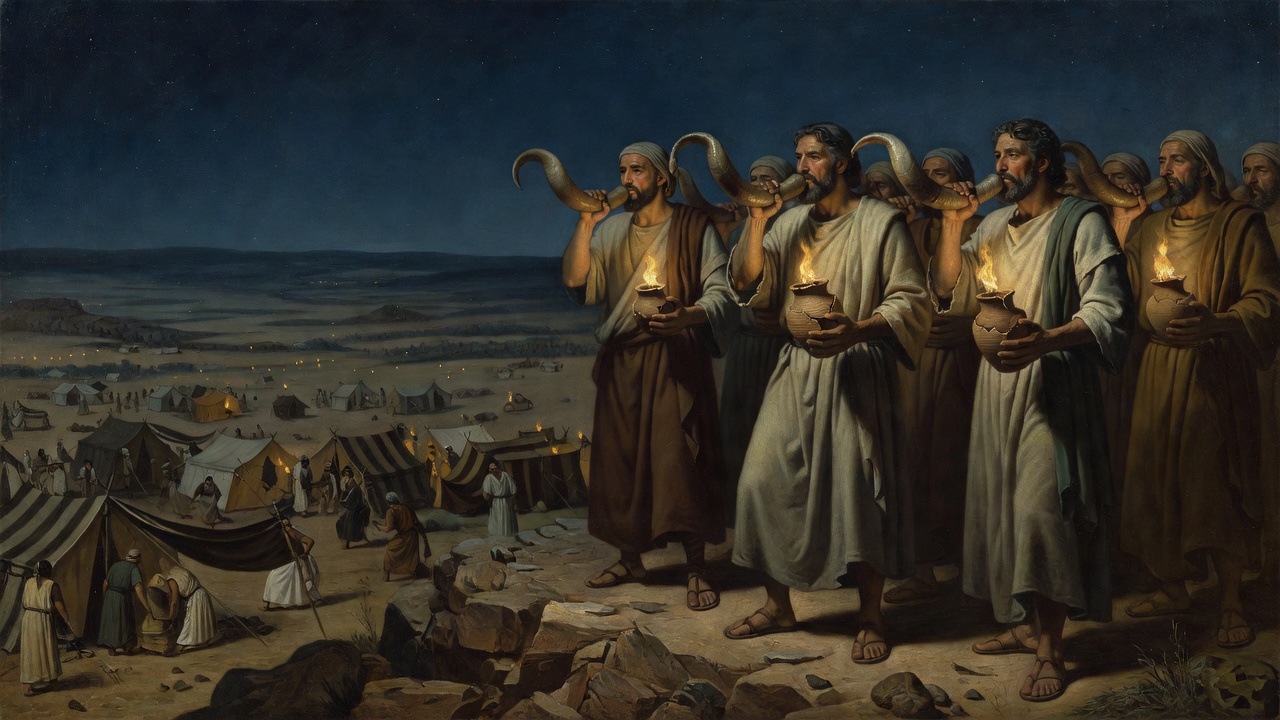
- Gideon used night tactics and psychological shock by dividing his 300 men into three companies armed only with rams' horns, torches, and clay jars. Surrounding the vast camp of Midianites and allied eastern nomads near the hill of Moreh during the night watch, the sudden sound of shattering jars and blowing horns caused the enemy to turn on one another in the dark.Sources: the Bible text itself · Moreh (little Hermon) · East
- As the Midianites fled toward the Jordan River, the tribe of Ephraim was summoned to cut off their retreat at the river crossings. The Ephraimites captured and executed two Midianite leaders, Oreb (meaning 'raven') and Zeeb (meaning 'wolf').Sources: the Bible text itself · Oreb · Zeeb · Ephraim
Notes written with AI assistance from open sources (Theographic Bible Metadata, CC BY-SA 4.0; Easton’s Bible Dictionary, public domain) and reviewed before publishing.
Places in this chapter
- Midian · 28.495, 35.012 · verses 1, 2, 7, 8, 12, 13, 14, 15, 23, 24, 25
- Amalek · 30.648, 34.422 · verse 12
- East · Today: region around Amman · 31.955, 35.934 · verse 12
- Jordan · Today: Jordan River · 31.761, 35.558 · verses 24, 25
Only places identified with high confidence are shown (90% or more according to the scholarly sources compiled by OpenBible). Period map: DARE (Digital Atlas of the Roman Empire), CC BY 4.0; modern map: © OpenStreetMap contributors; places: OpenBible.info (CC BY 4.0).
Credits and license for this translation
Baibal Olcim
The Holy Bible in the Matupi Chin language of Mynmar with Strong's numbers
Public Domain
Language: Matupi Chin (Chin, Matu)
Published in Mynmar, which is not a signatory to international copyright treaties. Copyright may apply locally in Mynmar.
2026-07-16
Source: http://ebible.org/hlt/ · eBible.org