Acts 16
U BULUNGANA U NIGA · Tap a verse to see its cross-references.
E Timoti e la gono mer ere Pol mere Sailas
1Ere Pol mere Sailas i silaia tara taun i Debi me na butu ria tara taun i Listra. Na tara han teka a toa Kristen e ka, a solonen e Timoti. E tsinanen nonei a pala turu Jiu na nonei a Kristen has. Kaba e tamanen a toun Grik. 2Nu Kristenir i Listra ni Aikoniam i hatein a markato tere Timoti me poier, “Nonei a katun a niga.” 3Ne Pol e ngil e Timoti ga la gono meien. Ba nonei e lue nen me hapö nena a hatoatongo tere Sunahan i pikpikönen. Taraha, u Jiu hoboto ti kaia tara han teka i atei sil e tamane Timoti a toun Grik. Nu Grik i namala kukutei nonei a markato tara hipö teka ti tagala sil koru u Jiu. 4Ba nori e lala ria turu taun ba te hatei rer u Kristen u ranga ti kitseia u aposol na pal kapan i Jerusalem ba te poier, “Alimiu go kukutiam a ka teka.” 5Bu nihamana turu Kristen e butu hatagala koruna, nu hiase i taren e butu hapan susul turu mamanu lan.
E Pol e tarei a katununa i Masedonia
6Ba nori e la hagusuna ria tara provins i Pritsia na i Galesia. Nu Namnamei u Goagono e hatei rien te gi ma tatei hihatuts menien u ranga tere Sunahan tara han i Eisia. 7Ba nori e na hanoa ria tara provins i Misia, me katsin torohanan la uar i iahana a provins i Bitinia. Kaba u Namnamei tere Iesu e hatu kap reien. 8Ba nori e la hatalis ba ner i Misia me la uar tara taun i Troas. 9Na tara bong be Pol e tareto u toa u hiharuto. Ba nonei e tarena a toun Masedonia te tuol ba te ranga hatatagi menen me poiena, “Alö go aroho uama i Masedonia ba te mi taguhu ramo lam!” 10Te kapaia u hiharuto, ba lam* te katsin la tala uam tara provins i Masedonia, taraha alam u atei sil e Sunahan e ngö rio lam te go na hala meni lam u Bulungana u Niga tara barebana i han teka.
E Lidia e hamanaia tere Iesu
11Alam u osaia tara tolala ba te la ba nem a taun i Troas me aroho hamatskö uam tara tolo i Samotres. Bu hamahö ba lam te la soku uam tara taun i Niapolis. 12Alam u la ban i Niapolis ba te kete uam i Pilipai, a taun a kapan tara man han i iahana provins i Masedonia. Tara provins teka i ka hasia a tei Rom u para. Ba lam e gamon ka mia i Pilipai. 13Na turu Lan u Goagono turu Jiu, alam u la u i ielesala tara taun ba te na tuku mia tara makum i rehina ramun olo tu poeia lam a makum ti roron singoia u Jiu. Ba lam e gumum me ranga gono merem a tohaliou ti gono hakapa. 14A toa tahol a solonen e Lidia e kaia tara tohaliou ti hengo rio lam. Nonei a taholuna tara taun i Taiataira na nonei e roron haholin u labalaba a holnen te la sei. Nonei e roron hatsunoni e Sunahan, ba Tsunono e kalatsena a torinen ba nonei e hengo hanige iena u ranga tere Pol. 15Ba nonei e luena a baptais na pala i tanen ti susohoia i luma i tanen i habaptais has. Ba nonei a tahol e ranga hatatagina me poiena, “Te atei sile mia limiu alia e hamana koru uagu tara Tsunono, ba limiu te mi tapa mia i luma i tar.” Ba nonei e las hagum hatagala rano lam.
Nori i haka ria ere Pol mere Sailas tara karabus i Pilipai
16Turu toa u lan alam u la u tara makum ti roron singoia, ba toa taholun kukui puku e hitupali mera nolam. Nonei a taholun sueke te harangi a toa mate a omi, ba tahol e lu bera nei a moni pan u katunun hakui i tanen tara toukuin sueke. 17Ba nonei e kukutiena e Pol na lam has ba te ngöna me poiena, “A pal tson teka u katunun kui tere Sunahan i iasa koru. Nori e haruto rari limiu a maroro te lu sila namia limiu a nihitaguhu tere Sunahan.” 18Ba tahol teka e kato noa lasina turu mamana u lan. Be Pol e soso koru mena a ka teka ba te habiritsina me poiena tara mate, “Alia e ranga mego lö tara solona e Iesu Kristo, alö go koul ban a tahol teka.” Ba mate a omi e la ba nanen i teka puku. 19Na pal barebana ti hakui a tahol teka i atei sil a ka ti lulue ien a moni e kapa tala. Ba nori i tsepa reto ere Pol mere Sailas me las tsibil raren ba te la mera rien tara pal kapan i hihitoani. 20Ba nori e na piou rarien turu katun tara gamman me poier, “A pal tson teka u Jiu, na nori e mi kato homier a taun i tarara. 21Nori e mi hihatuts has ner a markato te hapiu nena u lo i tarara. Ara e ma tatei hanige rei a ka teka, taraha ara a tei Rom.” 22Ba barebana e hatangana hobotor turu ranga teka. Bu gamman e hatangana hasir bu katun i taren e kis kata ba ner u hasobu tere Pol mere Sailas, ba nori e singata rarien a pata. 23Nori i singata hapan koru ren me na haka rarien tara luman karabus. Ba nori e poier tara tson pepeitokap tara karabus, “Alö go pepeito kap haniger a elasolana katun teka.” 24Tara poata te hengoe ien u ranga teka, ba nonei e haka ranen tara toa rum i iogana me hakits kap ranei a man mouren a makumun timba a tiama. 25Kaba tara gusuna bong be re Pol mere Sailas e singo uar tere Sunahan me soloseier e Sunahan turu köman lotu, bu palair u karabus e hengo raren. 26Ba toa nun e songots butuna me gas hapanena a luman karabus me noana turu kopina u tul i tanen. Ba i teka koru bu tamana hoboto te takalatar, bu tsien e tapurese ria turu karabus me rusur. 27Ba tson pepeitokap e supakatana me tagulena. Ba poata te tare ien u tamana i takalata hakapa, ba nonei e lousena u kilatan hiatatung i tanen me katsin ngats hamatie nei a peisanen, taraha nonei e poei u karabus i bus hakapa. 28Be Pol e ku hapan koruna me poiena, “Alö go ma ngatsei a peisamulö! Alam hoboto e kam!” 29Ba tson pepeitokap e ngö silena u lam me pieta tasuna me tuhatukun nena i matana ere Pol mere Sailas, ba te tololo mena nimatout. 30Ba nonei e la halakasa mera nen me poiena, “A ma tsi tsunono, alia go kato uiname ba lia te luegu a nihitaguhu tere Sunahan?” 31Ba nori e poier, “Alö go hamana u tara Tsunono e Iesu, ba lö te luem a nihitaguhu tere Sunahan. Na e kato has uana i iesana tara pal katun i tamulö.” 32Ba nori e toan hateie rien u ranga tere Sunahan me hatei has rer u katun hoboto ti kaia i luma i tanen. 33Ba i gusuna bong noa ba tson pepeitokap teka e lu rena ere Pol mere Sailas me galusena u takiraha i taren. Ba i teka puku ba nonei na pala hoboto i tanen e luer a baptais. 34Ba nonei e piou rena ere Pol mere Sailas me sei ria i luma i tanen, ba nonei e hanou ranen. Ba nonei na pala hoboto i tanen e sasala korur ti hamana uen tere Sunahan. 35Poata te lania a lan, bu gamman e hala rarima u polis me poier, “Na purese riam a elasolana katun.” 36Ba tson pepeitokap e na hatei nena a ka teka tere Pol me poiena, “U gamman e hala narima u ranga te poiena alimiu mere Sailas e gi purese riou. La tala mula ba te la hanigamiu.” 37Be Pol e poiena turu polis, “Nori i ma kot hamatskö merai lam na nori i singata rilam a pata i matar u barebana. Alam has u katunur i Rom, kaba nori i haka has ria lam tara karabus. Na nori e katsin purese rario lam ba te katsin hala hamous tsipon rario lam. E moa koru! Nori peisa e gi lama ba te mi halakasa rario lam!” 38Bu polis e na hatei ner u ranga teka turu gamman. Ba poata ti hengo nien ere Pol mere Sailas u katunur i Rom, ba nori e matoutu talar. 39Ba nori e na ranga hatatagi tori ria i taren. Ba nori e lakasa gono mera ren tara luman karabus ba te tahul raren te gi la ba menien a taun. 40Be re Pol mere Sailas e la ba ner a luman karabus me la uar i luma tere Lidia, ba nori e na tara rer a pal barebana ti hamanaia tere Iesu. Ba nori e ranga gono mera ren me kato hatagaler a nihamana i taren, ba nori e toan lar.
Did you know?
From Lystra to Philippi
- At Lystra, Paul met Timothy, a disciple of whom the brothers in Lystra and Iconium spoke well, the son of a believing Jewish woman and a Greek father. Wanting him as a companion, Paul had him circumcised on account of the Jews there, who knew that his father was Greek. Easton's Bible Dictionary (1897) says Timothy probably lived in Lystra and seems to have been converted during Paul's earlier visit.Sources: the Bible text itself · Timotheus
- After being kept from speaking in the province of Asia, Paul and his companions traveled through Phrygia and Galatia. At the border of Mysia they were not permitted to enter Bithynia, so they went down to Troas, Mysia's chief port on the northwest coast of Asia Minor, a city named for ancient Troy about four miles to the north. There a night vision of a man of Macedonia pleading for help led them to sail to that Roman province north of Greece.Sources: the Bible text itself · Mysia · Troas · Macedonia
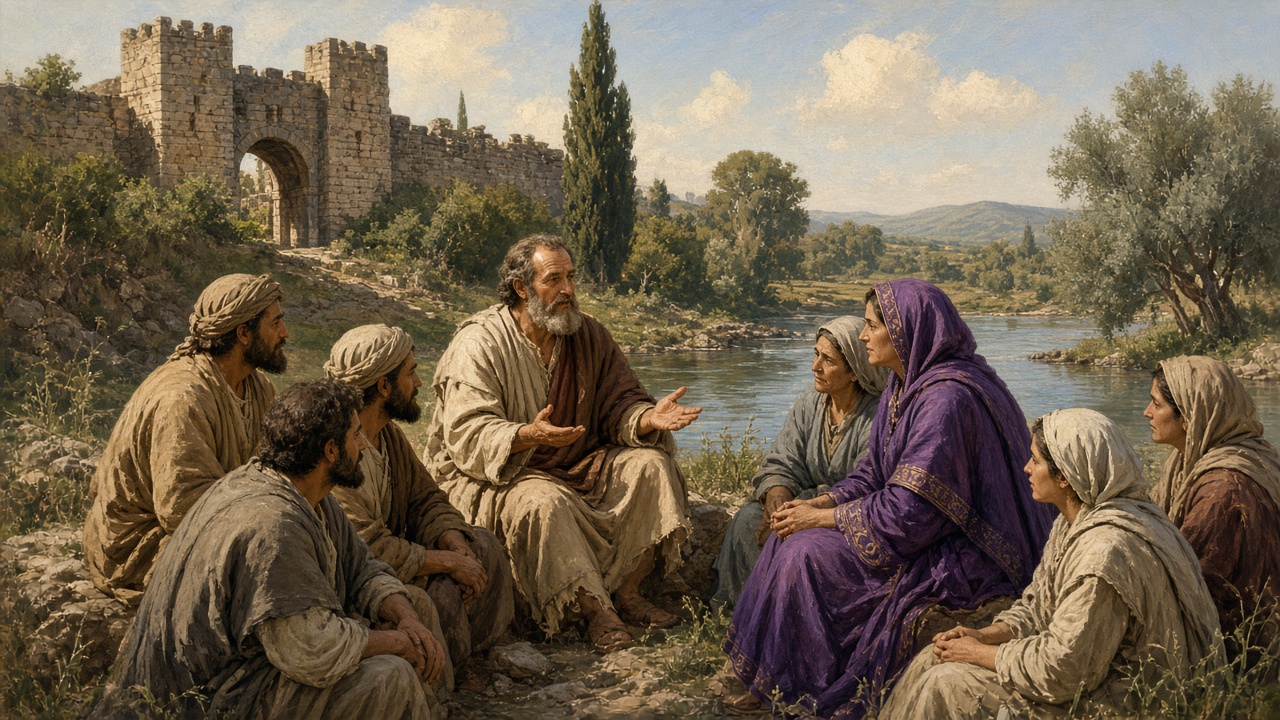
- In the Roman colony of Philippi, Paul and his companions found a customary place of prayer by the river outside the city gate, where women had gathered. Among them was Lydia, a dealer in purple cloth from Thyatira and a worshiper of God; after she and her household were baptized, she persuaded the travelers to stay at her house. Easton's Bible Dictionary (1897) describes her as a proselyte of considerable wealth and as the first person in Europe to embrace Christianity.Sources: the Bible text itself · Lydia
Notes written with AI assistance from open sources (Theographic Bible Metadata, CC BY-SA 4.0; Easton’s Bible Dictionary, public domain) and reviewed before publishing.
Places in this chapter
- Lystra · Today: Tel Lystra · 37.602, 32.338 · verses 1, 2
- Iconium · Today: Konya · 37.872, 32.492 · verse 2
- Jerusalem · 31.777, 35.234 · verse 4
- Asia · 38.400, 28.300 · verse 6
- Galatia · 39.267, 32.983 · verse 6
- Phrygia · 39.000, 31.000 · verse 6
- Bithynia · 40.500, 31.000 · verse 7
- Mysia · 40.000, 28.500 · verses 7, 8
- Troas · Today: Alexandria Troas · 39.752, 26.159 · verses 8, 11
- Greece · 37.972, 23.727 · verse 9
- Macedonia · 41.600, 22.540 · verses 9, 10, 12
- Neapolis · Today: Kavala · 40.935, 24.415 · verse 11
- Samothrace · Today: Samothraki · 40.450, 25.583 · verse 11
- Philippi · 41.012, 24.285 · verse 12
- Thyatira · Today: Akhisar · 38.920, 27.837 · verse 14
Only places identified with high confidence are shown (90% or more according to the scholarly sources compiled by OpenBible). Period map: DARE (Digital Atlas of the Roman Empire), CC BY 4.0; modern map: © OpenStreetMap contributors; places: OpenBible.info (CC BY 4.0).
Credits and license for this translation
U BULUNGANA U NIGA
The New Testament in the Halia Language of Papua New Guinea
Nupela Testamen long tokples Halia long Niugini
copyright © 2020 Wycliffe Bible Translators, Inc.
Language: Halia
Translation by: Wycliffe Bible Translators
This translation is made available to you under the terms of the
Creative Commons Attribution-Noncommercial-No Derivatives license 4.0.
You may share and redistribute this Bible translation or extracts from it in any format, provided that:
You include the above copyright and source information.
You do not sell this work for a profit.
You do not change any of the words or punctuation of the Scriptures.
Pictures included with Scriptures and other documents on this site are licensed just for use with those Scriptures and documents.
For other uses, please contact the respective copyright owners.
2022-06-08
Source: http://png.bible/hla/ · eBible.org