Genesis 28
Buk Niu In Hida Balu nol Dehet deng Apan-kloma ki in Dadi ka · Tap a verse to see its cross-references.
1Kon nam Isak haman Yakob le belen hangun, hidim tui-tekan noan, “Hii babanan ne! Ku saap nol tana-bihaat Kanaꞌan deken. 2Mo ku lako se Padan Aram, se ku upum Betuel uma. Ku laok saap nol baki Laban ana bihata las mesa. 3Nang le Ama Lamtua Allah man Kuasa Dudui ka, bel hangun se ku, le halin ku ana-upum mas taplaeng mamo, nol ku in hua-koet tas, daid bangsa mamo man in muun-tes isi. 4Nang le Ama Lamtua in hid nol upung Abraham ma nahi se ku, nol ku in hua-koet tas. Nang le ku haup dale, man Ama Lamtua Allah in hid hidi, le bel upung Abraham son na.” 5Tekan hidi ela kon, Isak sao Yakob lako Padan Aram, se un bakin Laban nol upu Betuel uma.
Esau saap nol Ismael ana bihata la
6Dedeng Yakob sium hidi un ama ka nol ina ka in leka ka kon, un bok lako Padan Aram. 7Esau ming haup noan, Isak bel hangun se Yakob son, hidim kaing le boel saap nol tana-bihaat Kanaꞌan lo. Un kon ming haup noan, Isak lokan le laok saap nol oen bakin na ana bihata mesa, se Padan Aram.
8Un kon tana noan, un ama ka kom un sapans atuil Kanaꞌan nas lo. 9Tiata Esau lako se ama tuan Ismael lua, hidim un saap pait Ismael ana ka, ngala Mahalat. Mahalat na mo, Nebayot palin bihata.
Yakob natloa se Betel
10Hidi kon Yakob nang soleng Beer Syeba, le lako el Haran. 11Oras lelo la dene kam, un lako lius se mana mesa, kon un nini se la. Un mana le nini kon, un kat batu mesa, le taon daid hlunin.
12Duman na, un natloa noan un ngat net elan mes dil se dale kia, nol un tula ka lako pes se apan nua. Hidim Ama Lamtua Allah ima-ii in deng sorga nguas niu-saek se elan na. 13Se in natloa na dalen, Yakob net AMA LAMTUA dil se un halin na, hidim tek noan, “Auk niam AMA LAMTUA, man ku upum Abraham nol ku amam Isak Lamtuan Allah. Mam Auk bel dale ni se ku nol ku in hua-koet tas. 14Mam ku in hua-koet tas mamon na el ahu ka. Nol mam oen holhising lakos papmes se maan ola-ol tuun. Deng ku in hua-koet tias sam, mam totoang bangsa in se apan-kloma ki ngias haup hangun. 15Nangan babanan! Ku laok elol tuun kon, Auk leo-leo nol ku, le doha-tinang ku. Mam Auk kil pait nol ku maa se dale nia. Auk nang soleng ku sii siing-siing lo. Nol Auk in hid nol ku nias, totoang Auk taos le dadi.”
16Yakob nahkitu deng un in nini ka kon, un tek noan, “Halas-sam auk tana le AMA LAMTUA kon muik ne nia!” 17Nol un lii, kon un nangan noan, “Idaah! Maan ni tao auk bulung dili. Taon elola ko, Ama Lamtua Allah uma la muik ne maan nia! Maan ni, Un hnita in laok bus el sorga ka.”
18Ola oskaong bii kon Yakob hangu, le un kat baut in tian nini un bon na ka, hidim un pii halin daid tada. Hidim un doan mina se baut na dapa, le todan-lahing Ama Lamtua. 19Un ngali maan na, ngala Betel, un nahin na noan ‘Ama Lamtua Uma la’. (Hmunan nu maan na ngala Lus).
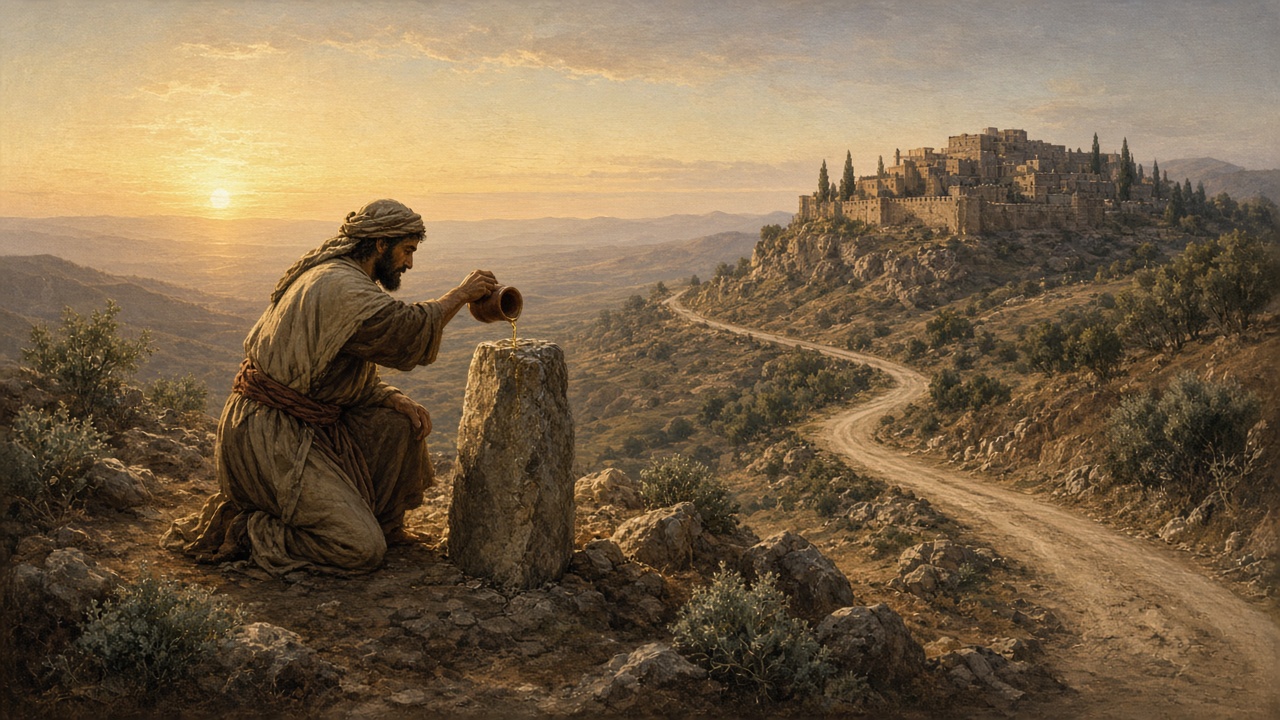
20Hidi na kon, Yakob nikit sumpa noan, “Eta Ama Lamtua Allah leo-leo nol au, le doha-tinang auk se auk lalan in lako nia, hidim bel auk in kaa nol kai-baut in pake, 21didiin auk pait nol boa-blingin nam, mam AMA LAMTUA daid auk Lamtuan Allah. 22Baut man auk in pii nia, daid maan in todan-lahing Ama Lamtua Allah. Nol totoang man Ama Lamtua in bel au ngas, op hngulu lam, auk bel pait op mesa.”
Did you know?
Jacob's Journey and Dream at Bethel
- Isaac sent Jacob from Beersheba to Paddan-aram to take a wife from the daughters of Laban, his mother Rebekah's brother, rather than from the Canaanite women. Paddan-aram, called the plain of Aram, is commonly regarded as the Mesopotamian district around Haran, where Laban lived; Haran, also called the city of Nahor, was where Abraham stayed after leaving Ur until his father Terah died.Sources: the Bible text itself · Paddan-aram · Haran · Laban
- The place where Jacob dreamed, set up as a pillar the stone he had put under his head, and poured oil on it was the royal Canaanite city of Luz; he renamed it Bethel. Easton's Bible Dictionary (1897) locates Bethel in central Palestine, about ten miles north of Jerusalem, and notes that the name was at first apparently given to a sanctuary in the neighborhood of Luz, and was not given to the city itself until after the tribe of Ephraim conquered it.Sources: the Bible text itself · Luz · Bethel (of Palestine)
- When Esau learned that Isaac had blessed Jacob and ordered him not to marry a Canaanite woman, he went to Ishmael and married Mahalath, sister of Nebaioth and daughter of Abraham's son Ishmael, in addition to the wives he already had. Easton's Bible Dictionary (1897) also calls her Bashemath and notes that Esau's three wives receive different names in the Edomite genealogy of Genesis 36 from those given in the narrative of Genesis 26 and 28.Sources: the Bible text itself · Bashemath
Notes written with AI assistance from open sources (Theographic Bible Metadata, CC BY-SA 4.0; Easton’s Bible Dictionary, public domain) and reviewed before publishing.
Places in this chapter
- Canaan · 32.767, 35.333 · verses 1, 6, 8
- Haran · Today: Harran · 36.864, 39.033 · verse 10
- Luz · Today: Beitin · 31.923, 35.241 · verse 19
Only places identified with high confidence are shown (90% or more according to the scholarly sources compiled by OpenBible). Period map: DARE (Digital Atlas of the Roman Empire), CC BY 4.0; modern map: © OpenStreetMap contributors; places: OpenBible.info (CC BY 4.0).
Credits and license for this translation
Buk Niu In Hida Balu nol Dehet deng Apan-kloma ki in Dadi ka
Genesis and the New Testament in Helong
Kejadian dan Perjanjian Baru dalam bahasa Helong
copyright © 2011 Unit Bahasa dan Budaya
Language: Helong
Translation by: Wycliffe Bible Translators, Inc.
This translation is made available to you under the terms of the
Creative Commons Attribution-No Derivatives license 4.0.
You may share and redistribute this Bible translation or extracts from it in any format, provided that:
You include the above copyright and source information.
You do not make any derivative works that change any of the actual words or punctuation of the Scriptures.
Pictures included with Scriptures and other documents on this site are licensed just for use with those Scriptures and documents.
For other uses, please contact the respective copyright owners.
2022-03-11
Source: http://ebible.org/hegNTpo/ · eBible.org