Psalms 1
Biblica® Buɗaɗɗen Littafi Mai Tsarki, Sabon Rai Don Kowa™ · Tap a verse to see its cross-references.
About this book
About Psalms
- Easton's Bible Dictionary (1897) presents the Psalms as the work of various authors, owed especially to David and his contemporaries, while poets of later generations added further songs. Easton remarks that, for this reason, the collection more completely reflects every phase of human emotion and circumstance than it otherwise could. The titles ascribe 73 psalms to David; Easton also notes that Peter and John (Acts 4:25) attribute the anonymous Psalm 2 to him, and that about two-thirds of the collection have been ascribed to David.Sources: Easton: Psalms
- Easton's Bible Dictionary (1897) holds that no psalm can be proved later than the time of Ezra and Nehemiah, so the collection spans about a thousand years. It records the presumption that the five smaller collections were made at times of high religious life: the first near the close of David's life, the second in the days of Solomon, the third by the singers of Jehoshaphat, the fourth by the men of Hezekiah, and the fifth in the days of Ezra.Sources: Easton: Psalms
- Like the Pentateuch, the Psalter is divided into five books, each closing with a doxology or benediction: Psalms 1-41, 42-72, 73-89, 90-106, and the remaining 44. Easton reports many ascriptions to David, to Solomon in Psalms 72 and 127, to Moses in Psalm 90, to Heman the Ezrahite in Psalm 88, and to Ethan the Ezrahite in Psalm 89, while many other psalms are anonymous.Sources: Easton: Psalms
- Some titles connect psalms with singers of worship. Psalms 50 and 73-83 are addressed to Asaph, a Levite and one of the leaders of David's choir, skilled in music and called a seer; the Asaph entry says the sons of Asaph were his descendants or, more probably, a class of poets or singers who recognized him as their master. The sons of Korah, a leading part of the Kohathite singers, were entrusted with arranging and singing Psalms 42, 44-49, 84, 85, 87, and 88, and Psalms 39, 62, and 77 are addressed to Jeduthun, to be sung after his manner or in his choir.Sources: Easton: Psalms · Asaph (Levite)
- Psalm 136 is generally called the great hallel, though the Talmud also includes Psalms 120-135. Psalms 113-118 form the hallel recited at the three great feasts, at the new moon, and on the eight days of the feast of dedication. Easton counts 116 direct quotations from the Psalter in the New Testament, and notes that in Luke 24:44 the word psalms means the Hagiographa, the holy writings, one of the sections into which the Jews divided the Old Testament.Sources: Easton: Psalms
Notes written with AI assistance from open sources (Theographic Bible Metadata, CC BY-SA 4.0; Easton’s Bible Dictionary, public domain) and reviewed before publishing.
LITTAFI NA ƊAYA
1Mai farin ciki ne mutumin
da ba ya aiki da shawarar mugaye
ko yă yi abin da masu zunubi suke yi
ko yă zauna tare da masu yin ba’a.
2Amma yana jin daɗin bin dokar Ubangiji,
kuma yana ta nazarinta dare da rana.
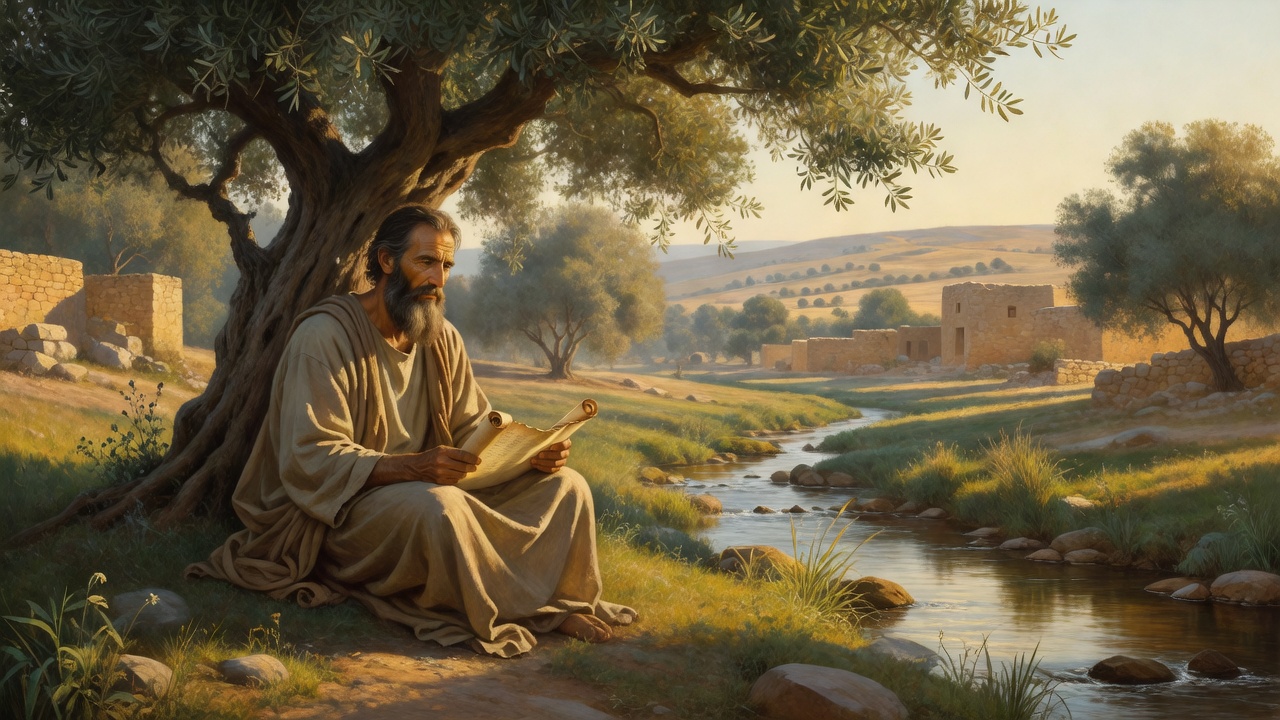
3Yana kama da itacen da aka shuka kusa da maɓulɓulan ruwa,
wanda yake ba da amfani a daidai lokaci
wanda kuma ganyensa ba sa bushewa.
Duk abin da yake yi, yakan yi nasara.
4Ba haka yake da mugaye ba!
Su kamar yayi ne
da iska take kwashewa.
5Saboda haka mugaye ba za su iya tsayawa a shari’a ba,
balle a sami masu zunubi a taron adalai.
6Gama Ubangiji yana lura da yadda adalai suke yin abubuwa,
amma ayyukan mugaye za su kai su ga hallaka.
Did you know?
The Two Paths
- Psalm 1 contrasts two ways of living through vivid agricultural imagery: the righteous person is compared to a fruitful tree nourished beside streams of water, while the wicked are likened to light chaff easily blown away by the wind.Sources: the Bible text itself
- The opening verses describe a clear progression away from evil—refusing to walk in the counsel of the wicked, stand in the path of sinners, or sit among mockers—and turning instead to constant meditation on the Law of the LORD.Sources: the Bible text itself
Notes written with AI assistance from open sources (Theographic Bible Metadata, CC BY-SA 4.0; Easton’s Bible Dictionary, public domain) and reviewed before publishing.
Credits and license for this translation
Biblica® Buɗaɗɗen Littafi Mai Tsarki, Sabon Rai Don Kowa™ Hausa: Biblica® Buɗaɗɗen Littafi Mai Tsarki, Sabon Rai Don Kowa™ (Bible) of Nigeria copyright © 2009, 2020 Biblica, Inc. Language: Hausa Contributor: Biblica, Inc. An sami wannan aiki a sauƙaƙe a ƙarƙashin lasisin Ƙasa da ƙasa na Lasisin Creative Commons Attribution-ShareAlike 4.0 na Ƙasa da ƙasa (CC BY-SA). Don a ga kwafin wannan lasisi, a ziyarci: http://creativecommons.org/licenses/by-sa/4.0 ko kuma a aika ta wasiƙa zuwa ga Creative Commons, PO Box 1866, Mountain View, CA 94042, USA. “Biblica” wani tambarin ne da aka yi wa rajista ta hannun Biblica, Inc., kuma yin amfani da tambarin Biblica® na bukata rubutaccen izinin Biblica, Inc. A ƙarƙashin sharaɗin lasisin CC BY-SA, za ka iya kwafa ka kuma sāke raba wannan aikin da ba a gyaggyara ba muddin ba ka taɓa tambarin nan na Biblica® ba. Idan ka gyara wani kwafi ko ka juya wannan aiki, ta wurin kirkiro da aikin da aka samu, dole ne ka ka cire tambarin Biblica®. A aikin da aka samo, dole ne ka nuna canje-canjen da ka yi, ka kuma nuna aikin haka: “Ainihi aikin ta hannun Biblica, Inc. yana nan kyauta a www.biblica.com da buɗaɗɗen Littafi Mai Tsarki.” Dole sharaɗin neman izini ya fita a kan kan magana ko kuma a shafi neman izinin aiki kamar haka: Biblica® Buɗaɗɗen Littafi Mai Tsarki, Sabon Rai Don Kowa™ Neman RubutaccenIzini © 2009, 2020 ta hannun Biblica, Inc. Biblica® Open Hausa Contemporary Bible™ Copyright © 2009, 2020 by Biblica, Inc. “Biblica” wani tambarin ne da aka yi wa rajista a ofishi Lamba Ƙerar da Tambari a Amurka ta hannun Biblica, Inc. Wanda aka yi amfani ta wurin samun izini. “Biblica” is a trademark registered in the United States Patent and Trademark Office by Biblica, Inc. Used with permission. Dole kuma a samo aikin da ka yi daga ainihin aikin a ƙarƙashin wannan lasisi (CC BY-SA). Idan za ka so ka sanar da Biblica, Inc. dangane da juyinka na wannan aiki, sai ka tuntuɓe mu a https://open.bible/contact-us. This work is made available under the Creative Commons Attribution-ShareAlike 4.0 International License (CC BY-SA). To view a copy of this license, visit http://creativecommons.org/licenses/by-sa/4.0 or send a letter to Creative Commons, PO Box 1866, Mountain View, CA 94042, USA. Biblica® is a trademark registered by Biblica, Inc., and use of the Biblica® trademark requires the written permission of Biblica, Inc. Under the terms of the CC BY-SA license, you may copy and redistribute this unmodified work as long as you keep the Biblica® trademark intact. If you modify a copy or translate this work, thereby creating a derivative work, you must remove the Biblica® trademark. On the derivative work, you must indicate what changes you have made and attribute the work as follows: “The original work by Biblica, Inc. is available for free at www.biblica.com and open.bible.” Notice of copyright must appear on the title or copyright page of the work as follows: Biblica® Buɗaɗɗen Littafi Mai Tsarki, Sabon Rai Don Kowa™ Neman RubutaccenIzini © 2009, 2020 ta hannun Biblica, Inc. Biblica® Open Hausa Contemporary Bible™ Copyright © 2009, 2020 by Biblica, Inc. “Biblica” wani tambarin ne da aka yi wa rajista a ofishi Lamba Ƙerar da Tambari a Amurka ta hannun Biblica, Inc. Wanda aka yi amfani ta wurin samun izini. “Biblica” is a trademark registered in the United States Patent and Trademark Office by Biblica, Inc. Used with permission. You must also make your derivative work available under the same license (CC BY-SA). If you would like to notify Biblica, Inc. regarding your translation of this work, please contact us at https://open.bible/contact-us. This translation is made available to you under the terms of the Creative Commons Attribution Share-Alike license 4.0. You have permission to share and redistribute this Bible translation in any format and to make reasonable revisions and adaptations of this translation, provided that: You include the above copyright and source information. If you make any changes to the text, you must indicate that you did so in a way that makes it clear that the original licensor is not necessarily endorsing your changes. If you redistribute this text, you must distribute your contributions under the same license as the original. Pictures included with Scriptures and other documents on this site are licensed just for use with those Scriptures and documents. For other uses, please contact the respective copyright owners. Note that in addition to the rules above, revising and adapting God's Word involves a great responsibility to be true to God's Word. See Revelation 22:18-19. 2025-05-03
Source: http://ebible.org/hausa/ · eBible.org