Malachi 1
Bib Sen An · Tap a verse to see its cross-references.
About this book
About Malachi
- Easton's Bible Dictionary (1897) presents Malachi, a name meaning "messenger" or "angel," as the last of the minor prophets and the writer of the last book of the Old Testament canon. Nothing is known of him beyond what is contained in his book of prophecies.Sources: Easton: Malachi · Malachi
- Some have supposed that the name is simply a title for a messenger of Jehovah, not a proper name. Easton's Bible Dictionary (1897) concludes, however, that there is reason to regard Malachi as the prophet's ordinary name.Sources: Easton: Malachi · Malachi
- Easton's Bible Dictionary (1897) dates the prophecies to about 420 B.C., after Nehemiah's second return from Persia, or possibly before that return. Because Ezra does not mention him and he does not mention the restoration of the temple, the dictionary infers that he prophesied after Haggai and Zechariah.Sources: Easton: Malachi
- Easton's Bible Dictionary (1897) treats Malachi as a contemporary of Nehemiah, comparing Malachi 2:8 with Nehemiah 13:15 and Malachi 2:10-16 with Nehemiah 13:23. It also notes that the temple services were still in existence, citing Malachi 1:10, 3:1 and 3:10.Sources: Easton: Malachi
Notes written with AI assistance from open sources (Theographic Bible Metadata, CC BY-SA 4.0; Easton’s Bible Dictionary, public domain) and reviewed before publishing.
1Revelasyon pawòl SENYÈ a bay Israël pa Malachie.
2“Mwen te renmen nou,” pale SENYÈ a.
Men ou di: “Nan kisa ou te renmen nou an?”
“Se pa Ésaü ki te frè Jacob?” deklare SENYÈ a. “Men se Jacob Mwen te renmen; 3men Mwen te rayi Ésaü. Mwen te fè mòn li yo vin yon kote dezole, e Mwen te livre eritaj li bay chen mawon dezè yo.” 4Tandiske Edom di: “Yo fin bat nou nèt, men nou va retounen vin bati sou ranblè yo;” konsa pale SENYÈ Dèzame yo: “Yo va bati, men mwen va jete; konsa, moun va rele yo peyi mechan an, e pèp sou sila SENYÈ a fache pou tout tan an.”
5Zye nou va wè sa e nou va di: “SENYÈ a gran, menm pi lwen lizyè Israël la!”
6“Yon fis onore papa li, e yon sèvitè onore mèt li. Alò, si Mwen se yon papa, kote onè pa M nan? Epi si Mwen se yon mèt, kote respè M nan?” pale SENYÈ Dèzame yo a prèt yo ki meprize non Mwen an. “Men nou di: ‘Nan kisa nou te meprize non Ou an?’ 7N ap ofri pen ki souye sou lotèl Mwen an. Men nou di: ‘Nan kisa nou te souye Ou a?’ Nan sa, n ap di: ‘Tab SENYÈ a meprizab.’ 8Lè nou ofri bèt avèg kon sakrifis la, èske sa pa yon mal? Epi lè nou ofri bèt ki bwate, e ki malad la, èske sa pa yon mal? Poukisa nou pa ofri sa yo bay gwo chèf peyi a? Èske l ap kontan avèk nou? Oswa, èske se ak dousè ak kè kontan ke l ap aksepte nou?” pale SENYÈ Dèzame yo.
9Men koulye a, chèche mande favè Bondye, pou Li kapab beni nou? Ak yon ofrann konsa, èske L ap aksepte okenn nan nou ak dousè? mande SENYÈ Dèzame yo.
10O ke te genyen youn nan nou pou ta fèmen pòt yo, pou nou pa ta chofe dife pou granmèsi sou lotèl Mwen an! “Mwen pa kontan avèk nou”, pale SENYÈ Dèzame yo. “Ofrann nan k ap sòti nan men nou, Mwen p ap aksepte l nonpli. 11Paske depi solèy la leve jis rive kote li kouche a, non Mwen va gran pami nasyon yo, e tout kote, lansan ak ofrann sereyal ki san tach va vin ofri a non Mwen. Paske non Mwen va gran pami nasyon yo,” pale SENYÈ Dèzame yo. 12“Men nou ap pwofane li lè nou di: ‘Tab SENYÈ a vin souye, fwi li, menm manje li vin meprizab.’ 13Nou di tou: ‘Gade, a la fatigan sa fatigan!’ Nou pa vle menm pran sant li,” pale SENYÈ Dèzame yo. “Konsa, nou te pote sa ke yo te pran nan vyolans, sa ki te bwate ak sa ki te malad. Konsa menm, nou pote ofrann nan! Èske se sa ke Mwen ta dwe aksepte nan men nou an?” pale SENYÈ a.
14“Men malè pou sila k ap twonpe a, ki gen nan bann mouton li an, yon mal, ki fè sèman pou livre li, men ki anfen, fè sakrifis bay SENYÈ a ak yon bèt ki gen defo. Paske Mwen se yon gwo Wa,” pale SENYÈ Dèzame yo, “e non Mwen etonan pami nasyon yo.”
Did you know?
Honoring God and Defective Offerings
- The name Malachi means messenger or angel. While some have suggested it was a title rather than a proper name, scholars and traditions widely treat it as the prophet's personal name, placing his ministry during the period of Nehemiah, after Haggai and Zechariah.Sources: Malachi
- The opening dispute recalls the twin brothers Jacob and Esau, the ancestors of Israel and Edom. The text contrasts God's covenant love for Israel with the judgment and desolation coming upon the mountainous region of Edom.Sources: Esau (Edom) · Jacob (Israel) · Edom · the Bible text itself
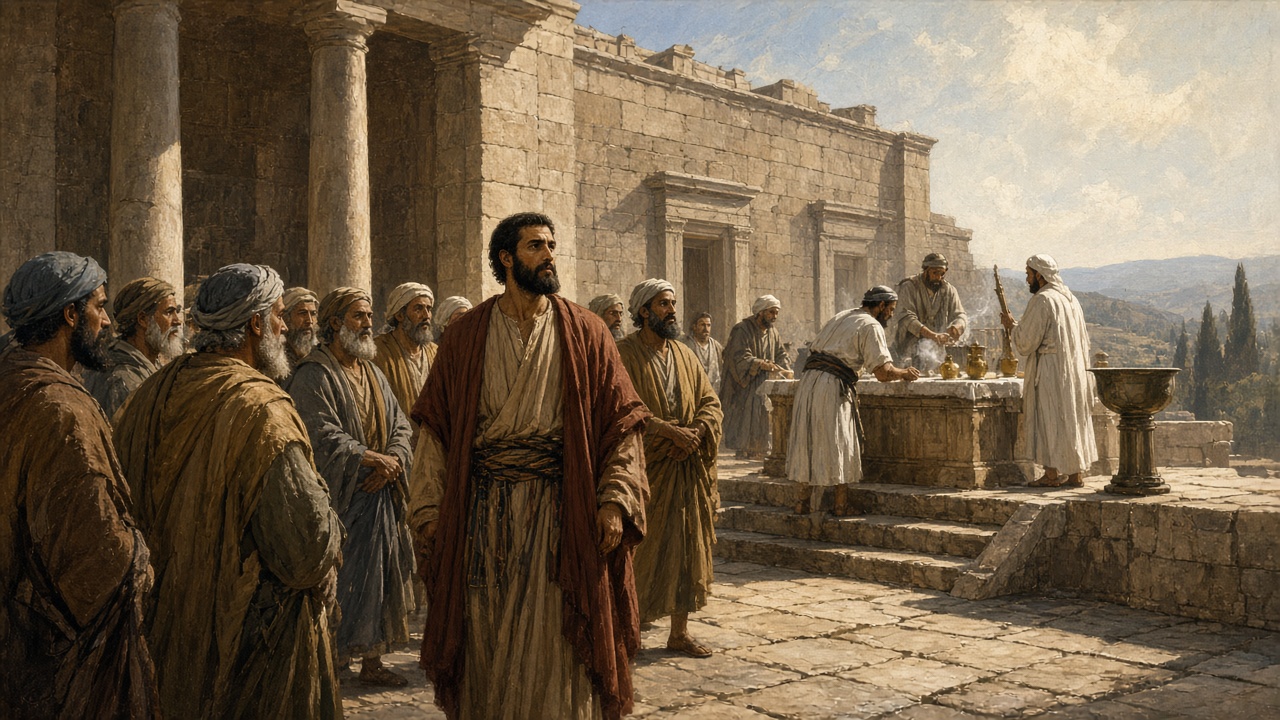
- The priests are rebuked for offering blind, lame, and diseased animals on the altar rather than unblemished livestock. Malachi exposes their disrespect by asking whether a civil governor would accept such inferior gifts.Sources: the Bible text itself
Notes written with AI assistance from open sources (Theographic Bible Metadata, CC BY-SA 4.0; Easton’s Bible Dictionary, public domain) and reviewed before publishing.
Places in this chapter
- Edom · 30.746, 35.604 · verse 4
Only places identified with high confidence are shown (90% or more according to the scholarly sources compiled by OpenBible). Period map: DARE (Digital Atlas of the Roman Empire), CC BY 4.0; modern map: © OpenStreetMap contributors; places: OpenBible.info (CC BY 4.0).
Credits and license for this translation
Bib Sen An
The Holy Bible in Haitian Creole, 2023 update
copyright © 2017-2023 Ron Smith
Language: Kreyòl Ayisyen (Haitian)
Translation by: Ron Smith
Contributor: Felix Nixon
This translation is made available to you under the terms of the
Creative Commons Attribution Share-Alike license 4.0.
You have permission to share and redistribute this Bible translation in any format and to make reasonable revisions and adaptations of this translation, provided that:
You include the above copyright and source information.
If you make any changes to the text, you must indicate that you did so in a way that makes it clear that the original licensor is not necessarily endorsing your changes.
If you redistribute this text, you must distribute your contributions under the same license as the original.
Pictures included with Scriptures and other documents on this site are licensed just for use with those Scriptures and documents.
For other uses, please contact the respective copyright owners.
Note that in addition to the rules above, revising and adapting God's Word involves a great responsibility to be true to God's Word. See Revelation 22:18-19.
2026-06-11
Source: http://ebible.org/hatbsa/ · eBible.org