Isaiah 5
Bib Sen An · Tap a verse to see its cross-references.
1Kite mwen chante koulye a pou byeneme mwen an, selon chan rezen Li.
Byeneme m nan te gen yon chan rezen sou yon kolin byen fètil.
2Li te fouye toupatou li,
retire wòch li yo,
e te plante li avèk pye rezen pi chwazi a.
Li te bati yon fò nan mitan l,
e te fouye yon basen diven ladann.
Alò, li te sipoze pou l ta pwodwi bon rezen yo,
men li te pwodwi sèlman sa ki pa bon.
3Konsa, O abitan Jérusalem yo ak mesye Juda yo,
jije antre Mwen menm ak chan rezen Mwen an.
4Kisa anplis ki gen pou fèt pou chan rezen Mwen an ke M pa t fè deja?
Poukisa lè M te atann a bon rezen yo,
li te vin pwodwi sa ki pa bon yo?
5Pou sa a, kite Mwen di nou koulye a sa M ap fè ak chan rezen sa a:
Mwen va retire kloti li e li va brile;
Mwen va kraze miray li e li va vin foule nèt.
6Mwen va gaye gate l nèt.
Li p ap koupe ni sèkle ak wou,
men pikan ak zepin va vin leve nan li.
Anplis, Mwen va pase lòd sou nwaj yo
pou lapli pa tonbe ladann.
7Paske chan rezen SENYÈ dèzame yo se lakay Israël,
e pèp Juda a se plant ki ba Li plezi a.
Konsa, Li t ap chache jistis;
men olye sa Li te jwenn san vèse;
pou ladwati, men olye sa, moun k ap rele “Anmwey”.
8Malè a sila ki ogmante kay sou kay
ak chan a sou lòt chan,
jiskaske pa gen plas,
pou ou oblije rete sèl nan mitan peyi a!
9Nan zòrèy mwen SENYÈ dèzame yo te sèmante:
“Anverite, anpil kay va vin vid;
menm sa ki bèl yo, san moun pou rete ladann.
10Paske kat ekta tèren p ap donnen plis ke yon bat (22 lit) diven
e yon omè (220 lit) p ap bay plis ke yon efa (22 lit) sereyal.”
11Malè a sila ki leve granmaten yo
pou yo ka kouri dèyè bwason fò,
sila ki rete kanpe tan lannwit pou diven an ka anflame yo.
12Gwo fèt pa yo akonpanye ak jwe gita ak ap, tanbouren, flit ak diven;
men yo pa okipe zèv SENYÈ yo,
ni yo pa konsidere zèv men Li yo.
13Pou sa, pèp Mwen an antre an egzil akoz mank konesans yo;
epi mesye ki gen onè yo
rete grangou e foul moun yo rete sèch ak swaf.
14Pou sa, Sejou mò yo vin fè gòj li pi gwo
e louvri bouch li jiskaske li pa ka kontwole;
epi bèlte a Jérusalem, tout pèp li a,
ak gwo kri kè kontan yo, vin desann ladann.
15Pou sa, tout moun yo va imilye e limanite va abese;
anplis, zye a ògeye a va vin febli nèt.
16Men SENYÈ dèzame yo va leve wo nan jijman
e Bondye sen an va montre sentete Li nan ladwati.
17Konsa, jèn mouton yo va manje alèz konsi se nan chan patiraj
e etranje yo va manje pami ansyen mazi a moun rich yo.
18Malè a sila ki rale inikite ak kòd manti,
e ki fè peche tankou se kòd kabwèt;
19K ap di: “Kite Li fè vit,
kite Li prese fè travay Li pou nou ka wè;
kite volonte a Sila Ki Sen an Israël la
vin rapwoche pou fè sa rive pou nou ka konnen!”
20Malè a sila ki rele mal la bon,
ak bon an mal la;
sila ki prezante tenèb la tankou limyè a,
ak limyè a kon tenèb la;
sila ki prezante sa ki anmè a kon dous,
e sa ki dous kon anmè.
21Malè a sila ki saj nan pwòp zye yo
e ki sipoze ke yo byen koken yo!
22Malè a sila ki vanyan nan bwè gwòg la
e gen gwo kouraj nan mele bwason fò a,
23sila ki jistifye mechan yo pou kòb glise anba tab
e ki rachte dwa a sila ki gen rezon yo!
24Akoz sa, tankou lang dife a manje pay sèch yo
e konsonmen zèb sèch nan flanm nan,
konsa rasin yo va vin tankou pouriti,
e flè yo va vannen ale tankou pousyè;
paske yo fin rejte lalwa SENYÈ dèzame yo,
e te rayi pawòl a Sila Ki Sen An Israël la.
25Akoz sa, kòlè SENYÈ a te brile kont pèp Li a,
Li te lonje men l kont yo e te frape yo tonbe anba.
Mòn yo te tranble
e kadav yo te kouche tankou fatra nan mitan lari a.
Menm ak tout sa a, kòlè Li a poko fin pase, men men L toujou lonje.
26Konsa, Li va leve yon drapo a yon nasyon byen lwen
e Li va soufle pou li soti nan dènye pwent latè;
epi gade byen, li va vini byen vit ak gwo vitès.
27Nan nasyon sila a, nanpwen moun ki ni fatige, ni tonbe;
nanpwen moun k ap kabicha oswa k ap dòmi;
ni sentiwon nan senti li pa lage,
menm bretèl sandal li pa janm kase.
28Flèch li yo file e tout banza li yo fin koube;
pye cheval li yo parèt kon pyè silèks,
e wou cha li yo tankou toubiyon.
29Kri gwonde li tankou yon lyon
e vwa li tankou jèn lyon;
li fè gwo bri pandan l ap sezi viktim li an
e pote l ale kote nanpwen moun pou delivre li.
30Epi li va gwonde sou li nan jou sa a tankou gwo bri lanmè.
Si yon moun anwò dlo ta gade vè latè;
men gade, tout fènwa ak gwo twoub.
Menm limyè fènwa akoz nwaj li yo.
Did you know?
The Song of the Vineyard and the Six Woes
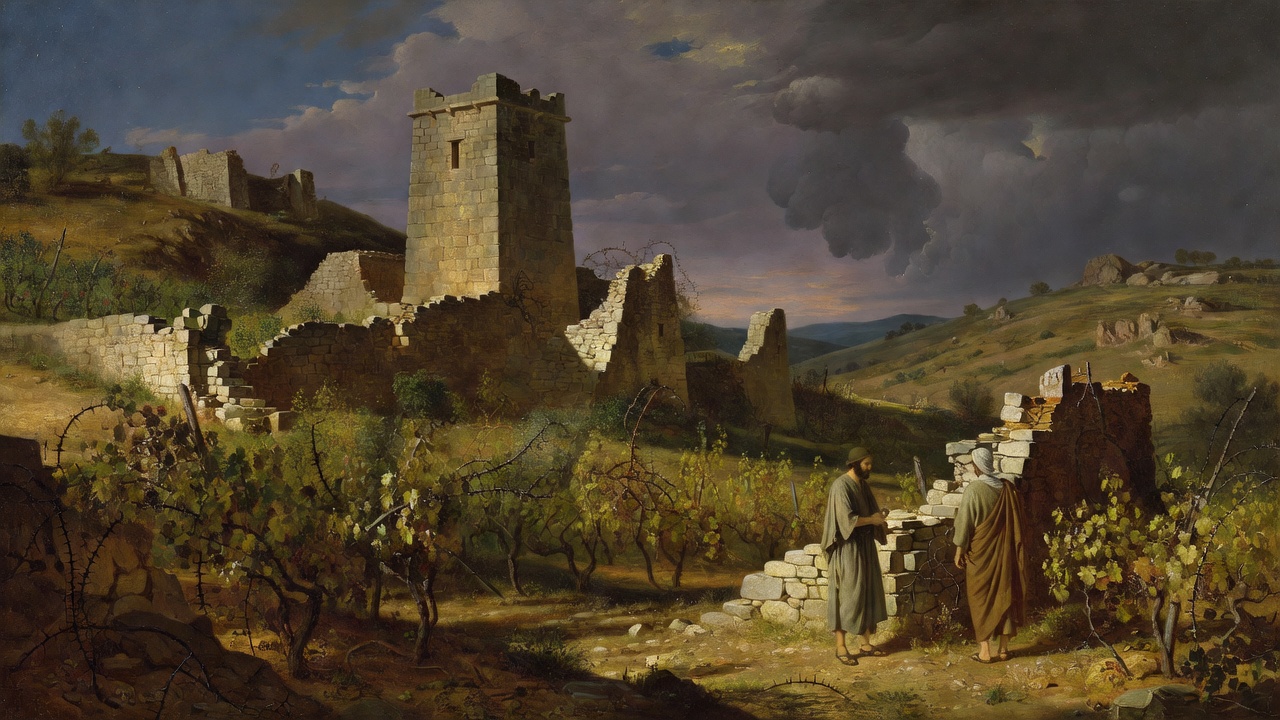
- The opening song in Isaiah 5 describes the elaborate labor of ancient Judean viticulture: clearing rocky hillsides of stones, building a protective stone watchtower, digging out a winepress in the bedrock, and planting prime vines surrounded by a protective hedge and wall. The poem turns into a legal parable where the vineyard represents the house of Israel and the people of Judah, from whom justice was expected instead of bloodshed.Sources: the Bible text itself
- The chapter delivers a series of six prophetic laments or woes, condemning specific social and moral abuses in Judah. These include wealthy landowners consolidating real estate by adding house to house and field to field, judges taking bribes to acquit the guilty while denying justice to the innocent, and leaders indulging in lavish feasting while ignoring divine instruction.Sources: the Bible text itself
- Isaiah's prophetic ministry in Jerusalem addressed the people of Judah over an extended period beginning in the mid-eighth century BC. The chapter concludes with a warning that the Lord would signal distant, disciplined foreign armies equipped with chariots, bows, and swift horses to execute judgment on the land.Sources: Jerusalem · Prophecies of Isaiah · the Bible text itself
Notes written with AI assistance from open sources (Theographic Bible Metadata, CC BY-SA 4.0; Easton’s Bible Dictionary, public domain) and reviewed before publishing.
Places in this chapter
Only places identified with high confidence are shown (90% or more according to the scholarly sources compiled by OpenBible). Period map: DARE (Digital Atlas of the Roman Empire), CC BY 4.0; modern map: © OpenStreetMap contributors; places: OpenBible.info (CC BY 4.0).
Credits and license for this translation
Bib Sen An
The Holy Bible in Haitian Creole, 2023 update
copyright © 2017-2023 Ron Smith
Language: Kreyòl Ayisyen (Haitian)
Translation by: Ron Smith
Contributor: Felix Nixon
This translation is made available to you under the terms of the
Creative Commons Attribution Share-Alike license 4.0.
You have permission to share and redistribute this Bible translation in any format and to make reasonable revisions and adaptations of this translation, provided that:
You include the above copyright and source information.
If you make any changes to the text, you must indicate that you did so in a way that makes it clear that the original licensor is not necessarily endorsing your changes.
If you redistribute this text, you must distribute your contributions under the same license as the original.
Pictures included with Scriptures and other documents on this site are licensed just for use with those Scriptures and documents.
For other uses, please contact the respective copyright owners.
Note that in addition to the rules above, revising and adapting God's Word involves a great responsibility to be true to God's Word. See Revelation 22:18-19.
2026-06-11
Source: http://ebible.org/hatbsa/ · eBible.org