Haggai 2
Bib Sen An · Tap a verse to see its cross-references.
1Nan venteyen jou nan setyèm mwa a, pawòl SENYÈ a te vin kote Aggée, pwofèt la. Li te di: 2“Pale koulye a a Zorobabel, fis a Schealthiel la, gouvènè a Juda a, a Josué, fis a Jotsadak la, wo prèt la e a retay a pèp la e di: 3‘Se kilès ki rete pami nou ki te wè tanp sa a lontan nan tout glwa li? Se kijan nou wè li koulye a? Èske li pa vin pa sanble anyen nan zye nou? 4Men koulye a, se pou ou vin dyanm, Zorobabel,’ deklare SENYÈ a: ‘Se pou ou vin dyanm, ou menm tou, Josué, fis a Jotsadak la, wo prèt la, e tout pèp peyi a, se pou nou vin dyanm,’ deklare SENYÈ a: ‘epi travay, paske Mwen avèk nou,’ deklare SENYÈ dèzame yo. 5Selon pwomès ke M te fè nou an, depi lè nou te sòti nan peyi Égypte la, Lespri M t ap viv pami nou. ‘Pa pè anyen!’ 6Paske konsa pale SENYÈ dèzame yo: ‘Yon fwa ankò nan yon ti tan, Mwen va souke syèl yo, tè a, lanmè a ak tè sèch la. 7Mwen va souke tout nasyon yo. Konsa, gwo richès de tout nasyon yo va vini, e Mwen va plen kay sa a ak glwa,’ pale SENYÈ dèzame yo. 8‘Ajan se pa M, e lò se pa M’, deklare SENYÈ dèzame yo. 9‘Dènye glwa kay sa a, va pi gran ke ansyen an,’ pale SENYÈ dèzame yo: ‘Epi nan plas sa a, Mwen va bay Lapè’, deklare SENYÈ dèzame yo.”
10Nan venn-kat nan nevyèm mwa a, nan dezyèm ane Darius la, pawòl SENYÈ a te vini a Aggée, pwofèt la. Li te di: 11“Konsa pale SENYÈ dèzame yo: ‘Kounye a mande prèt yo konsènan Lalwa a. Mande yo: 12Si yon nonm pote vyann sakre vlope nan ke wòb li, e avèk ke wòb li, li touche pen, manje kwit, diven, lwil, oswa nenpòt lòt manje, èske sa ki touche pa li menm va vin sakre?’”
Prèt yo te reponn: “Non”.
13Anplis, Aggée te mande: “Si yon moun ki pa pwòp akoz yon kadav, ta touche nenpòt bagay nan sa yo, èske moun sa va pa pwòp?”
Prèt yo te reponn: “Yo va vin pa pwòp.”
14Epi Aggée te di: “‘Se konsa pèp sa a ye. Epi se konsa nasyon sa a ye devan Mwen,’ deklare SENYÈ a: ‘Anplis, se konsa tout zèv men yo, ak sa ke yo ofri la yo, vin pa pwòp. 15Alò, koulye a, m ap priye nou byen konsidere sa soti nan jou sa a pou gade dèyè nèt: avan yon sèl wòch te plase sou yon wòch sou tanp SENYÈ a. 16Pandan tout tan sa a, lè yon moun te rive sou yon pil sereyal ak ven mezi, te gen sèlman dis. Lè yon moun te rive sou gwo ja diven, pou rale retire senkant mezi, te gen sèlman ven. 17Tout zèv ki te fèt ak men nou yo, Mwen te frape ak destriksyon, lakanni, ak lagrèl. Malgre sa, nou pa t retounen vin jwenn Mwen,’ deklare SENYÈ a. 18‘Byen konsidere sa, m ap priye nou. Soti nan jou sa a gade dèyè nèt, soti nan venn-katriyèm jou nan nevyèm mwa a; depi jou lè tanp SENYÈ a te fonde a, konsidere sa: 19Èske semans lan gen tan rive nan depo a? Menm pye rezen an, pye fig etranje a, pye grenad ak bwa doliv la, pa reyisi pote anyen. Malgre sa, soti nan jou sila a, Mwen va beni nou.’”
20Konsa, pawòl SENYÈ a te vini yon dezyèm fwa a Aggée nan venn-katriyèm jou nan mwa a e te di: 21“Pale ak Zorobabel, gouvènè a Juda a e di: ‘Mwen va souke syèl yo ak tè a. 22Mwen va boulvèse twòn a wayòm yo, e detwi pouvwa wayòm a nasyon yo. Epi Mwen va boulvèse cha lagè yo ansanm ak sila k ap kondwi cha yo. Cheval yo ak chevalye yo va tonbe, yo tout pa nepe a frè yo.’ 23‘Nan jou sa a,’ deklare SENYÈ dèzame yo: “Mwen va pran ou, Zorobabel, fis a Schealthiel la, sèvitè Mwen an,’ deklare SENYÈ a. ‘Epi konsa, Mwen va fè ou vin tankou yon bag so, paske Mwen te chwazi ou,’ deklare SENYÈ dèzame yo.”
Did you know?
The Promise of Future Glory
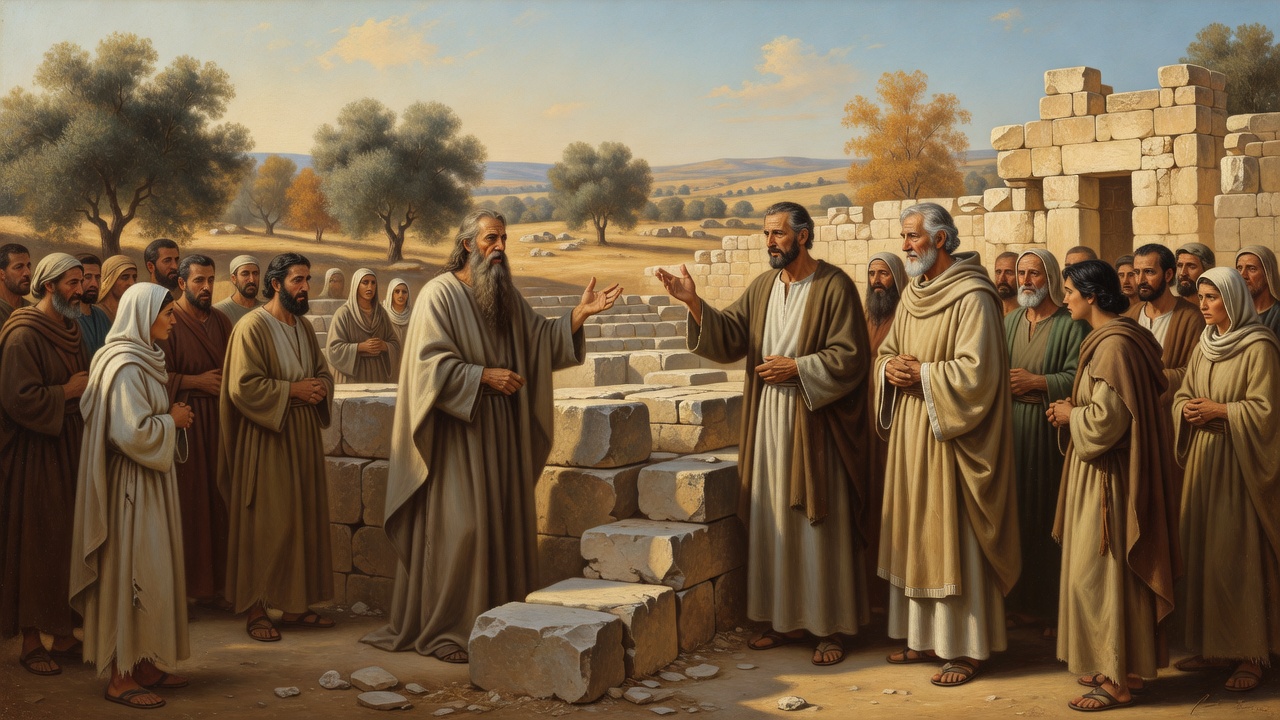
- When the foundation of the second temple was laid after the return from Babylon, older members of the community could still remember the magnificence of the original temple destroyed by Nebuchadnezzar. In response to their discouragement at the modest new structure, Haggai declared that the future glory of this house would surpass its former splendor.Sources: the Bible text itself · Zerubbabel · Haggai
- Haggai consulted the priests on questions of ritual law to illustrate a moral point. According to their rulings, holiness was not easily transmitted through indirect contact, whereas ceremonial defilement—such as from touching a corpse—spread immediately, mirroring how their past neglect had affected their offerings and harvests.Sources: the Bible text itself
- The restoration of the community was led by two key figures: Zerubbabel son of Shealtiel, who served as the civil governor, and Joshua son of Jehozadak, the high priest. At the end of the chapter, Haggai addresses Zerubbabel with the royal imagery of a signet ring, symbolizing divine authority and choice.Sources: the Bible text itself · Zerubbabel · Joshua
Notes written with AI assistance from open sources (Theographic Bible Metadata, CC BY-SA 4.0; Easton’s Bible Dictionary, public domain) and reviewed before publishing.
Places in this chapter
- Egypt · 30.129, 31.308 · verse 5
Only places identified with high confidence are shown (90% or more according to the scholarly sources compiled by OpenBible). Period map: DARE (Digital Atlas of the Roman Empire), CC BY 4.0; modern map: © OpenStreetMap contributors; places: OpenBible.info (CC BY 4.0).
Credits and license for this translation
Bib Sen An
The Holy Bible in Haitian Creole, 2023 update
copyright © 2017-2023 Ron Smith
Language: Kreyòl Ayisyen (Haitian)
Translation by: Ron Smith
Contributor: Felix Nixon
This translation is made available to you under the terms of the
Creative Commons Attribution Share-Alike license 4.0.
You have permission to share and redistribute this Bible translation in any format and to make reasonable revisions and adaptations of this translation, provided that:
You include the above copyright and source information.
If you make any changes to the text, you must indicate that you did so in a way that makes it clear that the original licensor is not necessarily endorsing your changes.
If you redistribute this text, you must distribute your contributions under the same license as the original.
Pictures included with Scriptures and other documents on this site are licensed just for use with those Scriptures and documents.
For other uses, please contact the respective copyright owners.
Note that in addition to the rules above, revising and adapting God's Word involves a great responsibility to be true to God's Word. See Revelation 22:18-19.
2026-06-11
Source: http://ebible.org/hatbsa/ · eBible.org