Ezekiel 33
Bib Sen An · Tap a verse to see its cross-references.
1Konsa, pawòl SENYÈ a te rive kote mwen. Li te di: 2“Fis a lòm, pale a fis a pèp ou yo pou di yo: ‘Si Mwen mennen nepe sou yon peyi, e pèp peyi a pran yon nonm soti pami yo pou fè li gadyen yo, 3epi lè li wè nepe a ap vini sou peyi a, li soufle sou twonpèt pou avèti moun yo, 4men sila ki tande son twonpèt la pa okipe l, e nepe a rive pran l, mennen l ale, san li ap tonbe sou pwòp tèt li. 5Li te tande son twonpèt la men li pa t okipe l. San li va sou tèt li. Men si li te okipe sa a, li t ap sove lavi li. 6Men si gadyen an wè nepe a ap vini, e li pa sonnen twonpèt la, moun yo pa avèti, e nepe a rive retire nenpòt moun pami yo, moun nan soti nan inikite li. Men san li, Mwen va egzije sa a nan men gadyen an.’
7“Alò, pou ou menm, fis a lòm, Mwen te chwazi ou kon gadyen pou lakay Israël. Konsa, ou va tande yon mesaj soti nan bouch Mwen pou avèti yo pou Mwen. 8Lè M di a mechan an: ‘O nonm mechan anverite ou va mouri’, men ou pa pale pou avèti e detounen mechan an pou l ka kite chemen mechan li an, nonm mechan sa a va mouri nan inikite li, men san li, Mwen va egzije sa nan men ou. 9Men si ou, bò kote pa ou, ou avèti yon nonm mechan pou vire kite chemen li, e li pa vire kite chemen li an, li va mouri nan inikite li, men ou delivre lavi ou.
10“Alò, pou ou, fis a lòm, pale ak lakay Israël: ‘Pale konsa e di: “Anverite, transgresyon nou yo ak peche nou yo, sou nou, e nou ap pouri ladan yo. Donk kòman nou ka viv?”’ 11Pale ak yo: ‘“Jan Mwen viv la,” deklare Senyè BONDYE a: “Mwen pa pran plezi nan lanmò a mechan yo, men pito pou mechan an vire kite chemen li an pou li viv. Retounen, retounen kite chemen mechan nou yo! Poukisa konsa ou ta mouri, O lakay Israël?”’
12“Epi ou menm, fis a lòm, di a sitwayen parèy ou yo: ‘Ladwati a yon nonm dwat p ap ka delivre li nan jou transgresyon li. E mechanste a mechan an, li p ap tonbe akoz li, si li vire kite mechanste a. Ni yon nonm dwati p ap ka viv sou ladwati li nan jou ke li vin fè peche a.’ 13Lè Mwen di a nonm dwat la ke, anverite, li va viv la, e li tèlman kwè nan ladwati li pou li komèt inikite, okenn nan zèv dwat li yo p ap vin sonje; men nan menm inikite sa ke li te fè a, li va mouri. 14Men lè Mwen di a mechan an: “Anverite, ou va mouri,” e li vire kite peche li, pou vin pratike lajistis ak ladwati, 15si yon nonm mechan vin remèt sa li te pwomèt pou bay, remèt sa li te pran nan vòlè, mache nan règleman ki bay lavi san ke li pa komèt inikite, li va anverite viv. Li p ap mouri. 16Okenn nan peche ke li te komèt yo p ap vin sonje kont li. Li pratike lajistis ak ladwati. Anverite, li va viv.
17“‘Malgre sa, sitwayen parèy ou yo di: “Chemen Senyè a pa dwat,” men se pwòp chemen pa yo ki pa dwat la. 18Lè moun ladwati a kite ladwati pou komèt inikite, alò, li va mouri ladann. 19Men lè mechan an vire kite mechanste li an pou vin pratike lajistis ak ladwati, li va viv ladan yo. 20Men nou di: “Chemen SENYÈ a pa jis”. O lakay Israël, Mwen va jije nou chak selon chemen nou.’”
21Alò, nan douzyèm ane egzil nou an, nan senkyèm jou nan dizyèm mwa a, yon moun ki te chape Jérusalem te vin kote mwen. Li te di: “Yo fin pran vil la.” 22Alò, men SENYÈ a te sou mwen pandan nwit lan avan moun chape a te vin parèt la. Epi konsa, Li te louvri bouch mwen avan lè li te vin kote mwen nan maten an. Donk, bouch mwen te louvri e mwen pa t ankò bèbè.
23Epi pawòl SENYÈ a te vin kote mwen. Li te di: 24“Fis a lòm, sila kirete kote dezole sa yo nan peyi Israël ap di: ‘Abraham se te yon sèl, malgre sa, li te posede tè a. Men nou menm anpil. Peyi a te bay a nou.’ 25Pou sa, pale yo: ‘Konsa pale Senyè BONDYE a: “Nou manje vyann ak san ladann; nou leve zye nou vè zidòl yo pandan n ap vèse san. Èske konsa, nou ta dwe vin posede peyi a? 26Nou mete konfyans nou nan nepe nou, nou komèt zak abominab, e nou tout souye madanm a vwazen nou. Èske konsa, nou ta dwe posede peyi a?”’
27“Konsa ou va pale ak yo: ‘Konsa pale Senyè BONDYE a: “Jan Mwen viv la, anverite, sila ki nan savann yo va tonbe pa nepe. Nenpòt moun ki nan chan ouvri a, Mwen va bay li a bèt sovaj pou devore li, e sila ki nan sitadèl ak nan kav yo, yo va mouri akoz ensèk ak gwo maladi. 28Mwen va fè tè a vin dezole jis pou l etone moun. Ògèy a pouvwa li a va sispann. Mòn Israël yo va vin dezole jiskaske pèsòn p ap travèse yo. 29Konsa yo va konnen ke Mwen se SENYÈ a, lè M fè peyi a vin yon dezolasyon ak yon dezè akoz tout zak abominab ke yo te komèt yo.”’
30“Men pou ou menm, fis a lòm, sitwayen parèy ou yo ap pale de ou. Akote miray yo ak nan pòtay kay yo, y ap pale youn a lòt, yo chak a frè yo pou di: ‘Vini koulye a pou tande mesaj sila ki sòti nan SENYÈ a.’ 31Yo vin kote ou jan moun konn vini. Yo chita devan ou tankou pèp Mwen an pou yo tande pawòl ou. Men yo pa fè yo. Paske nan bouch, yo renmen, men kè yo ap kouri dèyè pwòp benefis pa yo. 32Gade byen, ou vin pou yo tankou yon chan sansyèl ki chante pa yon moun ak yon bèl vwa, byen jwe sou enstriman. Paske yo tande pawòl ou yo, men yo pa pratike yo.
33“Pou sa, lè a rive—gade byen, li va rive—alò, yo va konnen ke yon pwofèt te la nan mitan yo.”
Did you know?
The Watchman and the Fall of Jerusalem
- In ancient times, a watchman stationed on a city wall was tasked with blowing a ram's horn to warn residents of an approaching enemy. Ezekiel was appointed as a spiritual watchman for Israel, charged with warning the people so that each individual would be held personally accountable before God for their response.Sources: the Bible text itself
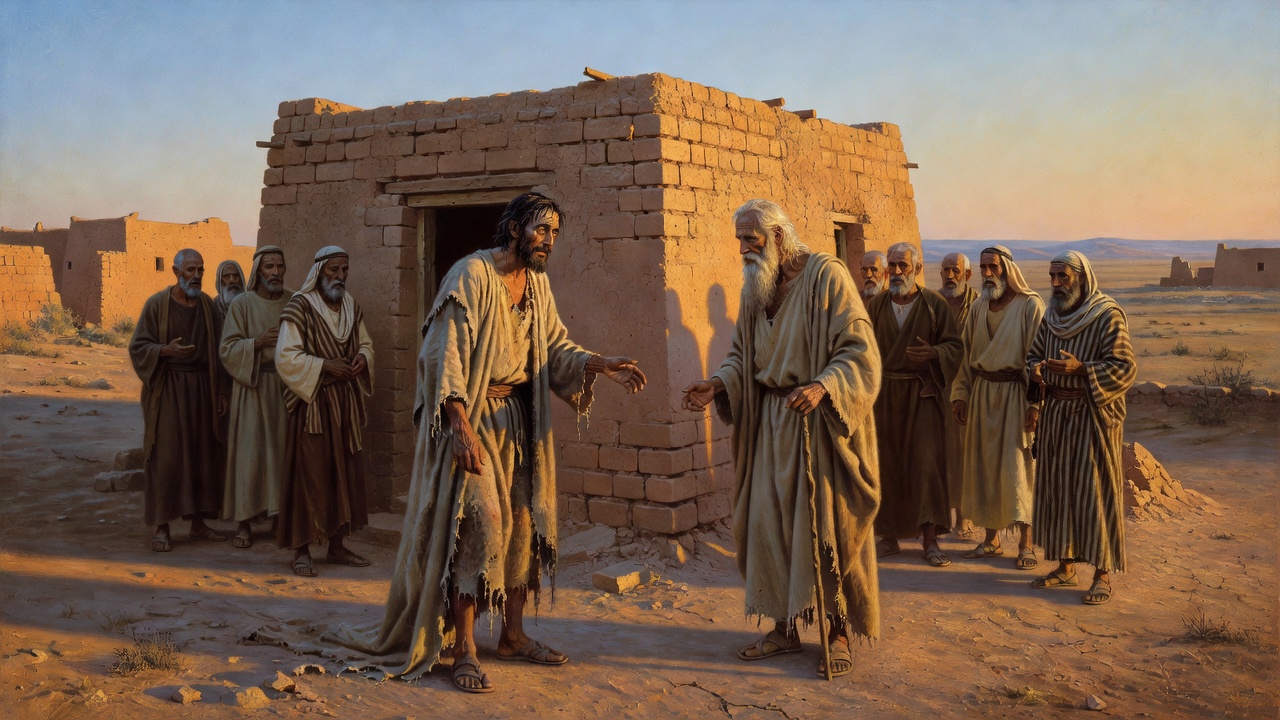
- In the twelfth year of the Babylonian exile, a fugitive arrived from Jerusalem with the report that the city had fallen. The evening prior to the messenger's arrival, God ended Ezekiel's muteness, enabling him to speak freely once again to the community of exiles.Sources: the Bible text itself · Jerusalem
- Survivors living among the ruins in the land of Israel claimed their right to the land by appealing to Abraham, arguing that if one man inherited the land, they as a multitude certainly would. Ezekiel countered that their continued idolatry, bloodshed, and injustice disqualified them from possessing it.Sources: the Bible text itself · Abraham
Notes written with AI assistance from open sources (Theographic Bible Metadata, CC BY-SA 4.0; Easton’s Bible Dictionary, public domain) and reviewed before publishing.
Places in this chapter
- Jerusalem · 31.777, 35.234 · verse 21
Only places identified with high confidence are shown (90% or more according to the scholarly sources compiled by OpenBible). Period map: DARE (Digital Atlas of the Roman Empire), CC BY 4.0; modern map: © OpenStreetMap contributors; places: OpenBible.info (CC BY 4.0).
Credits and license for this translation
Bib Sen An
The Holy Bible in Haitian Creole, 2023 update
copyright © 2017-2023 Ron Smith
Language: Kreyòl Ayisyen (Haitian)
Translation by: Ron Smith
Contributor: Felix Nixon
This translation is made available to you under the terms of the
Creative Commons Attribution Share-Alike license 4.0.
You have permission to share and redistribute this Bible translation in any format and to make reasonable revisions and adaptations of this translation, provided that:
You include the above copyright and source information.
If you make any changes to the text, you must indicate that you did so in a way that makes it clear that the original licensor is not necessarily endorsing your changes.
If you redistribute this text, you must distribute your contributions under the same license as the original.
Pictures included with Scriptures and other documents on this site are licensed just for use with those Scriptures and documents.
For other uses, please contact the respective copyright owners.
Note that in addition to the rules above, revising and adapting God's Word involves a great responsibility to be true to God's Word. See Revelation 22:18-19.
2026-06-11
Source: http://ebible.org/hatbsa/ · eBible.org