Deuteronomy 21
Bib Sen An · Tap a verse to see its cross-references.
1“Si yon moun yo te touye, twouve kouche nan mitan chan nan peyi ke SENYÈ a bannou pou posede a, epi yo pa konnen ki moun ki te frape li, 2alò, ansyen nou yo avèk jij nou yo va ale deyò pou mezire distans pou rive nan vil ki antoure sila ke yo te touye a.
3“Li va fèt ke vil ki pi pre moun ke yo te touye a, la pou ansyen nan vil sa a pran yon bèf gazèl ki sòti nan twoupo a, ki poko travay, e ki poko rale chaj. 4Konsa, ansyen nan vil sa yo va mennen gazèl la desann nan yon vale avèk kouran dlo, ki potko raboure ni plante. Li va kase kou gazèl la nan plas kote vale a.
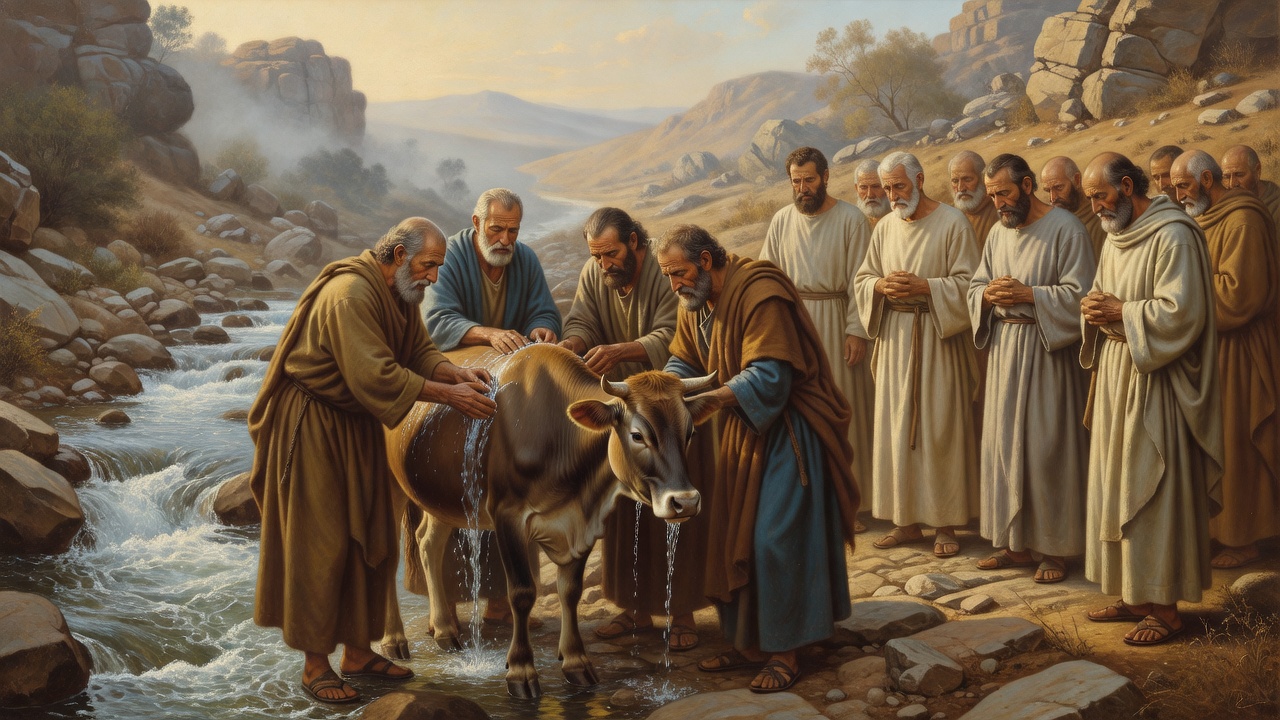
5“Alò, prèt yo, fis a Levit yo, va pwoche toupre, paske SENYÈ a, Bondye nou an, te chwazi yo pou sèvi Li e pou beni nan non SENYÈ a; chak kont, chak ka blese, se yo menm k ap regle yo. 6Tout ansyen nan vil ki pi pre moun ke yo te touye a va lave men yo sou gazèl kou kase nan vale a. 7Yo va reponn e di: ‘Men nou pa t vèse san sa a, ni zye nou yo pa t wè li. 8Padone pèp Ou a, Israël, ke ou te peye ranson pou li a; O SENYÈ, pa mete koupabilite san inosan an nan mitan pèp Ou a, Israël.’ Epi koupabilite san pa yo a va padone. 9Konsa, nou va retire koupabilite san inosan an soti nan mitan nou, lè nou fè sa ki dwat nan zye SENYÈ a.
10“Lè nou sòti nan batay kont lènmi nou yo, epi SENYÈ, Bondye nou an, livre yo nan men nou pou nou mennen yo ale an kaptivite, 11epi nou vin wè pami kaptif yo yon bèl fanm, nou gen yon dezi pou li pou ta pran li kòm madanm pou nou menm, 12alò, nou va mennen li lakay nou. Li va pase razwa sou tèt li, e taye zong li. 13Li va, osi, retire rad kaptivite li yo, e li va fè lamantasyon pou papa li avèk manman li pandan jis yon mwa. Apre, nou kapab vin antre ladann pou vin mari li, e li va madanm nou. 14Li va rive ke, si nou pa kontan avèk li, alò, nou va kite li ale kote li vle a; men anverite, nou p ap gen dwa vann li pou lajan. Nou p ap maltrete li, akoz nou te imilye li.
15“Si yon nonm gen de madanm, youn ke li renmen anpil e lòt la ke li pa renmen, epi toude fè fis pou li, si premye ne a, se pou sila ke li pa renmen an, 16epi li va rive nan jou ke li vin separe byen li gen avèk fis li yo, li pa kapab fè fis a sila li te renmen an vin premye ne avan fis a sila li pa t renmen an, ki se premye ne a. 17Men li va rekonèt premye ne a, fis a sila li pa t renmen an, avèk yon doub pòsyon a tout sa li posede; paske se te kòmansman fòs li. A li devni dwa a premye ne a.
18“Si yon nonm vin gen yon fis tèt di k ap fè rebelyon, epi li refize obeyi papa li oswa manman li, epi lè l resevwa chatiman, li pa menm koute yo, 19alò, papa li avèk manman li va sezi li, e mennen li deyò vè ansyen vil yo nan pòtay vil pa li a. 20Yo va di a ansyen vil yo: ‘Fis pa nou sa a tèt di e rebèl, li refize obeyi nou, li voras, e li bwè anpil gwòg.’ 21Alò, tout mesye lavil yo va lapide li ak kout wòch jiska lanmò. Konsa, nou va retire mal sa a nan mitan nou. Tout Israël va tande bagay sa a e yo va vin gen krentif.
22“Si yon nonm te fè yon peche ki merite lanmò, epi nou fè l pann sou yon bwa, 23kò li pa pou pann tout nwit lan sou bwa a, men nou va, anverite, antere li nan menm jou a. (Paske sila ki pann nan, modi pou Bondye.) Se konsa pou nou pa degrade tè ke Bondye te bannou kòm eritaj la.
Did you know?
Justice, Family Rights, and Communal Purity
- When a murdered body was found in an open field with no known killer, the elders of the closest town were required to perform an atonement ritual. In an unplowed valley with running water, they washed their hands over a heifer while Levitical priests attended, clearing the community of bloodguilt.Sources: the Bible text itself
- Under the laws of inheritance, a father could not transfer the firstborn's rights to a younger son out of favoritism for a beloved wife. The eldest son, even if born to an unloved wife, was legally guaranteed a double portion of the father's estate.Sources: the Bible text itself
- If an executed criminal's body was hung on a tree as a public warning, it had to be taken down and buried before nightfall. The law stated that anyone hung on a tree was under God's curse, and leaving the corpse overnight would defile the land.Sources: the Bible text itself
Notes written with AI assistance from open sources (Theographic Bible Metadata, CC BY-SA 4.0; Easton’s Bible Dictionary, public domain) and reviewed before publishing.
Credits and license for this translation
Bib Sen An
The Holy Bible in Haitian Creole, 2023 update
copyright © 2017-2023 Ron Smith
Language: Kreyòl Ayisyen (Haitian)
Translation by: Ron Smith
Contributor: Felix Nixon
This translation is made available to you under the terms of the
Creative Commons Attribution Share-Alike license 4.0.
You have permission to share and redistribute this Bible translation in any format and to make reasonable revisions and adaptations of this translation, provided that:
You include the above copyright and source information.
If you make any changes to the text, you must indicate that you did so in a way that makes it clear that the original licensor is not necessarily endorsing your changes.
If you redistribute this text, you must distribute your contributions under the same license as the original.
Pictures included with Scriptures and other documents on this site are licensed just for use with those Scriptures and documents.
For other uses, please contact the respective copyright owners.
Note that in addition to the rules above, revising and adapting God's Word involves a great responsibility to be true to God's Word. See Revelation 22:18-19.
2026-06-11
Source: http://ebible.org/hatbsa/ · eBible.org