Matthew 9
Bib La · Tap a verse to see its cross-references.
1Jezi moute nan kannòt la, li tounen lòt bò lanmè a ankò, nan lavil kote l' te ye a. 2Se konsa, yo pote ba li yon nonm paralize kouche sou yon kabann. Jezi wè jan moun yo te gen konfyans nan li, li di nonm paralize a: Pran kouraj, pitit mwen, peche ou yo padonnen. 3Lè sa a, kèk dirèktè lalwa di nan kè yo: Nonm sa a ap pale mal sou Bondye. 4Men, Jezi te gen tan konnen sa ki t'ap pase nan tèt yo. Li di yo: Poukisa n'ap fè move lide konsa nan tèt nou? 5Kisa ki pi fasil pou m' di: Peche ou yo padonnen, osinon: Leve mache? 6Enben, m'ap fè nou konnen mwen menm, Moun Bondye voye nan lachè a, mwen gen pouvwa sou latè pou m' padonnen peche. Li vire, li di nonm paralize a: Leve kanpe, pran kabann ou, ale lakay ou. 7Nonm lan leve kanpe vre, li ale lakay li. 8Lè moun yo wè sa, yo tout te pè, yo fè lwanj Bondye dapre li te bay lèzòm kalite pouvwa sa a. 9Jezi kite kote l' te ye a. Antan li t'ap pase konsa, li wè yon nonm yo te rele Matye ki te chita nan biwo kontribisyon an. Jezi di l' konsa: Swiv mwen. Matye annik leve, li swiv Jezi. 10Pita, Jezi t'ap manje nan kay la. Te gen anpil pèseptè kontribisyon ak moun k'ap fè sa ki mal ki te vin chita sou tab avè l' ansanm ak disip li yo. 11Farizyen yo wè sa, yo di disip li yo: Poukisa Mèt nou an ap manje konsa ak pèseptè kontribisyon ansanm ak moun k'ap fè sa ki mal yo? 12Jezi tande sa, li di yo: Si yon moun ansante, li pa bezwen dòktè. Se moun malad ki bezwen dòktè. 13Ale non, chache konprann sans pawòl sa yo ki nan Liv la: Mwen vle pou nou gen kè sansib. Mwen pa bezwen bèt n'ap ofri pou touye pou mwen yo. Paske, mwen pa vin rele moun k'ap mache dwat devan Bondye, men moun k'ap fè sa ki mal yo. 14Disip Jan Batis yo pwoche bò kot Jezi, yo di li: Nou menm ak farizyen yo, nou fè jèn. Men, poukisa disip ou yo pa fè jèn tou? 15Jezi reponn yo: Eske zanmi yon nonm k'ap marye kapab nan lapenn toutotan nonm k'ap marye a la ak yo? Non, pa vre? Men, lè lè a va rive pou l' pa nan mitan yo ankò, se lè sa a y'a fè jèn. 16Pesonn pa pyese yon vye rad ak yon moso twal nèf. Paske, pyès nèf la va pati ak moso nan rad la. Lè sa a, rad la chire pi mal. 17Konsa tou, yo pa mete diven ki fenk fèt nan vye veso fèt an po. Si ou fè sa, veso an po yo gen pou pete, diven an gen pou koule atè; epi ou pèdi veso yo tou. Men, yo mete diven ki fèk fèt nan veso an po ki fenk fèt tou. Konsa, ni diven an ni veso an po yo ap byen konsève. 18Antan Jezi t'ap pale konsa ak moun yo, yonn nan chèf jwif yo vin rive, li mete ajenou devan Jezi. Li di li: Pitit fi mwen an fèk mouri. Men, vin mete men ou sou li pou li ka viv. 19Jezi leve, li swiv nonm lan. Disip li yo te ale avè l' tou. 20Lè sa a, yon fanm ki te malad pwoche pa dèyè Jezi. Li te gen pèdisyon depi douzan. Li manyen rebò rad Jezi a, 21paske li t'ap di nan kè l': Si m' ka manyen rad li sèlman, m'a geri. 22Jezi vire tèt li, li wè fanm lan. Li di l' konsa: Pran kouraj, mafi. Konfyans ou nan Bondye ap geri ou. Menm lè a, fanm lan geri. 23Lè Jezi rive kay chèf la, li wè mizisyen yo ki t'ap pare pou lantèman an, ansanm ak yon foul moun ki t'ap fè anpil bri. 24Jezi di yo: Tout moun, soti. Tifi a pa mouri. Se dòmi l'ap dòmi. Yo pran pase l' nan betiz. 25Lè foul moun yo fin soti, Jezi antre nan chanm lan. Li pran men tifi a. Lamenm, tifi a leve. 26Nouvèl la gaye nan tout peyi a. 27Jezi kite kote l' te ye a. Antan li t'ap pase yon kote, de avèg pran mache dèyè li. Yo t'ap rele: Pitit David, gen pitye pou nou! 28Lè Jezi rive nan kay la, avèg yo pwoche bò kote li. Jezi di yo: Eske nou kwè mwen ka fè sa pou nou? Yo reponn li: Wi, Mèt. 29Lè sa a, li manyen je yo, li di: Se pou sa fèt pou nou jan nou kwè l' la. 30Je yo louvri. Jezi pale byen sevè ak yo, li di yo: Tande byen, piga pesonn konn sa. 31Men, ale yo ale, yo pran nonmen non l' toupatou nan peyi a. 32Antan avèg yo taprale, kèk lòt moun mennen yon nonm bay Jezi. Nonm sa a te bèbè, paske li te gen yon move lespri sou li. 33Chase Jezi chase move lespri a, bèbè a pran pale. Foul moun yo te sezi anpil. Yo t'ap di: Nou poko janm wè bagay konsa nan peyi Izrayèl. 34Men, farizyen yo t'ap di: Se chèf move lespri yo ki ba l' pouvwa pou chase move lespri yo. 35Jezi t'ap mache nan tout lavil yo ak tout ti bouk yo. Li t'ap moutre moun yo anpil bagay nan sinagòg yo. Li t'ap fè konnen Bon Nouvèl Peyi kote Bondye Wa a. Li t'ap geri tout kalite maladi ak tout kalite enfimite. 36Lè Jezi wè tout bann moun sa yo, kè l' fè l' mal pou yo paske li wè yo te bouke, yo te dekouraje, tankou yon bann mouton san gadò. 37Lè sa a, li di disip li yo: Rekòt la anpil, men manke travayè pou ranmase l'. 38Mande mèt jaden an pou li voye travayè nan jaden l' lan.
Did you know?
Mercy, Healing, and New Wine
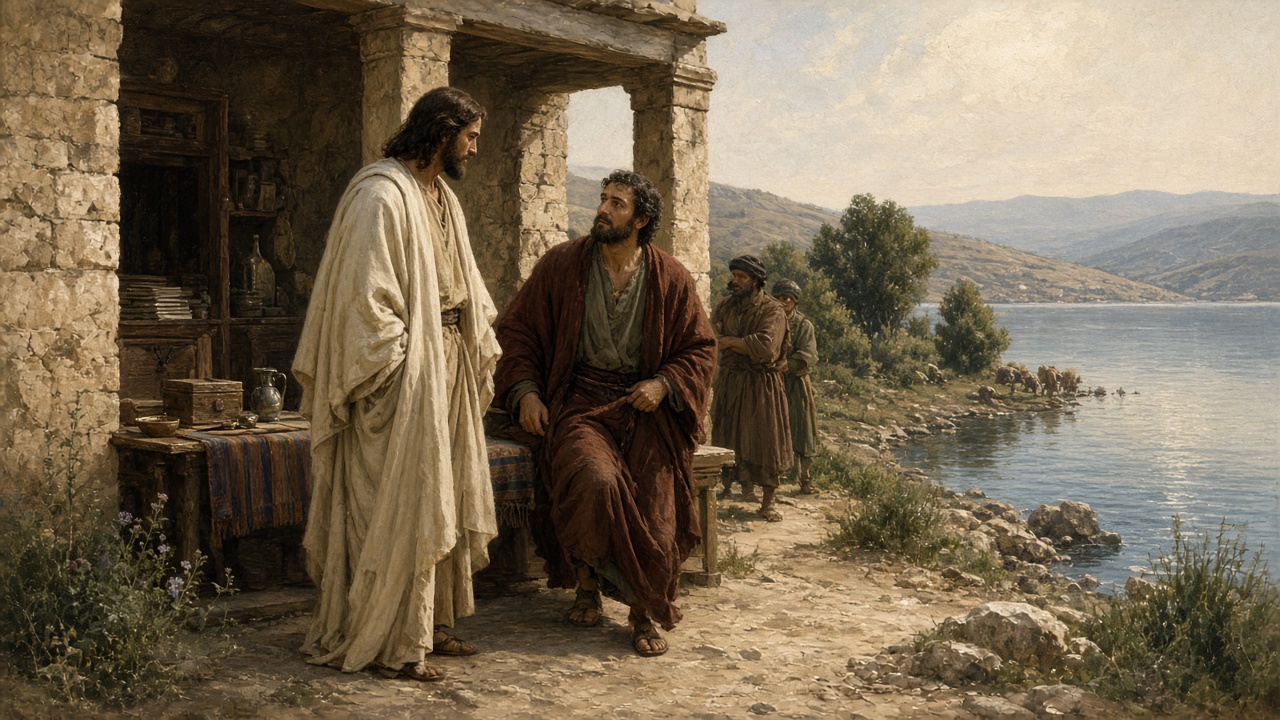
- Matthew, son of Alphaeus, was a publican, or tax collector, at Capernaum. Jesus, coming up from the side of the lake, passed the custom-house where Matthew sat and said, “Follow me.” He had formerly been known as Levi; that same day he gave a great feast, described as a farewell, for Jesus, the disciples, and probably many of his old associates.Sources: Matthew · the Bible text itself
- Those who ask why they and the Pharisees fast so often, while Jesus’ disciples do not, are disciples of John the Baptist. John is called the forerunner; he was of priestly descent, his father Zacharias a priest of the course of Abia and his mother Elisabeth one of the daughters of Aaron.Sources: John the Baptist · the Bible text itself
- One chronology places the healing of the paralyzed man, the call of Matthew, the question about fasting, and the parable of the wineskins in AD 28.Sources: Healing the Man with Palsy · Jesus Calls Matthew · Fasting Question · Parable of the Winseskins
Notes written with AI assistance from open sources (Theographic Bible Metadata, CC BY-SA 4.0; Easton’s Bible Dictionary, public domain) and reviewed before publishing.
Places in this chapter
- Sea of Galilee · 32.819, 35.590 · verse 1
Only places identified with high confidence are shown (90% or more according to the scholarly sources compiled by OpenBible). Period map: DARE (Digital Atlas of the Roman Empire), CC BY 4.0; modern map: © OpenStreetMap contributors; places: OpenBible.info (CC BY 4.0).
Credits and license for this translation
Bib La
The Holy Bible in Haitian Creole
Public Domain
Language: Kreyòl Ayisyen (Haitian)
In the Public Domain due to publication without copyright notice in 1985, and without subsequent registration within 5 years.
2020-03-10
Source: http://ebible.org/hat/ · eBible.org