2 Kings 2
Bib La · Tap a verse to see its cross-references.
1Lè a te rive pou Seyè a te fè Eli moute nan syèl nan yon toubouyon. Eli ak Elize pati ansanm, yo kite lavil Gilgal. 2Eli di Elize konsa: —Ou mèt rete isit la tande, paske Seyè a ban m' lòd pou m' al Betèl. Men, Elize reponn li: —Mwen pran ou menm ansanm ak Seyè ki vivan an pou temwen, mwen p'ap kite ou ale pou kont ou. Se konsa yo pati ansanm pou lavil Betèl. 3Men, yon gwoup pwofèt ki te rive lavil Betèl vin kontre Elize, yo di l' konsa: —Ou pa konnen Seyè a pral pran mèt ou a jòdi a? Elize reponn yo: —Mwen konn sa wi. Men nou menm, nou pa bezwen di anyen ankò! 4Apre sa, Eli di Elize: —Koulye a ou mèt rete isit la tande, paske Seyè a te ban m' lòd pou m' al Jeriko. Men, Elize reponn li: —Mwen pran ou menm ansanm ak Seyè ki vivan an pou temwen, mwen p'ap kite ou ale pou kont ou. Se konsa yo pati ansanm pou lavil Jeriko. 5Yon gwoup pwofèt ki te rete lavil Jeriko vin kontre Elize, yo di l' konsa: —Ou pa konnen Seyè a pral pran mèt ou a jòdi a? Elize reponn: —Mwen konn sa wi! Men nou menm, nou pa bezwen di anyen ankò. 6Apre sa, Eli di Elize: —Koulye a ou mèt rete isit la tande, paske Seyè a ban m' lòd pou m' al bò larivyè Jouden. Men, Elize reponn li: —Mwen pran ou menm ansanm ak Seyè ki vivan an pou temwen, mwen p'ap kite ou ale pou kont ou. Se konsa yo pati ansanm ankò. 7Senkant nan pwofèt Jeriko yo t'ap mache dèyè yo. Eli ak Elize rete bò larivyè Jouden an. Senkant pwofèt yo menm rete yon ti distans lwen yo. 8Eli wete gwo rad ki te sou li a, li woule l', li frape dlo a avè l'. Dlo a fann de bò. Eli ak Elize janbe lòt bò larivyè a san pye yo pa mouye. 9Lè yo fin janbe, Eli di Elize konsa: —Di m' kisa ou ta vle m' fè pou ou anvan Bondye pran m'. Elize reponn li: —Mwen ta renmen resevwa yon pòsyon doub nan lespri ki sou ou a. 10Eli di li: —Sa ou mande m' la a pa fasil. Men, si ou wè m' ak je ou lè m'ap kite ou la, w'ap jwenn sa ou mande a. Men, si ou pa wè m', w'a konnen ou p'ap jwenn li. 11Yo t'ap mache ansanm, yo t'ap pale yonn ak lòt lè yon cha dife ak chwal dife vin nan mitan yo. Epi li pote Eli moute nan syèl nan yon gwo toubouyon. 12Lè Elize wè sa, li rele Eli, li di: —Papa mwen! papa mwen! Ou menm ki te tankou yon gwo lame pou pran defans peyi Izrayèl la, ou ale! Epi li pa wè Eli ankò. Yon sèl lapenn pran Elize, li chire rad ki te sou li a fè de moso. 13Lèfini, li ranmase gwo rad ki te soti sou zepòl Eli tonbe atè a, epi li tounen. Rive bò larivyè Jouden an li kanpe. 14Li frape dlo a ak rad ki te soti sou zepòl Eli a, epi li di byen fò: —Kote Seyè a, Bondye Eli a? Li frape dlo a yon dezyèm fwa ak rad Eli a. Dlo a fann de bò. Elize janbe lòt bò larivyè a. 15Lè pwofèt Jeriko yo ki te pi devan an wè sa, yo di: —Lespri Eli a sou Elize! Yo vin jwenn li, yo bese tèt yo jouk atè devan l'. 16Yo di li: —Koute. Gen senkant nan nou la a. Nou tout se vanyan gason. Kite n' al chache mèt ou a. Ou pa janm konnen. Lespri Bondye a ka pran l' al lage sou yon mòn osinon nan yon fon. Men, Elize di yo: —Non. Pa voye pesonn dèyè l'. 17Men yo kenbe la avè l' jouk li di yo: —Bon. Nou mèt ale! Se konsa yo voye senkant moun yo al chache Eli. Yo pase twa jou ap chache, yo pa jwenn li. 18Yo tounen al jwenn Elize ki te rete ap tann yo lavil Jeriko. Elize di yo: —Mwen pa t' di nou nou pa t' bezwen ale! 19Moun lavil Jeriko yo vin di Elize: —Mèt, lavil la bati nan yon bon pozisyon, jan ou ka wè l' la. Men, dlo a pa bon, li fè tè a pa bay anyen. 20Elize di yo: —Pote ti gout sèl nan yon bòl tou nèf ban mwen! Yo pote veso sèl la bay Elize. 21Elize moute nan sous la, li voye sèl jete nan dlo a. Lèfini, li di: —Men sa Seyè a di: M'ap netwaye dlo sa a. Li p'ap janm touye moun ankò, ni li p'ap fè tè a rete san donnen anyen. 22Depi lè sa a dlo a vin bon jouk jounen jòdi a, jan Elize te di l' la. 23Elize kite lavil Jeriko, l' ale lavil Betèl. Li t'ap mache sou chemen an konsa, lè yon bann ti gason soti lavil la, yo pran pase l' nan betiz, yo t'ap rele: —Al fè wout ou, tèt chòv! Al fè wout ou, tèt chòv! 24Elize vire, li gade ti gason yo, li ba yo madichon nan non Seyè a. Lamenm, de lous soti nan rakbwa a, yo dechire karannde nan ti gason yo. 25Apre sa, Elize ale mòn Kamèl. Lèfini li tounen lavil Samari.
Did you know?
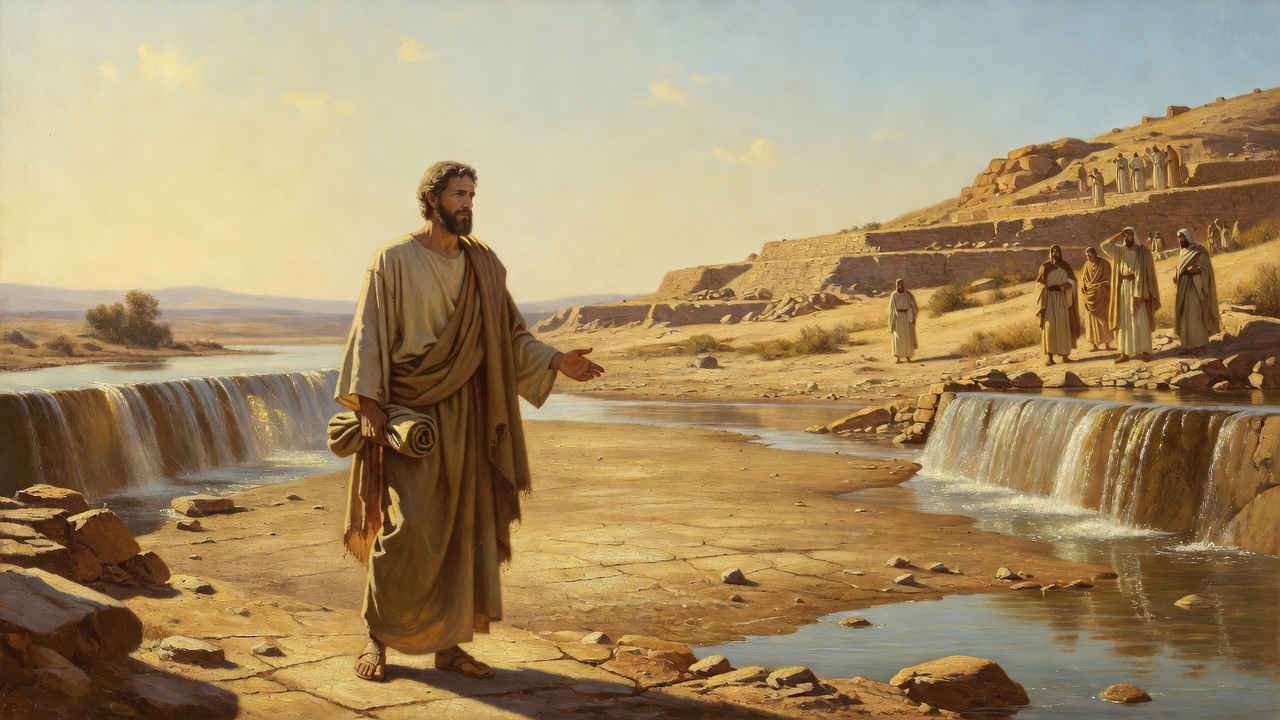
The Departure of Elijah and the Succession of Elisha
- Elijah's rough mantle had first marked Elisha's calling when Elijah threw it over his shoulders in the field. When Elijah was taken into heaven in a whirlwind, Elisha picked up the fallen cloak and struck the Jordan River with it, demonstrating to the watching prophets that he had received Elijah's spirit and succeeded him as prophet.Sources: Elisha · the Bible text itself
- The spring near Jericho, historically identified with Ain es-Sultan or Elisha's Fountain, had unwholesome water that left the surrounding land barren. Elisha purified the water by casting salt from a new bowl directly into the spring.Sources: Jericho · the Bible text itself
- Before crossing the Jordan, Elijah and Elisha visited communities of the sons of the prophets located at Bethel and Jericho. Fifty men from these prophetic groups watched the miraculous crossing from afar and later spent three days searching the surrounding hills and valleys for Elijah.Sources: Bethel (of Palestine) · Jericho · the Bible text itself
Notes written with AI assistance from open sources (Theographic Bible Metadata, CC BY-SA 4.0; Easton’s Bible Dictionary, public domain) and reviewed before publishing.
Places in this chapter
- Jericho · Today: Tell es Sultan · 31.872, 35.445 · verses 4, 5, 15, 18, 19, 23
- Jordan · Today: Jordan River · 31.761, 35.558 · verses 6, 7, 13
- Mount Carmel · 32.672, 35.023 · verse 25
- Samaria · 32.276, 35.195 · verse 25
Only places identified with high confidence are shown (90% or more according to the scholarly sources compiled by OpenBible). Period map: DARE (Digital Atlas of the Roman Empire), CC BY 4.0; modern map: © OpenStreetMap contributors; places: OpenBible.info (CC BY 4.0).
Credits and license for this translation
Bib La
The Holy Bible in Haitian Creole
Public Domain
Language: Kreyòl Ayisyen (Haitian)
In the Public Domain due to publication without copyright notice in 1985, and without subsequent registration within 5 years.
2020-03-10
Source: http://ebible.org/hat/ · eBible.org