Acts 27
Tũpa Ñehengagüer · Tap a verse to see its cross-references.
Pablo imondosa Roma ve
1Evocoiyase mborerecuar opɨhañemoñeta omboyoya yuvɨreco ore mondo ãgua carite pɨpe Italia ve. Sese omondo Pablo iyavei ambuae ava soquendaprɨ yuvɨreco mbɨa Julio serer vahe upe. Ahe mbɨa sundao rehɨi rerecuar secoi, ahe yuvɨrecoi vahe rer Mborerecuar upendar. 2Oroha carite pɨpe, ahe Adramitio sui yuvɨraso pota vahe Asia ve. Mbɨa Tesalónica pendar, Aristarco serer vahe, oha avei ore rupi, ahe secua Macedonia ɨvɨ rupi. 3Ahere ayihive oroyepota yemboyasa Sidón serer vahesave, aheve Julio saɨsupave Pablo upe aipo ehi: “Eguata tuprɨ nde mborɨpar rẽta rupi nde rese ihañeco tuprɨ ãgua yuvɨreco” ehi chupe. 4Sidón sui orosɨrɨse, oroso Chipre ɨvɨi rupi ɨvɨtu sui ore ñemoha ãgua. Oroso pota tẽi arɨ sosa cotɨ rupi, ndoroicatui rumo. Esepia, oipeyu pĩrata ɨvɨtu icotɨ sui. 5Evocoiyase oroguata para guasu pɨpe Cilicia, Panfilia ɨvɨi rupi. Ipare oroyepota tecua Mira yemboyasave, ahe Mira, Licia ɨvɨ pɨpe.
6Aheve sundao rerecuar oyosu carite ou vahe Alejandría sui, oso vaherã Italia ve. Evocoiyase ahe ipɨpe opa voi ore mboha. 7Ichui oroguata mbegüe setá arɨ. Oroporavɨquɨ́ iteanga oreyepota ãgua Gnido rovai. Ɨvɨtu oipeyu pĩrata vɨte. Sese oroyahuva Creta cotɨ, oroñocua tecua Salmón rovai rupi. Ẽgüe orohe oroso Creta cupe rupi. 8Supi yavai rai ore guata ãgua, ipare oroyepota yemboyasa Yemboyasa Avɨye vahe serer vahesave. Ahe ichui namombrɨi tecua Lasea.
9Ore yepota ãgua aheve, setá arɨ oromocañɨ. Ahese ɨvɨtu naporai catu oreu cute. Esepia, vɨrovɨ arɨ naporai catu vahe. Sese Pablo aipo ehi carite pɨpendar upe:
10—Mbɨa, naporai iri chira revo yande guata vɨte ãgua. Yaguata vɨtese, yamocañɨra carite, ivosɨita reseve, yande avei eté avɨyeteramo yacañɨ tẽira —ehi.
11Sundao rerecuar rumo nomboyeroyai iñehe, ahe omboyeroya catu carite reroguatasar, carite yar avei. 12Ahe yemboyasa naporai ɨvɨtu ai rãro ãgua aheve. Sese setá catu “yasoño” ehi vahe yuvɨreco, “Tayayepota catu Fenice ve, aheve tayasãro ɨvɨtu ai” ehi yuvɨreco viña. Ahe Fenice Creta ɨvɨrindar yemboyasa avɨye vahe. Aheve carite yuvɨroique norte ɨque rupi iyavei irohɨ ɨque rupi avei yepi.
Ɨvɨtu ai para guasu pɨpe
13Oipeyu mbegüemise ɨvɨtu irohɨ cotɨ sui, ipɨhañemoñeta yuvɨreco, “Yaicatuño ité yande yepota ãgua” ehi yuvɨreco viña. Ahese orosɨrɨse ore yemboyasa sui, oroso Creta ɨvɨi rupi. 14Coiyemi tẽi rumo oyepota ɨvɨtu ai oreu Creta cotɨ sui. Ahe ɨvɨtu ai ou norte ɨque cotɨ sui. 15Oyepotase oreu, ndoroicatu iri eté sovaĩchi. Evocoiyase, “Tayande rerasoño” orohe chupe. 16Oroñocua caha pãhumi serer Cauda. Ahe oroñocuasave orovɨroha sãi ore caritemi ore carite guasu pɨpe. 17Orosupire, ahe oicuhacua carite guasu inicha pɨpe yuvɨreco. Ipare ipɨhañemoñeta yuvɨreco ‘carite oyeupi tiẽtera ɨvɨ cuhi Sirte serer vahe harɨve’ oya. Sese opa vɨroyɨ imombɨtasa yuvɨreco. Ahese ɨvɨtu ore reroguataño. 18Ɨvɨtu rumo ombohɨtú iteanga para guasu. Sese ahere ayihive oporavɨquɨ vahe omboɨpɨ carite vosɨita mombo yuvɨreco. 19Imombosapɨsa arɨ pɨpe, omombo vɨte mbahe carite resendar yuvɨreco. 20Setá arɨ ndoyecuai arɨ, yasɨtata avei oreu. Ɨvɨtu ai ndopaiño ité avei. Opa ité ore pɨhañemoñeta mocañɨ, “Yacañɨ tẽi etera para guasu pɨpe” orohe viña.
21Setá arɨ ore caruẽhɨ pare, Pablo opũha aipo ehi carite pɨpendar upe:
—Mbɨa, ehi acoi che reroya voira peye viña, nayasẽise Creta sui, ahese ndipoi chira co mbahe yandeu cũritei viña —ehi—. 22Cũritei, peyemonguerẽhɨ catuño. Esepia, ndipoi chira yande pãhu pendar omano vahe, carite güeraño rumo ocañɨ tẽira. 23Ayihi pɨsa oyemoporẽhɨ cheu Tũpa rembiguai semimbou, chupendar che aico, chupe avei aporavɨquɨ. 24Ahe aipo ehi cheu: “Pablo, eresɨquɨyei rene. Ereyepotaño itera Cesar upe. Tũpa oipɨ̃sɨro aveira opacatu nde rupindar carite pɨpendar” ehi cheu. 25Mbɨa, ayeroya Tũpa rese. Esepia, ahe omboavɨye itera oñehesa cheu. Sese peyemonguerẽhɨño —ehi—. 26Yande mohañira rumo ɨmbehɨ cotɨ caha pãhumi rese yande mondo —ehi.
27Ñuvɨrío semana ɨvɨtu ore reroguata pare ahe pɨ̃tu mbɨter pɨpe para guasu Adriático rupi oroicose, carite pɨpe oporavɨquɨ vahe ipɨhañemoñeta yuvɨreco ‘yarovɨ revo ɨvɨ yaico’ oya. 28Sese osãha para guasu rɨpɨgüer yuvɨreco. Ahe tɨpɨgüer treinta y seis metros tuprɨ. Ipare osɨrɨ irimi yuvɨreco. Aheve osãha iri, tɨpɨgüer veintisiete metros tẽi. Ahese oicua, “Yarovɨ ɨvɨ” ehi yuvɨreco. 29Ipɨhañemoñeta yuvɨreco: “Avɨyeteramo yayepotara itave” ehi. Sese yuvɨraso carite rupɨtave. Aheve osɨquɨyepave omombo irungatu carite mombɨtasa tuvicha vahe ɨpɨve yuvɨreco. “¡Omocohe voi tarahu Tũpa yandeu viña!” orohe tẽi. 30Oñemi potase oporavɨquɨ vahe carite guasu sui yuvɨreco, vɨroyɨ caritemi mbahemohasa. Ombopa pota tẽi ambuae carite pɨpendar yuvɨreco viña, “Oromombora carite renonendar imombɨtasa” ehi tuprɨ tẽi yuvɨreco. 31Pablo rumo aipo ehi sundao rerecuar upe, sundao eta upe avei imombehu:
—Ndopɨtaise carite pɨpe yuvɨreco co oñemi pota vahe, pe ndapeñepɨsɨroi chietera —ehi.
32Ahese sundao eta oyasɨa caritemi sã oitɨ ɨve imondo yuvɨreco.
33Cõhe ramose Pablo aipo ehi opacatu upe:
—Cũritei ñuvɨrío semana pemomba pecaruẽhɨ peico ‘¿mara yahera pĩha co yaico?’ pe hesa pɨpe. 34Evocoiyase pehuñomi mbahe cute pe ñepɨsɨro ãgua. Acoi ocañɨse carite, yande rumo nayacañɨi chira iyavei que ñepei pe ha nocañɨi chietera —ehi Pablo.
35Aipo ehi pare, oipɨsɨ pan, “Avɨye ndeu” ehi Tũpa upe ihu ãgua. Ahe imbohi pare, ohu. 36Evocoiyase opacatu ava oyemonguerẽhɨ yuvɨreco ocaru ãgua. 37Ore retacuer doscientos setenta y seis tuprɨ. 38Ore caru pare, oporavɨquɨ vahe opa omombo trigo carite vosɨita para guasu pɨpe iposɨiẽhɨ ãgua yuvɨreco.
Carite ocañɨ
39Cõhese, osepiase ɨvɨ, “¿Que pĩha yaico?” ehi tẽi yuvɨreco. Oyosuse rumo yãcua vahe, ipɨpe oime ɨvɨ cuhi ipiru vahe. Aheve yuvɨroique pota tẽi yuvɨreco viña. 40Oyasɨa ahe carite mombɨtasa cuasa carite sui yuvɨreco, omonguhi carite mboyahuvasa, osupi carite resendar turucuar imboguatasa yuvɨreco. Evocoiyase oroique oroso yãcua vahe pɨpe. 41Oroguatase rumo, oroyapi ɨvɨ cuhi. Aheve carite opãha ité sese. Ndoicatui eté seroyevɨ yuvɨreco iyavei carite rupɨta ɨ ohɨtu vahe opa tuprɨ oyoca.
42Ahese sundao eta, “Avɨyeteramo soquendaprɨ ohɨta tiẽtera, oñemi yuvɨreco. Sese yayucapa” ehi yuvɨreco chupe viña. 43Sundao rerecuar rumo ndoipotai Pablo mano ãgua, sese, “Teheni” ehi, “peyucai rene soquendaprɨ” ehi. “Ohɨta oicua vahe rane toyuvɨrocui ɨve, toyuvɨnose ɨvɨ rese yuvɨreco” ehi. 44“Ambuae evocoiyase ɨvɨrape, carite yecacuer rese toyasecoño yuvɨnose ãgua ɨvɨ rese” ehi. Ẽgüe orohe orosẽpa ɨvɨ rese oroso.
Did you know?
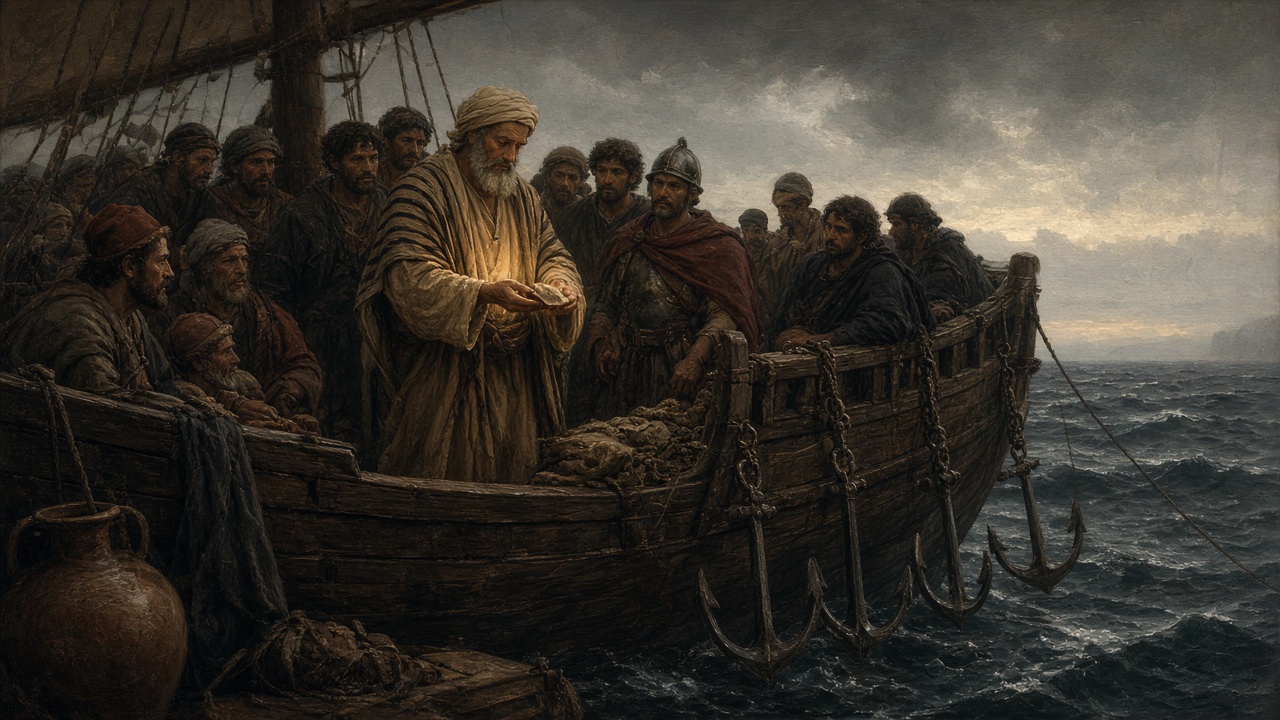
Storm and Shipwreck on the Way to Rome
- Paul and the other prisoners did not sail straight to Italy. At Caesarea they boarded a ship of Adramyttium, a city on the coast of Mysia in Asia Minor, bound for ports along the coast of Asia, a name Easton's Bible Dictionary takes in this verse as probably Asia Minor, and that ship carried them only as far as Myra in Lycia. There the centurion put them aboard an Alexandrian ship sailing for Italy; the dictionary notes that it was rare for a ship to sail from any port of Palestine direct to Italy.Sources: Adramyttium · Asia · the Bible text itself
- The prisoners were handed over to Julius, a centurion of the Imperial Regiment. Easton's Bible Dictionary identifies him as centurion of the Augustan cohort, or the emperor's body-guard, and describes his courteous regard for Paul. At Sidon, about twenty-five miles north of Tyre, he let Paul visit friends and receive care; later he blocked the soldiers' plan to kill the prisoners so that Paul's life would be spared.Sources: Julius · Sidon · the Bible text itself
- After Cnidus the ship worked along Crete, one of the largest islands in the Mediterranean, about 140 miles long and 35 broad, which Paul visited on this voyage to Rome. The account says the voyage had already become dangerous because it was after the Fast, and Fair Havens was unsuitable for wintering. One chronology dates the start of the journey to Rome to AD 56 and the shipwreck in the storm to AD 57.Sources: Crete · Journey to Rome begins · Paul is shipwrecked by a storm · the Bible text itself
Notes written with AI assistance from open sources (Theographic Bible Metadata, CC BY-SA 4.0; Easton’s Bible Dictionary, public domain) and reviewed before publishing.
Places in this chapter
- Italy · 41.892, 12.485 · verses 1, 6
- Adramyttium · Today: Oren · 39.501, 26.933 · verse 2
- Asia · 38.400, 28.300 · verse 2
- Thessalonica · Today: Thessaloniki · 40.638, 22.946 · verse 2
- Sidon · Today: Sandikli archaeological site in Sidon · 33.561, 35.372 · verse 3
- Cyprus · 35.000, 33.000 · verse 4
- Cilicia · 36.913, 34.892 · verse 5
- Lycia · 36.733, 29.900 · verse 5
- Myra · 36.259, 29.985 · verse 5
- Pamphylia · 37.000, 31.000 · verse 5
- Alexandria · 31.183, 29.896 · verse 6
- Cnidus · 36.686, 27.375 · verse 7
- Crete · 35.310, 24.893 · verses 7, 8, 12, 13, 14, 21
- Salmone · Today: Cape Sideros · 35.316, 26.312 · verse 7
- Fair Havens · Today: Kaloi Limenes · 34.930, 24.800 · verses 8, 12
- Lasea · Today: Lasaea · 34.941, 24.811 · verse 8
- Cauda · Today: Gavdos · 34.833, 24.083 · verse 16
- Syrtis · Today: Sidra · 31.500, 18.000 · verse 17
- Adriatic Sea · Today: Adriatic and Ionian Seas · 38.000, 19.000 · verse 27
Only places identified with high confidence are shown (90% or more according to the scholarly sources compiled by OpenBible). Period map: DARE (Digital Atlas of the Roman Empire), CC BY 4.0; modern map: © OpenStreetMap contributors; places: OpenBible.info (CC BY 4.0).
Credits and license for this translation
Tũpa Ñehengagüer
New Testament in Guarayu (BL:gyr:Guarayu)
copyright © 2011 Wycliffe Bible Translators, Inc.
Language: Guarayu
Translation by: Wycliffe Bible Translators, Inc.
Guarayu [gyr], Bolivia
Copyright Information
© 2011, Wycliffe Bible Translators, Inc. All rights reserved.
This translation text is made available to you under the
terms of the Creative Commons License: Attribution-Noncommercial-No Derivative Works.
( http://creativecommons.org/licenses/by-nc-nd/3.0/ )
In addition, you have permission to port the text to different file formats, as long as you
do not change any of the text or punctuation of the Bible.
You may share, copy, distribute, transmit, and extract portions
or quotations from this work, provided that you include the above copyright
information:
You must give Attribution to the work.
You do not sell this work for a profit.
You do not make any derivative works that change any of the actual words or punctuation of the Scriptures.
Permissions beyond the scope of this license may be
available if you contact
us with your request.
The New Testament
in Guarayu
© 2011, Wycliffe Bible Translators, Inc. All rights reserved.
This translation is made available to you under the terms of the
Creative Commons Attribution-Noncommercial-No Derivatives license 4.0.
You may share and redistribute this Bible translation or extracts from it in any format, provided that:
You include the above copyright and source information.
You do not sell this work for a profit.
You do not change any of the words or punctuation of the Scriptures.
Pictures included with Scriptures and other documents on this site are licensed just for use with those Scriptures and documents.
For other uses, please contact the respective copyright owners.
2014-04-25
Source: http://ebible.org/gyrNT/ · eBible.org