Genesis 16
Buki Kimaasabaina · Tap a verse to see its cross-references.
Ega natuna Isimaeli ina bíbina tetelina
1E kina go Eberam monena Serai nava geya ivenatuneta go, tauyana mana pákwana tayamo Itipita vavinaina yoina Ega. 2Tuwo ina Eberam ilatuwoko idigo kana,
‘Monegu, Yauwe guna venátuna ivagagale, tauna guna pákwana kwābi, taiyao komasīsi. Nakona tauyana manugu bei ivenátuna, e natuna yau natugu.’
Tuwo moitamo Eberam iguinuwe nakae Serai idige. 3Eberam bogina tala ana badabada yawou Kenani goi ikaaiyaka, e Serai ina pákwana Ega guma Itipita ikabi, Eberam ivamonene. 4E Eberam Ega taiyao simasisi, e ikéuwama. Ago tutayana ina kéuwama ilotowo, e ina towosi Serai ivasobusobuye. 5Tuwo Seraiyana ina Eberam ilatuwoko idigo kana,
‘Monegu, kom im puwoya, tauna agu mou ababane. Yau guna pákwana avinim go, tutayana iyagoi bego ikéuwama, ivasobusobuyegu. ¡Neta Yauwe itakinōida! ¿Avatau ibágala, kom geya yau?’
6Go kina Eberamyana idigo kana,
‘Gwa. Kom im pakwanayana nimam goi ayato. Kaga latuwom, nakae kuguinūwe yaina.’
Tuwo Serai ina pákwana Ega iyogedegede, tauna isiya ina yoyowo goi ikaaiyaka. 7Isiya ina doelu tayamo asa Sura kenaoina goi ikaaiyaka. Go Yauwe ina anerose tayamo ima amoko goi Egayana ibabane. 8Ibabane, e idigo kana,
‘¿Ega, Serai ina pákwana, nako kuma? ¿Bei nako kuna?’
‘Guna towosi Serai matana goi asiya’, Egayana kaena.
9Yauwe ina aneroseyana idigo kana,
‘Kwaluvīla kūna am towosi goi kukayasobuyēm tauyana yaina.’
10Tuwaina aneroseyana kana,
‘Bei tubumowo akisailidi, e adi badabada geya itoboinemta kwatuyaividi.’
11Tuwaina idigo kana,
‘Ame tutayana kukéuwama gobe kuvenátuna,
natum koroto.
Yauwe im kaiyakomou bogina igite,
tauna natumyana bei kuvayou Isimaeli.
12Tauyana bei ikaaiyaka woiwoi nakae.
Tomota liliudi sivakaleye,
e nakae tomota liliudi ivakaleyedi.
Tauyana anetava bei ikaaiyaka go,
ina bodao ituli ta kasa goi sikaaiyaka.’
13Tuwo Egayana idigo kana,
‘¡Iyaa! Yauwe bogina agite go, geya akamaseta.’
Tuwo Yauwe ivayoko Yaubada Togita. 14Moe pasina doeluyana asa Kadesi be Bereda nauyayanaidi goi tomota sivayou Bera Lakai Roi.
15E tuwo Ega ivenátuna, natuna koroto. Moe Eberam natuna, e ivayou Isimaeli. 16E kina go Eberamyana ana tala ana badabada 86 tutayana Ega natudi Isimaeli ivenatuni.
Did you know?
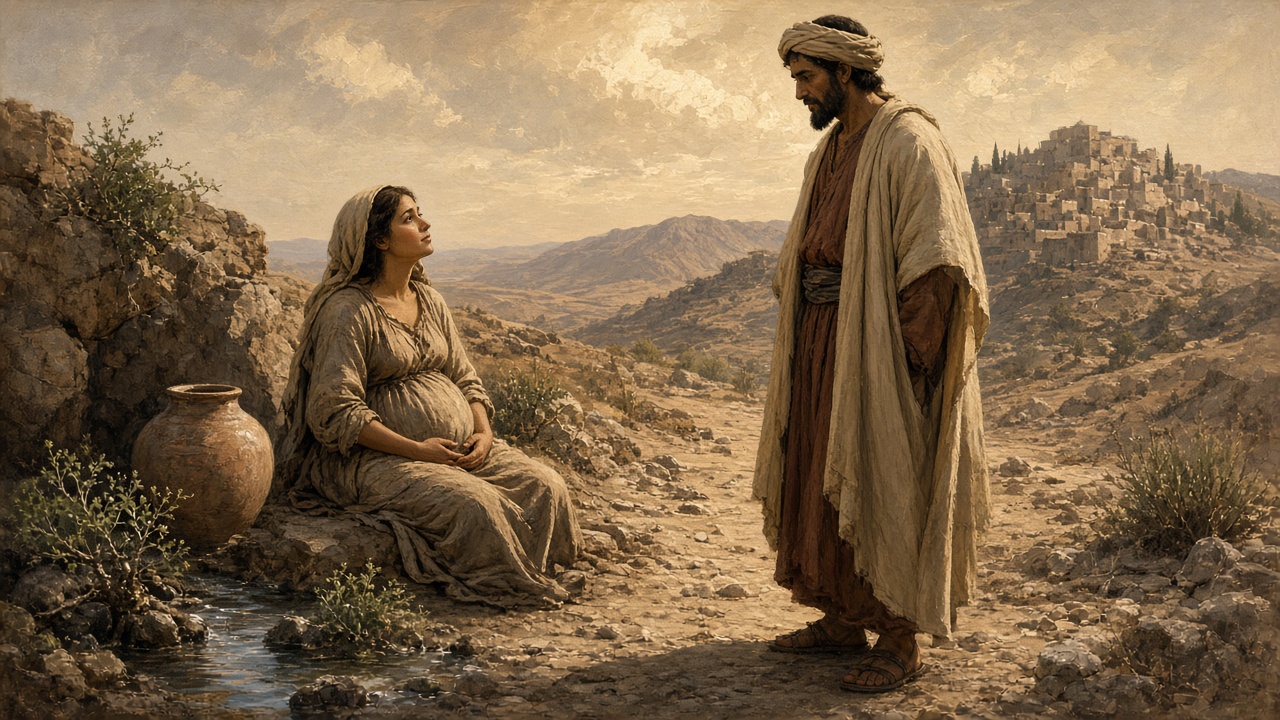
Hagar’s Flight and the Birth of Ishmael
- Hagar, an Egyptian maidservant of Sarai, bears a name understood to mean “flight,” or, according to others, “stranger.” After Abram had lived in Canaan for ten years, Sarai gave her to him as a secondary wife, hoping to build a family through her.Sources: Hagar · the Bible text itself
- When Sarai treated her harshly, Hagar fled along the road to Shur, through the desert that lay between her and Egypt, apparently intending to return to her relatives. The angel of the LORD found her by a spring of water there. Shur, meaning “wall,” was a wilderness on Egypt’s north-eastern border, probably named for frontier fortifications running from Pelusium to Heliopolis.Sources: the Bible text itself · Hagar · Shur
- Hagar called the LORD who spoke to her “the God who sees me,” and the well was named Beer-lahai-roi, “the well of the visible God,” between Kadesh and Bered, a town in the south of Palestine in the desert of Shur. She returned to Abram’s tent, and his eldest son, Ishmael, was born at Mamre when Abram was eighty-six; Abram gave him the name the angel had announced, because the LORD had heard her affliction.Sources: the Bible text itself · Hagar · Bered · Ishmael (Son of Hagar)
Notes written with AI assistance from open sources (Theographic Bible Metadata, CC BY-SA 4.0; Easton’s Bible Dictionary, public domain) and reviewed before publishing.
Places in this chapter
- Canaan · 32.767, 35.333 · verse 3
Only places identified with high confidence are shown (90% or more according to the scholarly sources compiled by OpenBible). Period map: DARE (Digital Atlas of the Roman Empire), CC BY 4.0; modern map: © OpenStreetMap contributors; places: OpenBible.info (CC BY 4.0).
Credits and license for this translation
Buki Kimaasabaina
The New Testament and part of the Old Testament of the Holy Bible in the Gumawana language of Papua New Guinea
Buk Baibel long tokples Gumawana long Niugini
copyright © 2019 Wycliffe Bible Translators, Inc.
Language: Gumawana
This translation is made available to you under the terms of the
Creative Commons Attribution-Noncommercial-No Derivatives license 4.0.
You may share and redistribute this Bible translation or extracts from it in any format, provided that:
You include the above copyright and source information.
You do not sell this work for a profit.
You do not change any of the words or punctuation of the Scriptures.
Pictures included with Scriptures and other documents on this site are licensed just for use with those Scriptures and documents.
For other uses, please contact the respective copyright owners.
2026-10-02
Source: http://png.bible/gvs/ · eBible.org