Exodus 27
Buki Kimaasabaina · Tap a verse to see its cross-references.
Vatulúkwana aba kasala kopwa // ana madágina manuna
1E Yauwe tuwaina kana,
‘Tomota kulatuwokōidi latuwogu gaigíyala taalaidi sikabidi, aba kasala simadagi. Ana mamanao be nakae ana papaeva moe ovatayamo panetayataya go, ana tukotuko moe ovatayamo. 2Simadagi ikavava, e ana sakusaku aivasi simadagidi matakubuna aivasi goi siyatoidi go, sakusakuyadi be aba kasala alova tayamo goi simadagidi. Siyatoidi ikavava, kopwa paaevaidi sikabidi, aba kasalayana goi sikaupatukoidi. 3Ikavava, e kopwa tuwaina sikabidi, aba kasala konanina simadagidi. Konaninayadi ame nakae: Silekau ana kaba vadoda, ana sabwero, ana borodisi, ana sisiwo be nakae pokova ana kaba vadoda simadagidi. 4Ikavava, e kopwa tuwaina sikabi, ana vátala simadagi yeu ana kaba dímila manuna. Go vatalayana matakubuna aivasi goi rini kopwa sikaupatukoidi go, sisowóduwo aba kasalayana toluyena goi. 5Ikavava, e aba kasala sinaena nauyayanaina goi sidodoi. 6Ikavava, aba kasala ana kaitakeo gaigíyala aiyuwo sibobóidi. Niga kopwa paaevaidi goi bei sipaimidi. 7Ikavava, aitakeoyadi sivaisiudi riniyadi aba kasala toluyena goi, dadavina tayamo, dadavina tayamo, e bei itoboinedi aba kasalayana sikaaitakeve. 8Aba kasalayana timba paaevaidi goi bei simadagi. Go sinaena daakakaina be nakae dibuna geya ana kaubodamo. Latuwogu simadagi nakae makayauna boi koyayana goi bogina avatulukoim.’ Aba kasala kopa|src="HK00256B.TIF" size="col" copy="BBoyd" ref="27:1-8"
Vatulúkwana Aba Kaiyaka yoyou // ana kali ana madágina manuna
9E Yauwe tuwaina kana,
‘Tomota kulatuwokōidi latuwogu guna Kaba Kaiyakayana sikali. E areko dedevidi sikabidi, guna Kaba Kaiyakayana ana kali simadagi. Aliyana youya dadavina ana mamanao moe ova 30. 10Kówala ana badabada 20 adi kaba táoya kopwa goi sivataoedi. Kowalayadi adi takudukudu goi rini be aba talagegeta siriba siyatoidi. 11Yawéyana dadavina goi nakae. Ana mamanao moe ova 30 go, kówala ana badabada 20 madi kaba táoya kopwa goi. Kowalayadi adi takudukudu goi rini be aba talagegeta siriba siyatoidi. 12E aliyana koiboga dadavina ana mamanao moe ovayawou ovanima go, kówala ana badabada yawou adi kaba táoya kopwa goi sivataoedi. Go sipodi goi rini be aba talagegeta siriba siyatoidi. 13E aliyana ana kaba siu goi moe bomatu dadavina, ana mamanao nakae ovayawou ovanima. 14Aba siu dadavina ana mamanao ovavasi panetayataya, dadavina ovavasi panetayataya. Go ana kówala dadavina aito, dadavina aito adi kaba táoya goi sivataoedi. E kowalayadi goi arekoyadi sivakosainedi. 16E búyala noyanoyaidi buruu, kalaakovidi toidi be kayakayaidi be nakae areko dedevidi sikabidi, gíluma ana tokatanaki sivini, ali ana kaba siu ana taboda kaarekoina igilumi. Go tabodayana ana mamanao moe ovanima ovayuwo. E kówala aivasi adi kaba táoya goi sivataoedi go, kowalayadi goi tabodayana sivakosaine. 17Kówala liliudi ali goi madi rini siriba be nakae madi kaba talagegeta siriba. Go kowalayadi adi kaba táoya moe kopwa. 18Ali ana mamanao moe ova 30 go, ana papaeva moe ovayawou ovanima. Go aliyana ana tukotuko moe ovatayamo panetayataya. Aliyana moe areko dedevidi go, kówala adi kaba táoya moe kopwa. 19Guna Kaba Kaiyakayana ana turu liliudi kopwa. E nakae ana kaba kokavata be nakae ali ana kaba kokavata liliudi moe kopwa.’
Vatulúkwana rampa ana pútuma manuna
20E Yauwe tuwaina kana,
‘Isileli tubunao kulatuwokōidi latuwogu sina oribe mumuna pokaka sikabi rampa manuna, e bei rampayadi lavilavi tamo tamo silotuvaninimidi sininínima. 21Guna Kaba Valoboda sinaena go, vabodaupa kaarekoina toluyena, e rampa adi kaba yata bei ikaaiyaka. Latuwogu rampayadi Eroni ma natunao sirugwausidi sininínima lavilavi ina nobuyana. Ame lovinayana ikaiyako vata Isileli tubunao yaimi.’
Did you know?
The bronze altar, the courtyard, and the lamps
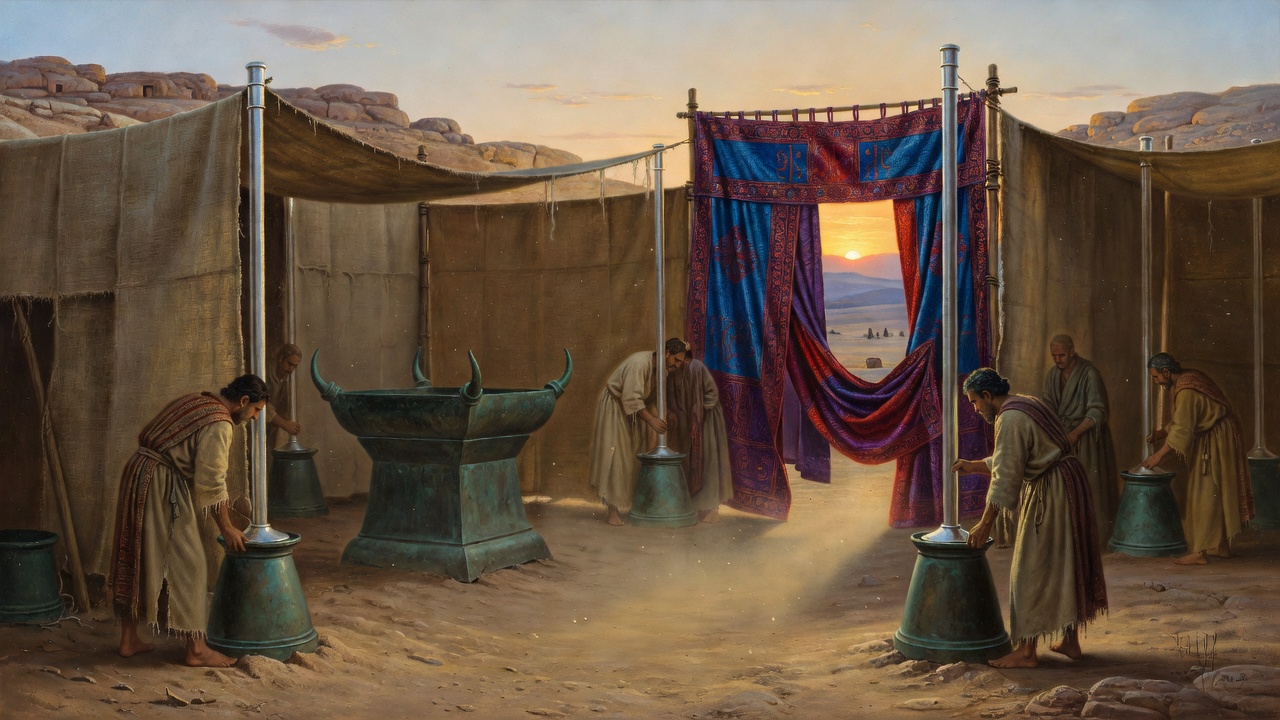
- This chapter calls for a square altar of acacia wood, five cubits long, five cubits wide, and three cubits high, with a horn on each of its four corners, the horns of one piece, and the altar overlaid with bronze. It was to be built hollow, of boards, with a bronze-mesh grate set beneath a ledge so that the mesh came halfway up, and with poles of acacia wood overlaid with bronze, inserted into rings so the altar could be carried. All its utensils—pots for removing ashes, shovels, sprinkling bowls, meat forks, and firepans—were to be bronze, and the altar was to be made just as shown on the mountain.Sources: the Bible text itself
- The courtyard of the tabernacle was to be a hundred cubits long and fifty cubits wide, with curtains of finely spun linen five cubits high. The south and north sides, each a hundred cubits long, were to have twenty posts and twenty bronze bases, with silver hooks and bands; the west side, fifty cubits wide, was to have ten posts and ten bases. The east side, toward the sunrise, was also fifty cubits wide, with a twenty-cubit gate curtain embroidered with blue, purple, and scarlet yarn and finely spun linen, on four posts, and with curtains of fifteen cubits on either side.Sources: the Bible text itself
- The Israelites were to bring pure oil of pressed olives for the light, so that the lamps would keep burning continually. In the Tent of Meeting, outside the veil in front of the Testimony, Aaron and his sons were to tend the lamps before the LORD from evening until morning, a permanent statute for the Israelites for the generations to come. Aaron, eldest son of Amram and Jochebed, was born in Egypt three years before his brother Moses, and by Elisheba, daughter of Amminadab of the house of Judah, whom he married, he had four sons: Nadab, Abihu, Eleazar, and Ithamar.Sources: the Bible text itself · Aaron
Notes written with AI assistance from open sources (Theographic Bible Metadata, CC BY-SA 4.0; Easton’s Bible Dictionary, public domain) and reviewed before publishing.
Credits and license for this translation
Buki Kimaasabaina
The New Testament and part of the Old Testament of the Holy Bible in the Gumawana language of Papua New Guinea
Buk Baibel long tokples Gumawana long Niugini
copyright © 2019 Wycliffe Bible Translators, Inc.
Language: Gumawana
This translation is made available to you under the terms of the
Creative Commons Attribution-Noncommercial-No Derivatives license 4.0.
You may share and redistribute this Bible translation or extracts from it in any format, provided that:
You include the above copyright and source information.
You do not sell this work for a profit.
You do not change any of the words or punctuation of the Scriptures.
Pictures included with Scriptures and other documents on this site are licensed just for use with those Scriptures and documents.
For other uses, please contact the respective copyright owners.
2026-10-02
Source: http://png.bible/gvs/ · eBible.org