Ezekiel 17
Nhanderuete ayvu iky'a e'ỹ va'e · Tap a verse to see its cross-references.
Mba'emo re ombojojaa rupi mokoĩ taguato ha'e uva'y omombe'uague
1Ha'e gui xevy Senhor oayvu ombou vy aipoe'i:
2— Ava ra'y, emombe'u peteĩ ayvu mba'emo re rembojoja vy Israel kuery oikuaa aguã.
3Ha'e vy aipo're: Po rami Senhor Nhanderuete ijayvu: Oiko peteĩ taguato tuvixa va'e. Ipepo ha'e hague ma ipuku, hague ma joo rami e'ỹ-e'ỹ pytã va'e. Ha'e va'e ma Líbano yvy re ou. Ha'e vy oipe'a heravy yary rovapy.
4Yvyra rovapy omondo heravy vy ogueraa peteĩ yvy mba'emo vendea ikuaia py. Mba'emo vendea kuery retã py ae oeja ovy.
5Ha'e gui henhoĩgue pendeyvy guigua ju ogueraa vy onhotỹ peteĩ yvy porãa py. Ojopy vy onhotỹ yy reia py, yy rembe rupi yvyra ikuai va'e rami oiko porã aguã.
6Ha'e va'e ma yvate vy uva'y hovana rei va'e oiko. Nda'yvatei rei va'eri hakã ma taguato-a katy ova oiny, iguy rupi hapo porã guive. Ha'e rami vy uva'y ete oiko, hakã porã ha'e hoky pyau guive.
7— Ha'e gui oiko taguato tuvixa va'e mboae. Ha'e va'e ma ipepo puku va'e, hague reta guive. Ha'e ramo ha'e katy ju ova uva'y rapo, hakã guive. Hi'yvypy guive oo ha'ea katy, onhemoakỹ uka vy.
8Yvy porãa py, ha'e yy anho oĩa rupi onhotỹ hakã ha'e hi'a reta aguã, ha'e uva'y iporãve va'e oiko aguã.
9Aipo're: Po rami Senhor Nhanderuete ijayvu: Ha'e va'e uva'y oiko porã 'rã teve? Taguato jypygua ou vy nomondoroi 'rã teve hapo, ha'e ndojayai 'rã ri hi'a, hogue ha'e ipyau jevy va'ekue ipirupa aguã? Mba'eta imbaraete e'ỹ va'e, avakue mbovy'i ete teĩ oapo'opa 'rã.
10Ha'e gui amboae henda py onhotỹ ramo ha'e py nda'u oiko porã 'rã ri? Any, mba'eta yvytu kuaray oua katy oipeju ramo ipirupa rive 'rã. Hi'yvypy guive 'rã ipirupa ovy.
11Ha'e ramo xevy pe Senhor oayvu ombou vy aipoe'i:
12— Aỹ ma aipo're xere opu'ã rei va'e kuery pe: Ndapeikuaai teve mba'erã pa kova'e nunga oikoa? Ma'ẽ, Babilônia pygua huvixa Jerusalém tetã re ou vy oipe'a heravy raka'e huvixave ha'e yvatekueve ikuai va'ekue. Babilônia tetã katy ogueraapa.
13Ha'e vy huvixave ra'y kuery regua peteĩ ojou vy hexeve ojapo peteĩ rami ikuai aguã, oura uka guive. Ha'e gui ijyvy gui ogueraapa ipo'aka va'ekue
14openaa ha'e javi rupi yvyĩve'i aguã nonhemboyvatevei aguã rami. Ha'e rami avi peteĩ rami ikuai aguã regua ojapo va'ekue rami ikuai va'e rire okuave'i nho 'rãgue.
15Ha'e rami teĩ ha'e va'e huvixa ma Babilônia pygua huvixa rovai opu'ã vy guembiguai kuery omondouka raka'e Egito katy, kavaju ha'e heta avakue ogueru aguã ha'e gui. Ha'e rami ete mba'emo vai apoare nda'u oo jepe 'rã ri? Peteĩ rami ikuai aguã ojapo pyre ombovaipa rire nda'u oo jepe 'rã teve?
16Any, anhetẽ ete xee Senhor Penderuete xee ae rekove rupi aura vy aipoa'e: Ha'e va'e omano 'rã Babilônia yvy py, huvixarã moĩare yvy py ae, ha'e oĩa py ae 'rã omano, ouraague ha'e peteĩ rami ikuai aguã ojapoague ombovaipa rire.
17Ha'e rã Egito pygua huvixa Faraó ma ixondaro ha'e hexegua kuery heta teĩ noipytyvõi 'rã joe opu'ãa py, mba'eta tetã rovai yvy omboaty 'rã kora áry rupi oaxa aguã jojuka retaa rupi.
18Mba'eta ouraague omboyke, ha'e peteĩ rami ikuai aguã jopopyy ratã reve ojapo va'ekue ombovaipa vy ha'e nunga ha'e javi ojapo raka'e. Ha'e nunga rupi ae ndoo jepei 'rã.
19Ha'e nunga rupi anhetẽ ete xee Senhor Penderuete xerekove rupi aura vy aipoa'e: Xerery rupi ouraague omboykeague ha'e peteĩ rami ikuai aguã ojapo va'ekue ombovaipaague ma ajapo 'rã inhakã re ae ojeapa aguã rami.
20Ha'e rami vy hi'áry aipyo 'rã xekya, ha'e vy ambo'a 'rã xenhuã py. Babilônia yvy katy araa uka vy ha'e py aikuaa pota 'rã xerovai opu'ã reiague re.
21Hexeve ojava va'ekue, ixondaro kuery ha'e javi reve ojukapaa 'rã kyxe py. Ha'e rã okuave'i va'e ma amoaĩmba 'rã yvytu ha'e javi oipejua katy. Ha'e ramo peikuaa 'rã xee Senhor ae xeayvuague.
22— Po rami Senhor Nhanderuete aipoe'i: Xee ma teĩgue ju aipe'a 'rã peteĩ yary rovapy anhotỹ aguã. Hakã iporãvea gui ajaya 'rã ipyauvea oĩ va'ekue, ha'e gui peteĩ yvyty yvateve ha'e iporãve va'e áry ju 'rã anhotỹ.
23Israel regua yvyty re ae 'rã anhotỹ. Ha'e ramo hakã reta ha'e hi'a porã 'rã. Ha'e rami vy yary iporãve va'e 'rã oiko. Iguýry ma opa marãgua mymba kuery ikuai 'rã. Hakã rupi ma kuaray'ãa py opa marãgua guyra ju 'rã onhemboaity okuapy.
24Ha'e rami rire yvyra ikuai va'e ha'e javi oikuaa 'rã xee Senhor ae yvyra yvatekueve reitya aiko, ha'e rã yvyĩgueve ma ambo'yvate va'e. Yvyra pyau amombiru va'e, ha'e rã ipirukue ma ambopyau ju va'e. Xee aipoa'eague xee Senhor ae ajapo ju.
Did you know?
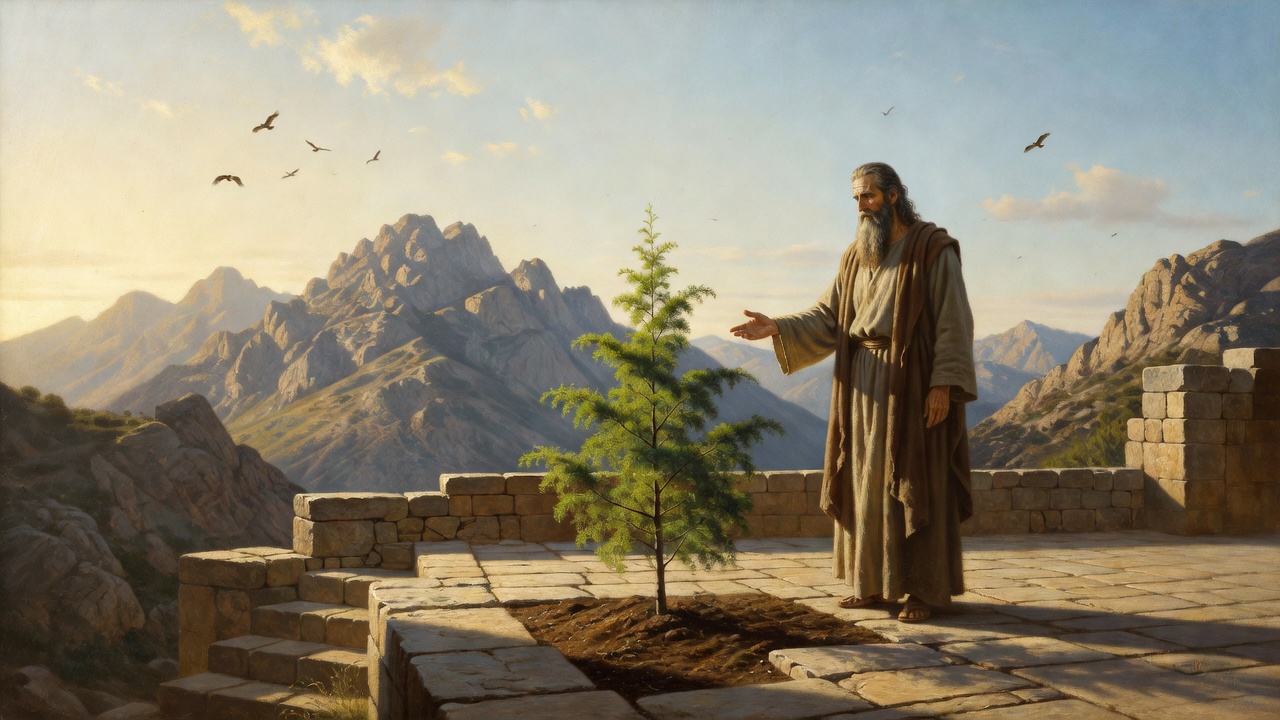
The Parable of the Eagles and the Cedar
- Ezekiel presents a political allegory where the first great eagle represents the king of Babylon, who captured Jerusalem's royal leadership and established a vassal king under a solemn covenant. The second eagle represents Egypt and its Pharaoh, to whom the Judean ruler turned for cavalry and military assistance in defiance of his sworn allegiance.Sources: the Bible text itself · Babylon · Egypt · Pharaoh
- In the prophetic message, breaking a political vassal oath made under Babylon was treated not merely as diplomatic rebellion, but as spiritual treason against God, who regarded the sworn pledge as His own oath.Sources: the Bible text itself
- The chapter concludes with a reversal of human political schemes: God Himself promises to take a tender shoot from the top of the cedar and plant it upon the mountain heights of Israel, where it will grow into a majestic tree offering shelter to birds of every kind.Sources: the Bible text itself
Notes written with AI assistance from open sources (Theographic Bible Metadata, CC BY-SA 4.0; Easton’s Bible Dictionary, public domain) and reviewed before publishing.
Places in this chapter
- Lebanon · 33.540, 35.584 · verse 3
- Canaan · 32.767, 35.333 · verse 4
- Babylon · 32.543, 44.422 · verses 12, 14, 15, 16, 17, 20
- Jerusalem · 31.777, 35.234 · verses 12, 17
- Egypt · 30.129, 31.308 · verse 15
Only places identified with high confidence are shown (90% or more according to the scholarly sources compiled by OpenBible). Period map: DARE (Digital Atlas of the Roman Empire), CC BY 4.0; modern map: © OpenStreetMap contributors; places: OpenBible.info (CC BY 4.0).
Credits and license for this translation
Nhanderuete ayvu iky'a e'ỹ va'e
New Testament in Guaraní, Mbyá
copyright © 2004 Wycliffe Bible Translators, Inc.
Language: Mbyá Guaraní (Guaraní, Mbyá)
Translation by: Wycliffe Bible Translators, Inc.
Copyright Information
© 2004, Wycliffe Bible Translators, Inc. All rights reserved.
This translation text is made available to you under the
terms of the Creative Commons License: Attribution-Noncommercial-No Derivative Works.
( http://creativecommons.org/licenses/by-nc-nd/3.0/ )
In addition, you have permission to port the text to different file formats, as long as you
do not change any of the text or punctuation of the Bible.
You may share, copy, distribute, transmit, and extract portions
or quotations from this work, provided that you include the above copyright
information:
You must give Attribution to the work.
You do not sell this work for a profit.
You do not make any derivative works that change any of the actual words or punctuation of the Scriptures.
Permissions beyond the scope of this license may be
available if you contact
us with your request.
Printed book ISBN 853110565X
The New Testament
in Guaraní, Mbyá
© 2004, Wycliffe Bible Translators, Inc. All rights reserved.
This translation is made available to you under the terms of the
Creative Commons Attribution-Noncommercial-No Derivatives license 4.0.
You may share and redistribute this Bible translation or extracts from it in any format, provided that:
You include the above copyright and source information.
You do not sell this work for a profit.
You do not change any of the words or punctuation of the Scriptures.
Pictures included with Scriptures and other documents on this site are licensed just for use with those Scriptures and documents.
For other uses, please contact the respective copyright owners.
2014-08-06
Source: http://ebible.org/gun/ · eBible.org