1 Kings 1
Nhanderuete ayvu iky'a e'ỹ va'e · Tap a verse to see its cross-references.
About this book
About 1 Kings
- Easton's Bible Dictionary (1897) treats the authorship of the books of Kings as uncertain. A tradition that Jeremiah wrote them is, in Easton's view, supported by passages almost identical with parts of Jeremiah and by events Jeremiah knew personally, yet Easton thinks it more probable that Ezra, after the Captivity, compiled the books from earlier documents, perhaps written by David, Solomon, Nathan, Gad, and Iddo. Easton dates the composition between 561 B.C., when Jehoiachin was released from captivity by Evil-merodach, and 538 B.C., the decree of Cyrus.Sources: Easton: Kings, The Books of
- Easton says these books contain the annals of the kingdom from Solomon's accession until Nebuchadnezzar and the Babylonians subdued it, a period he estimates at about 453 years. 1 Kings opens while David is dying: Adonijah, his fourth son, who had become heir-apparent to the throne after the deaths of Amnon and Absalom, has himself proclaimed king, but Nathan and Bathsheba persuade David to enthrone Solomon at once. Solomon, David's son by Bathsheba, whose history is recorded in 1 Kings 1-11, came to the throne, Easton suggests, at about sixteen or eighteen.Sources: Easton: Kings, The Books of · Adonijah · Solomon
- In the Hebrew Scriptures the two books of Kings originally formed one book; the Septuagint first divided them and, with the Vulgate, numbers them as the third and fourth books of Kings, the books of Samuel being the first and second. Easton notes that Chronicles gives greater prominence to the priestly or Levitical office, while Kings gives greater prominence to the royal office, and that in the threefold division of the Scriptures by the Jews these books are ranked among the Prophets. The narrative points to earlier sources: the book of the acts of Solomon and the chronicles of the kings of Judah and of Israel.Sources: Easton: Kings, The Books of
- After Solomon's death the ten tribes revolted and invited Jeroboam, son of Nebat, to be their king; Easton calls him the first king of those tribes and dates his reign from 976 to 945 B.C. He had fled to Egypt under the protection of Shishak I, and later moved his residence from Shechem, his first capital, to Tirzah, which remained the chief residence of Israel's kings until Omri bought the hill of Shomeron from Shemer for two talents of silver and built Samaria. The later narrative includes Ahab, Omri's son and the seventh king of Israel, whose wife was Jezebel: to the calf worship introduced by Jeroboam he added the worship of Baal, and he was severely admonished by the prophet Elijah.Sources: Jeroboam · Tirzah · Samaria · Ahab
Notes written with AI assistance from open sources (Theographic Bible Metadata, CC BY-SA 4.0; Easton’s Bible Dictionary, public domain) and reviewed before publishing.
Davi tuja'i ete jave guare
1Huvixa Davi tuja'i ete, ha'e heta ma'etỹa oguereko ma ramo ajukue py onhovãmbaa teĩ ijeyro'y ae tema.
2Ha'e ramo ixupe hembiguai kuery aipoe'i:
— Oreruvixa, tove tojoua peteĩ kunhataĩ'i nerenonde oiko va'erã. Tove ndere topena toikovy, toke avi ndejyva py, ndeyro'y riae e'ỹ aguã — he'i.
3Ha'e rami vy Israel ha'e javi rupi oeka oje'oivy kunhataĩ'i iporãve va'e. Ha'e vy Suném pygua Abisague hery va'e ojou vy ogueru huvixaa py.
4Kunhataĩ va'e ma iporã ete va'e. Huvixa re opena oikovy, oipytyvõa rupi oiko teĩ huvixa ma hexe nopena rei.
Adonias huvixarã onhemoĩ uka rivexeague
5Ha'e gui Davi ra'y Adonias Hagite pi'a va'e ma onhemboyvate rei. Ha'e vy aipoe'i:
— Xee ae 'rã aĩ huvixarã — he'i. Ha'e rami vy ojou karóxa, kavaju áry guarã kuery ha'e cinqüenta avakue henonde rupi onha okuapy aguã.
6Ha'e rami teĩ tuu ma neĩ peteĩgue ma voi nda'ijayvui ixupe. Neĩ aipo nde'i: “Mba'e re tu guĩ rami reiko?” nde'i. Ha'e ma jaexa rã iporãve va'e avi, Absalão oiko rire oiko va'ekue.
7Ha'e rami vy Zeruia pi'a Joabe ha'e sacerdote Abiatar reve jogueroayvu, ha'ea katy ha'e kuery oo vy oipytyvõ aguã re.
8Ha'e rã sacerdote Zadoque ma Adonias-a katy ndooi, neĩ Joiada ra'y Benaia, profeta Natã, Simei, Reí ha'e Davi rembiguai kuery ipy'a guaxukueve va'e ma voi.
9Ha'e rire Adonias ma ita Zoelete py oĩa py oo vy ome'ẽ mymba kuery vexa'i, vaka ha'e ikyra ete va'e oapy reve, Rogel katy'i yvu oĩ va'e py. Ha'e katy oenoĩmba avi guyvy kuery huvixa ra'y ikuai va'e, ha'e gui avakue Judá pygua huvixa rembiguai kuery ha'e javive.
10Ha'e rã profeta Natã ma noenoĩ ukai ae, neĩ Benaia, avakue ipy'a guaxukueve neĩ guyvy Salomão ma voi.
Bate-Seba reve Salomão huvixarã oĩ aguã re Natã ijayvuague
11Ha'e rami rã Natã aipoe'i Salomão xy Bate-Seba va'e pe:
— Nerendui ri ty'y Hagite pi'a Adonias huvixarã onhemoĩague? Ha'e rami teĩ nhanderuvixa Davi ndoikuaai.
12Ha'e nunga rupi eju, toromongeta, reikove reve reo jepe aguã, ndepi'a Salomão voi.
13Tereo, ejexa uka huvixa Davi pe. Ha'e vy aipo're ixupe: “Xeruvixa, reura ma e'ỹ teve xee nerembiguai pe? Mba'eta aipo're va'ekue: ‘Ndepi'a Salomão ae ma oĩ 'rã huvixave xerekovia, xerenda áry ae 'rã oĩ’, 're va'ekue. Mba'e re tu ha'vy Adonias ri huvixarã onhemoĩ?” 're 'rã ixupe.
14Ha'e gui huvixa reve ndee ndeayvu teri reve ma xee voi avaẽ 'rã nderakykue. Ha'e vy xee ju xeayvu 'rã ndeayvuague rupi — he'i.
15Ha'e gui Bate-Seba ma opy huvixa oĩa py oo vy ojexa uka ixupe. Huvixa ma tuja'i raxa ma ramo Suném pygua Abisague oĩ avi oipytyvõa rupi.
16Ha'e gui huvixa renonde py Bate-Seba ojero'a vy oĩ guenapy'ã re. Ha'e ramo oporandu vy
— Mba'e tu reipota? — he'i huvixa.
17Kunha va'e ombovai:
— Xeruvixa, Senhor Nderuete renonde reura va'ekue xee nerembiguai va'e pe. Ha'e vy aipo're va'ekue: “Ndepi'a Salomão ae ma oĩ 'rã huvixarã xerekovia. Ha'e ae 'rã oguapy xerenda áry”, 're va'ekue.
18Ha'e rami teĩ aỹ ma Adonias ae onhemoĩ ra'e huvixaverã. Ha'e gui ndee xeruvixa, ndereikuaai teri.
19Ha'e va'e ma mymba kuery ojuka uka vy ome'ẽ ma vaka ra'y ikyrave va'e ha'e vexa'i oata aguã rami rei e'ỹ. Oenoĩmba avi huvixa kuery ha'e javi, sacerdote Abiatar ha'e xondaro kuery ruvixa Joabe. Ha'e rã ndera'y Salomão ma ha'e noenoĩ ukai.
20Ha'e rami teĩ xeruvixa, Israel kuery ha'e javi ma ndere meme oma'ẽ okuapy, ndee ae reikuaa uka porãve aguã mava'e ete pa nerenda áry oguapy va'erãa nderekovia huvixarã oĩ aguã.
21Ha'e rami e'ỹ rã xeruvixa, neramoĩ kueryague rami nenhono porãa rã xee ha'e xepi'a Salomão voi orerereko axya rei 'rã joapo vai va'ety rami rive — he'i.
22Huvixa reve kunha va'e ijayvu teri reve ovaẽ avi profeta Natã ha'e py.
23Ha'e ramo huvixa pe omombe'ua vy ixupe aipo'ea:
— Apy ma ko ovaẽ profeta Natã — 'ea ramove ha'e va'e ju ojero'a vy henonde ngova omboja yvy peve.
24Ha'e vy aipoe'i:
— Xeruvixa, ndee ae ri nhi'ã aipo're va'ekue: “Adonias 'rã huvixa oĩ xee ndaikovevei ma rire, ha'e vy ha'e ae ma 'rã oguapy xerenda áry”, 're ri ty'y?
25Mba'eta ange ma ha'e ou vy ojuka uka vaka ha'e mymba kuery ikyrakueve va'e, vexa'i kuery oata aguã rami e'ỹ guive. Ha'e vy oenoĩ ukapa huvixa ra'y kuery ha'e javi, xondaro kuery ruvixa ha'e sacerdote Abiatar. Ha'e ramo ha'e kuery oguerovy'a vy okaru ha'e oy'u okuapy henonde py. Ha'e vy ixupe aipoe'i okuapy: “Ha'eve ete ma nhanderuvixave Adonias!” he'i okuapy.
26Ha'e rã xee nerembiguai aiko va'e ma naxerenoĩ, neĩ sacerdote Zadoque, Joiada ra'y Benaia ha'e ndera'y Salomão ma voi.
27Xeruvixa, ndee ae ri nhi'ã rejapo uka va'ekue ha'e nunga? Mba'eta nerembiguai kuery pe ndereikuaa ukai teve nderekovia nerenda áry oguapy va'erãa — he'i.
28Ha'e ramo huvixa Davi ijayvu vy
— Penoĩ ju ha'vy Bate-Seba xea py — he'i. Ha'e rã kunha va'e ma huvixa renonde py ou ju vy ojexa uka ho'amy ixupe.
29Ha'e ramo huvixa oura reve aipoe'i:
— Anhetẽ ete ajexavaia ha'e javi gui Senhor oikove va'e xerepy va'ekue rery rupi aura vy aipoa'e:
30Kova'e ára pyve ajapo 'rã ndevy auraague. Mba'eta Senhor Israel kuery Ruete rery rupi aipoa'e va'ekue: “Ndepi'a Salomão ae 'rã oĩ xee naĩvei jave. Ha'e ae ju 'rã oguapy xerenda áry xerekovia”, ha'e va'ekue.
31Ha'e ramo Bate-Seba ma huvixa renonde py ojero'a vy yvy peve omboja ngova. Ha'e vy aipoe'i:
— Ha'eve ete ma xeruvixa Davi, raka'e rã peve guarã!
Huvixarã Salomão omoĩ okuapyague
32Ha'e gui ma Davi aipoe'i:
— Penoĩ xea py sacerdote Zadoque, profeta Natã ha'e Joiada ra'y Benaia — he'i ramo ha'e va'e kuery oguerua rã ojexa uka okuapy huvixa pe.
33Ha'e kuery pe huvixa aipoe'i:
— Peraa ke xee penderuvixa rembiguai kuery, ha'e pejapo xera'y Salomão mburika áry oĩ aguã rami. Ha'e vy peraapa Giom katy.
34Ha'e py ma profeta Natã reve sacerdote Zadoque omoĩ 'rã huvixarã Israel kuery re opena aguã. Ha'e gui pembopu 'rã mimby guaxu, ha'e vy “Ha'eve ete ma huvixave Salomão!” peje 'rã.
35Ha'e gui ma peju jevy 'rã hupive. Ha'e rã ha'e ma ou vy oguapy 'rã xerenda áry, xerekovia ha'e ju oĩ aguã, mba'eta xeayvuague rami vy ha'e ae 'rã opena Israel ha'e Judá kuery re — he'i.
36Ha'e rami rã Joiada ra'y Benaia huvixa ombovai vy aipoe'i:
— Ha'eve va'e. Po rami ae ta'ijayvu avi Senhor xeruvixa Ruete va'e.
37Xeruvixa, ndere Senhor openaague rami ae topena Salomão re voi. Ha'e rami vy tombopo'aka xeruvixa Davi po'akaa gui eteve voi — he'i.
38Ha'e gui huvixa pegua xondaro kuery reve oje'oi sacerdote Zadoque, profeta Natã ha'e Joiada ra'y Benaia. Huvixa Davi rymba mburika'i áry ae Salomão omoĩ vy ogueraa okuapy Giom py.
39Ha'e gui sacerdote Zadoque ma azeite ryru ombojerovia aty gui ogueru va'ekue oupi vy omoĩ Salomão re. Ha'e vy mimby guaxu ombopu rã heta va'e kuery ha'e javi oendu vy ojapukai:
— Ha'eve ete ma huvixa Salomão! — he'i okuapy.
40Ha'e gui hakykue oje'oipa vy gaita ombopu reve oguerovy'a ete heravy. Onhendu atã oje'oivy yvy voi omomyĩ rei aguã rami.
Adonias ojeupegua kuery reve onhemondyipa okuapyague
41Ha'e ramo Adonias ha'e oenoĩ va'ekue okarupa ma rire oendu okuapy. Joabe voi mimby pu oendu vy aipoe'i:
— Mba'e nungarã tu pova'e tetã katy gui hevovo rei va'e onhendu?
42Ha'e ijayvu teri reve ovaẽ sacerdote Abiatar ra'y Jônatas. Ha'e ramo ixupe Adonias aipoe'i:
— Eike na, mba'eta ndee ma ava ndepy'a guaxu va'e vy mba'emo pyau porã va'e anho 'rã nhi'ã reru orevy — he'i.
43Ha'e rã Jônatas ombovai vy aipoe'i Adonias pe:
— Ha'e rami 'rãgue py nhanderuvixa Davi ma omoĩ uka ra'e Salomão huvixaverã.
44Ha'e rami vy hexeve Davi omondouka sacerdote Zadoque, profeta Natã, Joiada ra'y Benaia ha'e ojeupegua xondaro kuery. Ha'e va'e kuery ma omoĩ huvixa rymba mburika'i áry ae.
45Ha'e vy Giom py sacerdote Zadoque ha'e profeta Natã omoĩ huvixaverã. Ha'e gui oguerovy'a ete reve ojevypa jogueruvy ramo tetã ha'e javi rupi hevovo rei okuapy. Ha'e va'e kuery ae rima ojapukai rã pendu va'e.
46Ha'e gui Salomão ma huvixa renda áry oguapy ae.
47Ha'e rami ae avi Davi rembiguai kuery yvatekueve ou okuapy ixupe oxarura. Ha'e vy aipoe'i okuapy: “Nderuete tojapo nderery gui Salomão rery omboetevea aguã rami. Tombopo'akave ndepo'akaa gui eteve”, he'i okuapy ramo huvixa ngupa áry ituia pyve ojero'a.
48Ha'e rami vy aipoe'i: “Ta'ima'endu'a porãa Senhor Israel kuery Ruete re, mba'eta ange nhandevy ombou xerenda áry oguapy va'erã, xee ae rexa py ma voi aexa va'e”, he'i.
49Ha'e rami rã Adonias hexeve guarã oenoĩ va'ekue oryryipa reve opu'ãmba vy oje'oipa joa katy e'ỹ-e'ỹ.
Adonias onhemboaxy ukaague
50Ha'e rã Adonias ma Salomão gui okyje vaipa avi vy opu'ã vy templo py oo, ha'e ojopy oiny altar apy'i ikuai va'e re.
51Salomão pe aipo'ea:
— Ma'ẽ, Adonias ma ndegui okyje vy oo altar apy'i re ojopy oiny. Ha'e vy aipoe'i: “Aỹ gui huvixa Salomão toura xejuka uka e'ỹ aguã kyxe py, hembiguai aiko rã”, he'i.
52Ha'e ramo Salomão ombovai:
— Ha'e va'e ma ha'evea rami ri oiko va'e ramo neĩ peteĩ'i hi'a ma voi ndo'ai 'rã yvy py. Ha'e rã hexe nda'evei va'e oĩa jaikuaa ramo omano 'rã — he'i.
53Ha'e ramo guembiguai kuery Salomão omondouka rã omboguejy okuapy altar gui. Ha'e ramo ha'e ou vy huvixa Salomão renonde py ojero'a. Ha'e rã aipoe'i ixupe:
— Tereo ju ndero katy.
Did you know?
The Succession to David's Throne
- As David's oldest surviving son after the deaths of Amnon and Absalom, Adonijah claimed the royal succession, backed by the military commander Joab and the high priest Abiathar. However, David chose his younger son Solomon, who was supported by the prophet Nathan, the priest Zadok, and the royal bodyguard under Benaiah.Sources: Adonijah · Solomon · the Bible text itself
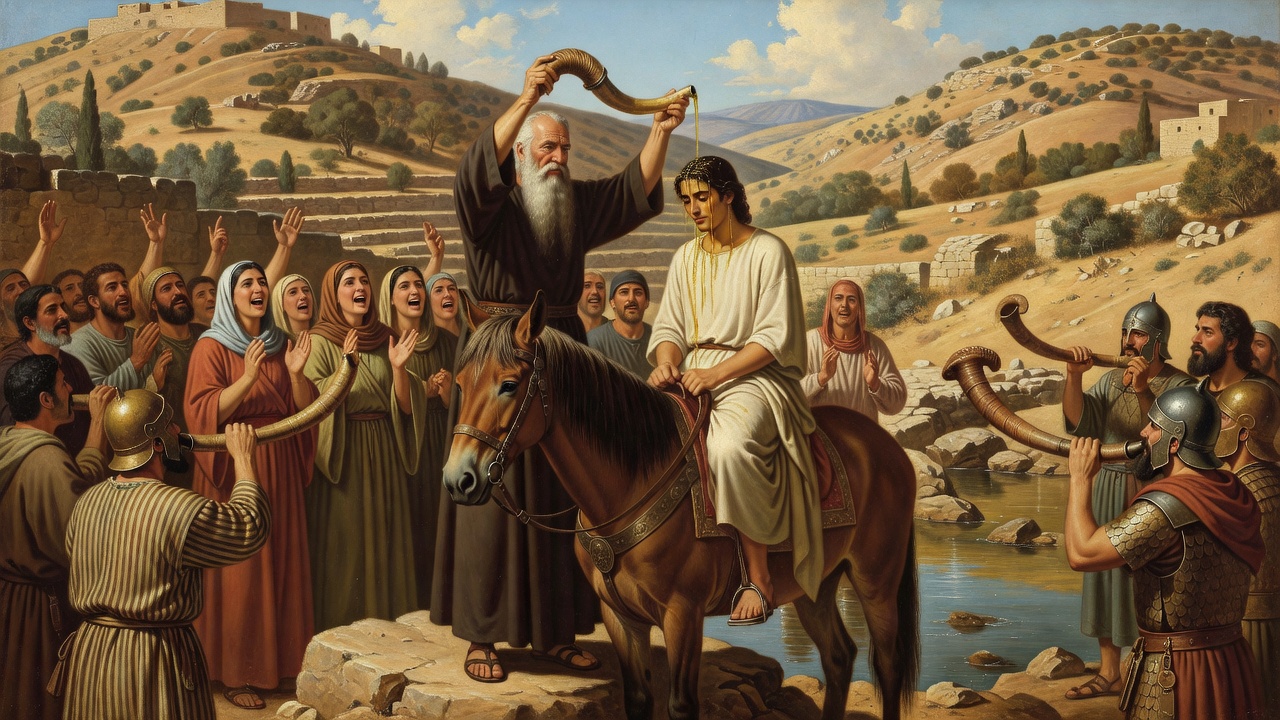
- Riding the king's own mule was a decisive public declaration of royal authority. By David's explicit instruction, Solomon was escorted down to the spring of Gihon, where Zadok anointed him king with oil taken from the tabernacle to the sound of ram's horns and popular celebration.Sources: Gihon · Zadok · the Bible text itself
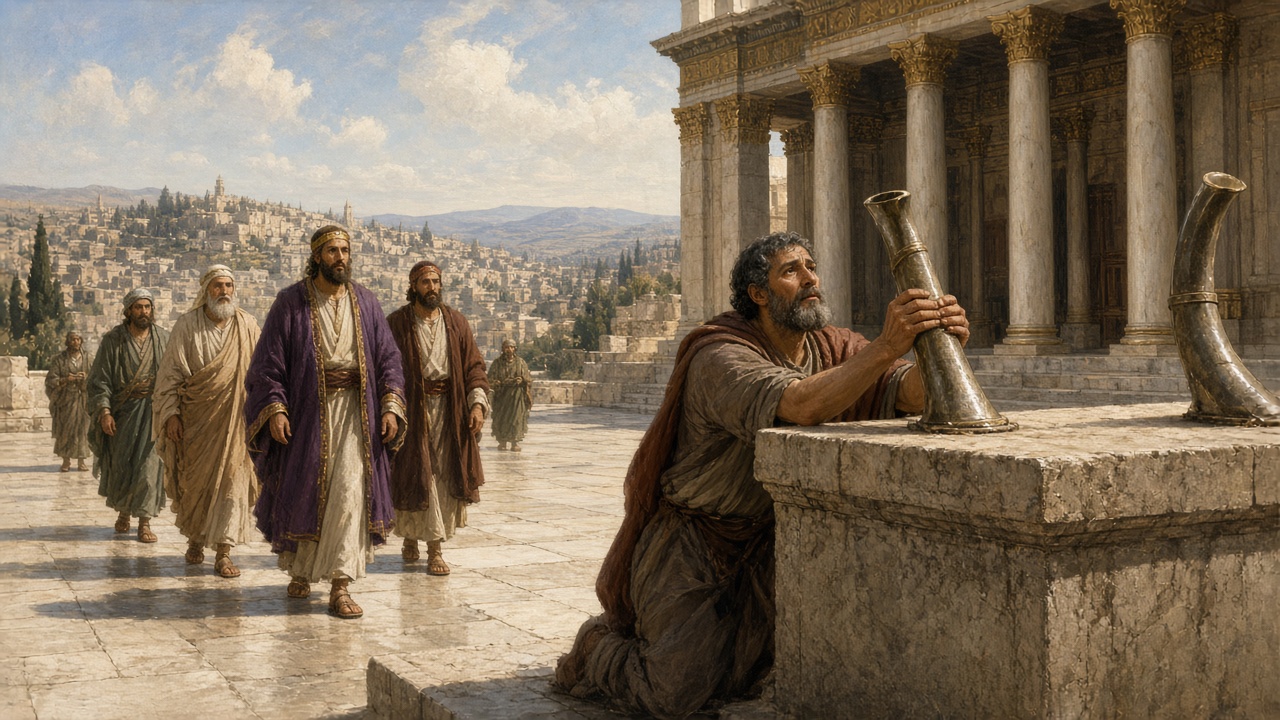
- Upon hearing of Solomon's public coronation, Adonijah fled in terror and sought asylum by taking hold of the horns of the sacrificial altar. Solomon granted him conditional clemency, sparing his life so long as he proved himself a worthy man.Sources: Adonijah · the Bible text itself
Notes written with AI assistance from open sources (Theographic Bible Metadata, CC BY-SA 4.0; Easton’s Bible Dictionary, public domain) and reviewed before publishing.
Places in this chapter
- Shunem · Today: Sulam · 32.606, 35.334 · verse 3
- Serpent’s Stone · Today: within 100 m of Bir Ayub · 31.767, 35.236 · verse 9
- Gihon · Today: Gihon Spring · 31.773, 35.236 · verses 33, 38, 44, 45
- Jerusalem · 31.777, 35.234 · verse 40
Only places identified with high confidence are shown (90% or more according to the scholarly sources compiled by OpenBible). Period map: DARE (Digital Atlas of the Roman Empire), CC BY 4.0; modern map: © OpenStreetMap contributors; places: OpenBible.info (CC BY 4.0).
Credits and license for this translation
Nhanderuete ayvu iky'a e'ỹ va'e
New Testament in Guaraní, Mbyá
copyright © 2004 Wycliffe Bible Translators, Inc.
Language: Mbyá Guaraní (Guaraní, Mbyá)
Translation by: Wycliffe Bible Translators, Inc.
Copyright Information
© 2004, Wycliffe Bible Translators, Inc. All rights reserved.
This translation text is made available to you under the
terms of the Creative Commons License: Attribution-Noncommercial-No Derivative Works.
( http://creativecommons.org/licenses/by-nc-nd/3.0/ )
In addition, you have permission to port the text to different file formats, as long as you
do not change any of the text or punctuation of the Bible.
You may share, copy, distribute, transmit, and extract portions
or quotations from this work, provided that you include the above copyright
information:
You must give Attribution to the work.
You do not sell this work for a profit.
You do not make any derivative works that change any of the actual words or punctuation of the Scriptures.
Permissions beyond the scope of this license may be
available if you contact
us with your request.
Printed book ISBN 853110565X
The New Testament
in Guaraní, Mbyá
© 2004, Wycliffe Bible Translators, Inc. All rights reserved.
This translation is made available to you under the terms of the
Creative Commons Attribution-Noncommercial-No Derivatives license 4.0.
You may share and redistribute this Bible translation or extracts from it in any format, provided that:
You include the above copyright and source information.
You do not sell this work for a profit.
You do not change any of the words or punctuation of the Scriptures.
Pictures included with Scriptures and other documents on this site are licensed just for use with those Scriptures and documents.
For other uses, please contact the respective copyright owners.
2014-08-06
Source: http://ebible.org/gun/ · eBible.org