Genesis 28
Nacom Pejume Diwesi po diwesi pena jume diwesi xua Jesucristo yabara tinatsi · Tap a verse to see its cross-references.
1Isaacbe Jacobwan wama, mayanguen tabig nebuig kønrrai tranabe, trencha karubig køn:
—Nui srain kønrrai yu Canaán pirau ishumburmeran lanrrab kømø cha. 2Kurra, Padan-Aram pirausrømay inrrø cha, tru Betuel ñui usrai møskai waisrømay. Incha ñui kuchimøskai Labanwei kan nimbasrwan ñui srain kønrrai lanrrig cha. 3Inchen Maramburab Marøb Tiusbe ñune mayanguen tabig nebuig kønrrai mara, ñune ureg larrø nørrø tøgagønrrai tranøb, ñuinukkurri purø nørrø misag søtømera nemisramnegatig martrun cha. 4Katø Abrahamwan tru mayanguen tabig nebuig kønrrai trannrrab misrig købigwan ñunba, ñuinukkurri amrrub misaameranba ñun trannrrain cha. Tru møiya ñi peesrøngurri ka arruatø lataig tsuin pirøwan ñimui mara waramig kønrrai, tru pirøwan Abrahamwein kønrai Tius nun keta trannrrabmisra kørrømisrig købigwan.—
5Øyamay Isaacbe Jacobwan Padan-Aramsrømay inrrai ørig købig køn, tru Betuel arameowei nusrkai tru Labanwei yausrømay. Truibe Rebecaimbe nuchag købig køn, Jacobweimba Esaúweimbabe usrin køben.
6Inchen Esaúbe wammørøbig køn, møskai Isaacbe tru mayanguen tabig nebuig kønrrai tranøb, sraingucha lappe, Padan-aramsrø lanrrai chiben. Incha tru mayanguen tabig nebuig kømigwan møskai tranabe, øyeeg karua pasri ashibig køn: “Yu Canaán ishumburmeran ñui srain kønrrai marøb pasrønrrab kømø” cha. 7Inchen Jacobpe møskawanba usranba møra, Padan-Aramsrømay yai ashibig køn Esaúbe. 8Incha treekkurri nui møskai Isaacbe tru Canaánsrø ishumburmerane chigucha tab kømui ashibig kuin kui wetøbeña, 9Esaúbe Abrahamwei nusrkai Ismael tsuisrømay ya, tru katøgan sralø kømnetø, trusrø Mahalatwan nui srain kønrrai marøbig køn, tru Abrahamwei nusrkai Ismaelwei nimbasrwan, tru Nebaiotwei nuchawan.
Tius Jacobwan Betelsrø Kenamisrøb
10Inchen Jacobpe Beersebagurri webya, Haran pirausrømay ibig køn. 11Inchen yandø kanbalø puabe, pørr pinaiben, truyu yem kørrømisrøbig køn. Incha truyu kan srug tsubigwan kuña mara trarra, truyu kinrrab tsumisrøbig køn. 12Inchen truyu nun piappe treeg piabig køn: Kan escalera, srømbalasrøngurri pirausrø punøsrkain pasrappe, tru kappe srømbalasrø kebacha pasrøben, møimbe truwane angelesmera nebambamba, kørrørrumba inchib køben, 13Jehovábe palasrø pasrøwabe, trenchibashib:
—Nabe Jehová kur cha, Abraham ñui aweluwei Tius, Isaac ñui møskawei Tius, ñi uyu kib tsuig pirøwane ñunba, ñuinukkurri amrrub misaameranba tranamønrrun chib. 14Ñuinukkurri amrrub misaamerabe purø nørrø køptø, pirau kan usrø tui lataig kønrrun cha, pørr pinebgatømaywansrø, pørr neeshibgatømaywansrø, walliguebwansrø, waguebwansrø, misag larrøbicha warønrrun cha. Ñui yellyugurri pirau muba kuimburab maya misaabe, ñigurri mayanguen tabig nebuilø kønrrun cha. 15Nabe ñiba pasrar cha. Ñi chu yaindøgucha nabe ñun chi kømønrrai ashib tøga pasrøwa, katøle i piraumay nabe ñune pera arrumønrrun cha. Na ñun maig martrab taigwan na trunun maramnegatig nabe ñune elachimumønrrun— taig køn tru piabyube.
16Inchen Jacob tru piab tsuigugurri kiagasrabe, trenchibig køn: “Isa kømø, Jehovábe yu pasrøben, nabe treeg kuitamappe isumubrain køn” cha. 17Incha truba kørig kui inchabe, trenchibig køn: “Yube si, purø kørig kømdiig køtan cha. Chi peg kømøtø, Tiuswei yaba, srømbalasrø yaskappa køn” cha.
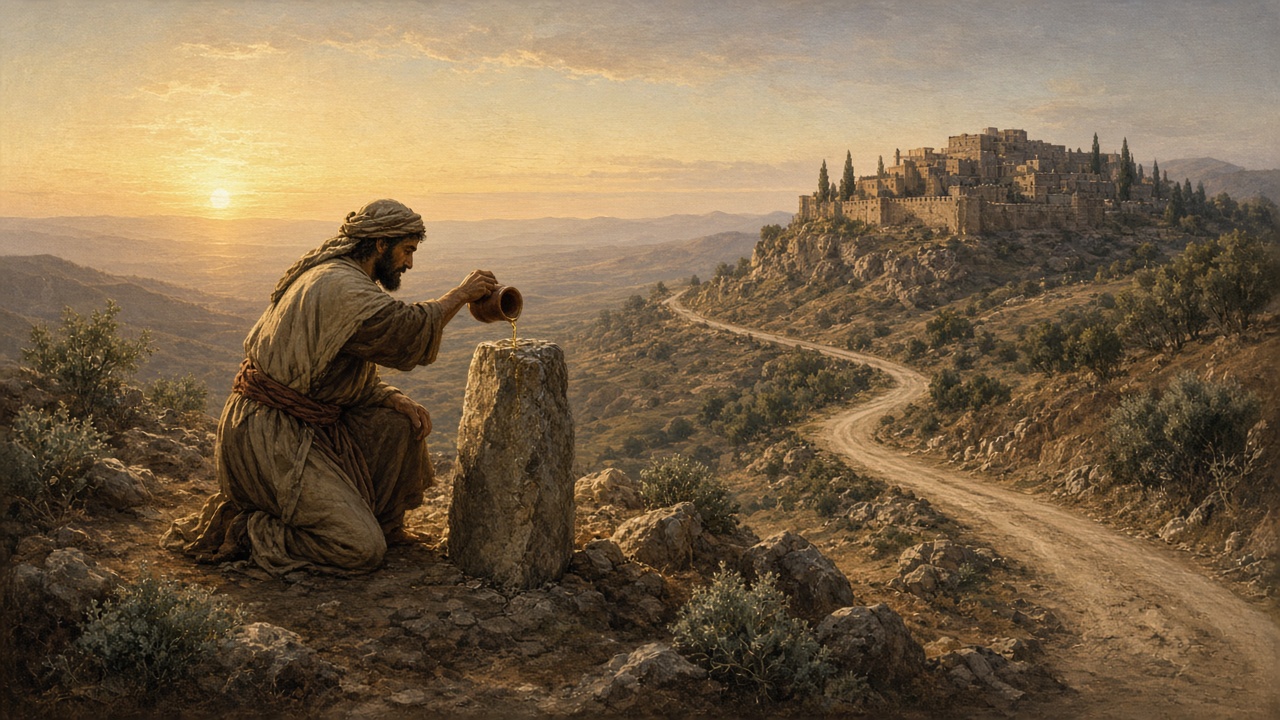
18Inchen Jacobpe løtsøzhig kurrabe, tru nø kuña mari srugwan kusrua, kan pilar lataig ølneb pasra, truyu øyeeg puigwan aschai trubala aceite itølushibig køn. 19Incha truyube Betel cha wamabig køn, merrabsrømbe tru ciudawane Luz cha wamig købig kuindøgucha.
20Incha Jacobpe nuinetø øyeeg martrab cha kørrømisrøbig køn: “Tius naba lincha pasrab, na møi øyeeg inrrab yaigu nan chigucha kømønrrai ashib, nan mamig, mutsamig tranøb, pula pasramig tranøb, 21katø na nai møskawei yausrø chigucha kømø, katøle pishindø tab ka puinabene, Jehovábe nai Tius kønrrun cha. 22Inchen i srugwan kan pilar lataig ølgandø na kusrua pasriibe, Tiuswei ya kønrrun cha. Inchen Tius nan chigurrimbunø tranigugurri nabe cienyu diezbatø, diezbatø nun tranamønrrun” chibig køn, Jacobpe.
Did you know?
Jacob's Journey and Dream at Bethel
- Isaac sent Jacob from Beersheba to Paddan-aram to take a wife from the daughters of Laban, his mother Rebekah's brother, rather than from the Canaanite women. Paddan-aram, called the plain of Aram, is commonly regarded as the Mesopotamian district around Haran, where Laban lived; Haran, also called the city of Nahor, was where Abraham stayed after leaving Ur until his father Terah died.Sources: the Bible text itself · Paddan-aram · Haran · Laban
- The place where Jacob dreamed, set up as a pillar the stone he had put under his head, and poured oil on it was the royal Canaanite city of Luz; he renamed it Bethel. Easton's Bible Dictionary (1897) locates Bethel in central Palestine, about ten miles north of Jerusalem, and notes that the name was at first apparently given to a sanctuary in the neighborhood of Luz, and was not given to the city itself until after the tribe of Ephraim conquered it.Sources: the Bible text itself · Luz · Bethel (of Palestine)
- When Esau learned that Isaac had blessed Jacob and ordered him not to marry a Canaanite woman, he went to Ishmael and married Mahalath, sister of Nebaioth and daughter of Abraham's son Ishmael, in addition to the wives he already had. Easton's Bible Dictionary (1897) also calls her Bashemath and notes that Esau's three wives receive different names in the Edomite genealogy of Genesis 36 from those given in the narrative of Genesis 26 and 28.Sources: the Bible text itself · Bashemath
Notes written with AI assistance from open sources (Theographic Bible Metadata, CC BY-SA 4.0; Easton’s Bible Dictionary, public domain) and reviewed before publishing.
Places in this chapter
- Canaan · 32.767, 35.333 · verses 1, 6, 8
- Haran · Today: Harran · 36.864, 39.033 · verse 10
- Luz · Today: Beitin · 31.923, 35.241 · verse 19
Only places identified with high confidence are shown (90% or more according to the scholarly sources compiled by OpenBible). Period map: DARE (Digital Atlas of the Roman Empire), CC BY 4.0; modern map: © OpenStreetMap contributors; places: OpenBible.info (CC BY 4.0).
Credits and license for this translation
Nacom Pejume Diwesi po diwesi pena jume diwesi xua Jesucristo yabara tinatsi
New Testament in Guambiano
copyright © 2010 Wycliffe Bible Translators, Inc.
Language: Guambiano
Translation by: Wycliffe Bible Translators, Inc.
Copyright Information
© 2010, Wycliffe Bible Translators, Inc. All rights reserved.
This translation text is made available to you under the
terms of the Creative Commons License: Attribution-Noncommercial-No Derivative Works.
( http://creativecommons.org/licenses/by-nc-nd/3.0/ )
In addition, you have permission to port the text to different file formats, as long as you
do not change any of the text or punctuation of the Bible.
You may share, copy, distribute, transmit, and extract portions
or quotations from this work, provided that you include the above copyright
information:
You must give Attribution to the work.
You do not sell this work for a profit.
You do not make any derivative works that change any of the actual words or punctuation of the Scriptures.
Permissions beyond the scope of this license may be
available if you contact
us with your request.
The New Testament
in Guambiano
© 2010, Wycliffe Bible Translators, Inc. All rights reserved.
This translation is made available to you under the terms of the
Creative Commons Attribution-Noncommercial-No Derivatives license 4.0.
You may share and redistribute this Bible translation or extracts from it in any format, provided that:
You include the above copyright and source information.
You do not sell this work for a profit.
You do not change any of the words or punctuation of the Scriptures.
Pictures included with Scriptures and other documents on this site are licensed just for use with those Scriptures and documents.
For other uses, please contact the respective copyright owners.
2014-04-25
Source: http://ebible.org/gum/ · eBible.org