Nehemiah 8
Tupàn ze'eg · Tap a verse to see its cross-references.
Umugeta Ezàrà Tupàn ze'eg teko wanupe kury
17 haw zahy mehe teko Izaew paw wiko tawhu weko haw pe wà. 'Ar ipy mehe uzemono'og oho Zeruzarez pe wà, katu pe ukenawhu 'Y heta haw her ma'e henataromo wà. Wenoz ma'e xaxeto Tupàn ze'eg ikwaw par Ezàrà her ma'e pe wà kury. — Erur Tupàn Tuweharupi Wiko Ma'e ze'eg Izaew wanupe imur pyrer Moizez pe imur pyrer nehe, xe urewe nehe, i'i izupe wà. 2Ezàrà werur a'e pape teko wazemono'ogaw pe. Awa wà, kuzà wà no, kwarearer ma'e kwaw par wà no, kuzàtàigwer ma'e kwaw par wà no, uzemono'og a'e pe wà. 3A'e pe katu pe ukenawhu henataromo Ezàrà umugeta Tupàn ze'eg teko wanupe kury. Uzypyrog kwarahy ihem mehe. Umugeta wi wi te kwarahy wapytepe hin mehe. Paw rupi uzeapyaka katu hehe uzekaiw katu pà wà.
4Ezàrà u'àm ywyrapew rehe. Teko uzapo a'e ywyrapew izupe wà. — Epu'àm hehe Tupàn ze'eg imugeta mehe nehe, i'i izupe wà. Iawyze har rehe amo awa u'àm wà: Maxixi, Xema, Anai, Uri, Iwki, Mazez. Iahurehe u'àm amo awa wà no: Penai, Mizaew, Mawki, Azu, Azimanana, Zakari, Mezurà.
5Ezàrà upyta a'e pe ywyrapew rehe iaiha katu haw pe teko wanenataromo. Paw rupi ume'e hehe wà. Pape ipiaok mehe upu'àm paw rupi wà. 6Na'e uze'eg Ezàrà wanupe kury. — Pemume'u Tupàn Tuweharupi Wiko Ma'e uhua'u ma'e ikatu haw nehe, i'i wanupe. Teko paw upir uzywa ize'eg iwazar pà izupe wà. — Azeharomoete, azeharomoete, i'i wà. Na'e wapyk upenàràg rehe uwa imuhyk pà ywy rehe wà kury, Tupàn imuwete katu pà wà kury.
7A'e re upu'àm upyta haw pe wà. Na'e Erewi izuapyapyr umume'u Tupàn ze'eg teko wanupe wà. Na'aw waner xe wà: Zezua, Mani, Xeremi, Zami, Aku, Xametaz, Oni, Mazez, Kerit, Azari, Zozamaz, Ànà, Perai. 8Umugeta Tupàn ze'eg oho waiko wà. Na'e umume'u katu a'e ze'eg wanupe wà no. Nezewe mehe teko ukwaw katu wà.
9Tupàn ze'eg imugeta haw henu mehe teko uzai'o wà. Na'e tuwihaw Neemi a'e, xaxeto Ezàrà Tupàn ze'eg kwaw katu har a'e no, Erewi izuapyapyr a'e pe har a'e ze'eg imume'u har a'e wà no, uze'eg teko wanupe ma'e imume'u katu pà wà kury. — Ko 'ar Tupàn Tuweharupi Wiko Ma'e omonokatu uzeupe a'e. A'e rupi pezemumikahy zo nehe. Pezai'o zo nehe. 10Peho peneko haw pe zegar hawhu iapo pà nehe. Aze naheta kwaw ma'e zegar haw rehe har amo pe nehe, pemono penemi'u ràm ikurer izupe nehe. Pemono win ikurer izupe nehe no. Ko 'ar uzemonokatu Tupàn Zanezar pe. A'e rupi pezemumikahy zo nehe. Penurywete haw Tupàn Tuweharupi Wiko Ma'e hemimur ràm pemukàg kar putar a'e nehe, i'i wanupe wà.
11Erewi izuapyapyr oho teko wamytemyteromo wà. — Pezemumikahy zo 'ar imonokatu pyrer ko 'ar zàwenugar rehe nehe, i'i oho waiko wanupe wà. 12Na'e teko paw oho weko haw pe wà. Umai'u urywete pà wà. Ui'u win pupe urywete pà wà no. Ma'e hereko har omono ma'e hereko 'ymar wanupe wà. Ta'e wenu katu Tupàn ze'eg wanupe imugeta pyrer a'e wà xe.
Mynykaw Tàpuzràn her ma'e
13Iku'egwer pe oho Ezàrà ipyr wà: teko uzeànàm ma'e wà, xaxeto wà, Erewi izuapyapyr wà. Izemu'e wer Tupàn ze'eg rehe hehe we a'e wà. 14Kwehe mehe Tupàn Tuweharupi Wiko Ma'e umuigo kar Izaew tàpuzràn pupe zegar hawhu Tàpuzràn her ma'e rehe a'e wà. Umume'u a'e ze'eg Moizez pe. A'e teko Ezàrà ipyr uzemu'e ma'e wexak a'e ze'eg pape rehe imuapyk pyrer wà kury.
15Na'e umume'u kar ko ze'eg Zeruzarez tawhu pe har nànàn, amogwer tawhu pe har nànàn no, taw pe har nànàn no. — Pehem peho ywytyr rehe ma'e 'yw hàkàgwer herur pà nehe: ywyra pin her ma'e hàkàgwer, uri hàkàgwer, muruta hàkàgwer, inaza ràn hàkàgwer, amo i'yw hàkàgwer. Pezapo tàpuzràn Tupàn ze'eg rupi katete nehe.
16Na'e teko paw oho ma'e'yw hàkàgwer herur pà wà kury. Uzapo tàpuzràn wàpuz henataromo katu pe wà, uma'etymaw rehe wà no, tàpuzuhu huwake katu pe wà no, katu pe ukenawhu 'Y heta haw her ma'e huwake wà no, ukenawhu Eparai her ma'e huwake wà no. 17Upyhyk awer wi uzewyr ma'e kwer paw uzapo tàpuzràn wà, ipupe upyta pà wà. Zuzue Nun ta'yr heko mehe arer we teko nuzapo pixik kwaw zegar hawhu tàpuzràn her ma'e wà. Uzapo wà kury. Hurywete paw rupi iapo mehe wà. 18Tuweharupi zegar haw 'ar ipy mehe arer we te 'ar iahykaw rehe har mehe umugeta amo Tupàn ze'eg ipegwer wà. Umumaw 7 'ar zegar haw iapo pà wà. 8 haw 'ar mehe uzapo uzemono'ogaw puka haw heta 'ymaw wà kury, zegar haw imumaw pà wà kury. Ta'e ze'eg kwehe arer uzapo kar nezewe haw wanupe a'e xe.
Did you know?
The Reading of the Law and the Feast of Booths
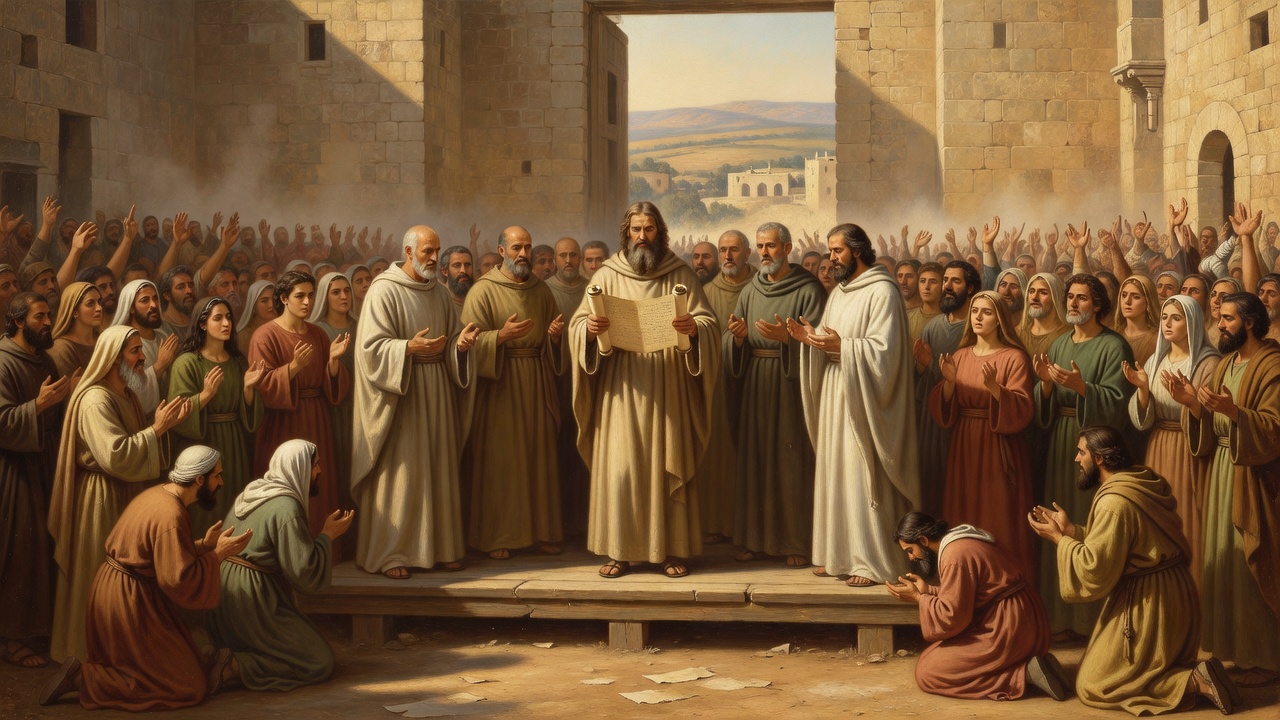
- Ezra the scribe, a priest descended from Aaron who had led exiles back from Babylon, read the Book of the Law of Moses from daybreak until noon to the assembly in Jerusalem. Standing on a high wooden platform in the square before the Water Gate, he read while Levites explained the text so the entire crowd could understand.Sources: the Bible text itself · Ezra · Water Gate · Jerusalem
- When the people wept upon hearing the Law read, Nehemiah the governor, Ezra, and the Levites instructed them not to grieve on a holy day. The people were told to celebrate with rich food and sweet drinks, share portions with those who had nothing prepared, and take comfort in the joy of the Lord.Sources: the Bible text itself
- After discovering the command in the Law to live in booths during the seventh month, the returned exiles gathered palm, olive, and myrtle branches to build shelters across Jerusalem's rooftops, courts, and squares by the Water Gate and the Gate of Ephraim. The text notes that the Israelites had not celebrated this feast in such a manner since the time of Joshua son of Nun.Sources: the Bible text itself · Water Gate · Gate of Ephraim
Notes written with AI assistance from open sources (Theographic Bible Metadata, CC BY-SA 4.0; Easton’s Bible Dictionary, public domain) and reviewed before publishing.
Places in this chapter
- Water Gate · Today: in Jerusalem · 31.777, 35.234 · verses 1, 3, 16
- Jerusalem · 31.777, 35.234 · verse 15
- Ephraim Gate · Today: in Jerusalem · 31.777, 35.234 · verse 16
Only places identified with high confidence are shown (90% or more according to the scholarly sources compiled by OpenBible). Period map: DARE (Digital Atlas of the Roman Empire), CC BY 4.0; modern map: © OpenStreetMap contributors; places: OpenBible.info (CC BY 4.0).
Credits and license for this translation
Tupàn ze'eg
Bible without Deuterocanon in Guajajára (BR:gub:Guajajára)
copyright © 2007 Wycliffe Bible Translators, Inc.
Language: Guajajára
Translation by: Wycliffe Bible Translators, Inc.
Guajajára [gub], Brazil
Copyright Information
© 2007, Wycliffe Bible Translators, Inc. All rights reserved.
This translation text is made available to you under the
terms of the Creative Commons License: Attribution-Noncommercial-No Derivative Works.
( http://creativecommons.org/licenses/by-nc-nd/3.0/ )
In addition, you have permission to port the text to different file formats, as long as you
do not change any of the text or punctuation of the Bible.
You may share, copy, distribute, transmit, and extract portions
or quotations from this work, provided that you include the above copyright
information:
You must give Attribution to the work.
You do not sell this work for a profit.
You do not make any derivative works that change any of the actual words or punctuation of the Scriptures.
Permissions beyond the scope of this license may be
available if you contact
us with your request.
Printed book ISBN 9788531109713
The Bible without Deuterocanon
in Guajajára
© 2007, Wycliffe Bible Translators, Inc. All rights reserved.
This translation is made available to you under the terms of the
Creative Commons Attribution-Noncommercial-No Derivatives license 4.0.
You may share and redistribute this Bible translation or extracts from it in any format, provided that:
You include the above copyright and source information.
You do not sell this work for a profit.
You do not change any of the words or punctuation of the Scriptures.
Pictures included with Scriptures and other documents on this site are licensed just for use with those Scriptures and documents.
For other uses, please contact the respective copyright owners.
2020-03-30
Source: http://ebible.org/gubBl/ · eBible.org