Joshua 4
Tupàn ze'eg · Tap a verse to see its cross-references.
12 ita teko imuma'enukwaw kar har
1Teko paw umumaw yrykaw ahaw paw a'e wà kury. Na'e Tupàn uze'eg Zuzue pe kury.
2Exaexak 12 awa teko wanehe we har ne wà nehe kury. Pitàitàigatu Izaew izuapyapyr umur kar putar pitài awa wà nehe. 3Eze'eg nezewe a'e 12 awa wanupe nehe. — Pepyhyk ita pitàitàigatu pe wà nehe, Zotàw yrykaw myter wi wanerur pà pe wà nehe, xaxeto wapyta awer wi pe wà nehe, ere wanupe nehe. — Peraha a'e ita yrykaw ywaz rehe nehe. Peker putar amo me kutàri pyhaw nehe. Pemono a'e ita ywy rehe peker haw huwake pe wà nehe, ere wanupe nehe, i'i Tupàn Zuzue pe.
4A'e rupi Zuzue omono'og a'e 12 awa Izaew wanehe we har a'e wà kury. Pitàitàigatu Izaew ta'yr wazuapyapyr umur kar pitài awa izupe wà. 5Uze'eg nezewe wanupe kury. — Peho Tupàn pezar ze'eg hyru henataromo nehe ty wà, Zotàw yrykaw myter pe nehe ty wà. Pe pitàitàigatu pepyhyk amo ita hupir pà peaxi'i rehe nehe, inugwer iwyr rehe heraha pà nehe, i'i wanupe. 6— A'e ita upyta putar a'e pe nehe, ma'e rehe pemuma'enukwaw kar har romo nehe. Amo 'ar mehe pena'yr upuranu putar penehe wà nehe. — Ma'in 'àg ita zanewe a'e wà, i'i putar peme wà nehe. 7— Tupàn umupytu'u kar Zotàw 'y iwyryk ire xe kwehe mehe a'e, uze'eg hyru henataromo a'e. Zotàw yrykaw hahaw mehe 'y upytu'u uwyryk ire a'e, peze pepurumuzàg wanupe nehe. 'Àg ita a'e wà, a'e ma'e uzeapo ma'e kwer rehe purumuma'enukwaw kar ma'e romo upyta Izaew izuapyapyr wanupe tuweharupi wà nehe, ere wanupe nehe, i'i Zuzue a'e 12 awa wanupe.
8A'e rupi Izaew izuapyapyr weruzar Zuzue ze'eg a'e wà kury. Weraha 12 ita Zotàw myter parer wà, ta'e heta 12 Izaew ta'yr izuapyapyr wà xe. Uzapo ma'e paw Tupàn ze'eg Zuzue pe imume'u pyrer rupi katete a'e wà kury. Weraha a'e ita uker haw pe wà. Umuapyk ywy rehe wà.
9Zuzue upyhyk amo ita a'e no, ywytyra'i zàwenugar iapo pà a'e pe, a'e ita Zotàw myter parer xaxeto wapu'àm awer rehe arer. (A'e xaxeto weraha Tupàn Ze'eg Hyru wà.) A'e ita a'e pe hin te ko 'ar rehe wà kury. 10A'e xaxeto Tupàn Ze'eg Hyru heraha har a'e wà, upyta Zotàw myter pe u'àm pà wà. Teko upyhyk a'e 12 ita wà. Xo a'e re xaxeto uhem oho 'y wi wà. (Izypy mehe Moizez uzapo kar Tupàn hemiapo putar haw teko wanupe. Imàno re Zuzue wiko Tupàn ze'eg imume'u har romo wanupe a'e kury.) Uzàn teko yrykaw hahaw pà wà kury. 11Upaw rupi hahaw ire xaxeto werur Tupàn Ze'eg Hyru teko wakutyr wà kury. Teko yrykaw waz har ume'e wanehe herur mehe wà. 12Awa Humen izuapyapyr wà, awa Kaz izuapyapyr wà no, awa Manaxe izuapyapyr wanehe arer wà no, wahaw yrykaw amogwer Izaew izuapyapyr wanenataromo wà. Weraha utakihe puku opo pe wà, Moizez ze'eg awer rupi katete a'e wà. 1340 miw awa zauxiapekwer puruàmàtyry'ym ma'e ru'u wahaw yrykaw Tupàn Zanezar henataromo a'e wà, kaiwer Zeriko tawhu huwake har ywytyr heta 'ymaw pe a'e wà. Uzemuàgà'ym puruàmàtyry'ymaw rehe wà. 14A'e 'ar rehe Tupàn ukwaw kar Zuzue ikàgaw Izaew izuapyapyr wanupe. Teko umuawate Zuzue hekuwe mehe we te imàno haw 'ar rehe wà. Izypy mehe umuawate Moizez a'e wà. A'e 'ar rehe umuawate Zuzue nezewegatete wà no.
15Na'e uze'eg wi Tupàn Zuzue pe kury.
16— Eze'eg xaxeto heze'eg hyru herur har wanupe nehe kury. — Pehem pezuwà Zotàw yrykaw wi nehe kury, ere wanupe nehe, i'i izupe.
17A'e rupi uze'eg wanupe. — Pehem pezuwà Zotàw wi nehe kury, i'i wanupe. 18A'e rupi xaxeto uhem yrykaw wi Tupàn Ze'eg Hyru herur pà wà kury. Upyrog ywy rehe wà kury. Tàrityka'i 'y Zotàw rupi har uzewyr uwyrykaw pe. Typy wi a'e 'ym mehe we arer zàwe.
19Pitài haw zahy rehe 10 haw 'ar rehe teko uzeupir Zotàw yrykaw wi a'e wà kury. Umupu'àm wàpuzràn uker haw iapo pà Ziwkaw rehe Zeriko tawhu huwake kwarahy hemaw kutyr wà kury. 20Upyhyk Zuzue a'e 12 ita Zotàw myter parer wà kury. Uzapo ywytyra'i a'e pe ita imuapyapyk pà i'ai'aromo pitàitàigatu. 21Uze'eg Zuzue Izaew izuapyapyr wanupe. — Amo 'ar mehe nehe, pezuapyapyr upuranu putar u wanehe uhy wanehe wà nehe. — Ma'in 'àg ita zanewe, i'i putar wà nehe. 22Nezewe peze wanupe nehe. — Kwehe mehe Izaew izuapyapyr wahaw Zotàw yrykaw ywy uxinig ma'e rehe wata pà a'e wà, peze wanupe nehe. 23— Ta'e Tupàn pezar umupytu'u kar Zotàw iwyryk ire penenataromo a'e xe. A'e rupi pepuner hahaw paw rehe. Xo hahaw pawire zo umuyryk kar wi 'y hupi a'e. Kwehe mehe Tupàn uzapo a'e ma'e zàwenugar Yryhupiràg pe. Kutàri uzapo a'e ma'e Zotàw yrykaw pe. Umuxinig 'y zanerenataromo. A'e rupi zapuner hahaw paw rehe. 24Uzapo Tupàn a'e purumupytuhegatu kar haw kwez a'e kury. Nezewe mehe teko ywy nànànar paw upuner putar ikàgaw ikwaw paw rehe a'e wà nehe. Nezewe mehe pekyze putar tuwe Tupàn pezar wi imuwete katu pà nehe, i'i Zuzue Izaew izuapyapyr wanupe.
Did you know?
Twelve Memorial Stones and the Crossing of the Jordan
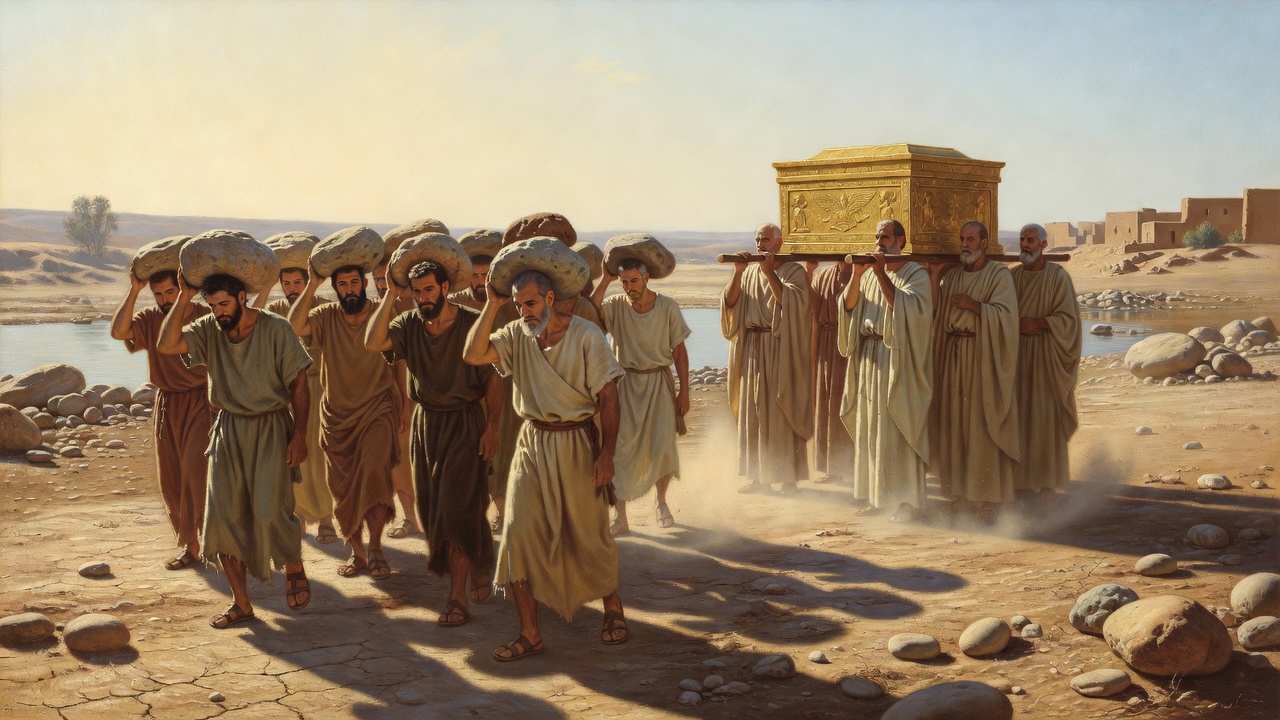
- The chapter describes two distinct sets of twelve stones: one gathered from the riverbed by twelve representatives from each tribe and erected at the encampment in Gilgal, and another set up by Joshua directly in the middle of the Jordan where the priests stood. These monuments were designed as permanent educational memorials for future generations.Sources: the Bible text itself · Gilgal
- Fulfilling instructions originally given by Moses, about 40,000 armed warriors from the tribes of Reuben, Gad, and the half-tribe of Manasseh crossed at the forefront of Israel onto the plains of Jericho, even though their own allotted territories were on the eastern side of the Jordan.Sources: the Bible text itself · Reuben · Gad · Manasseh (son of Joseph)
- The crossing of the Jordan is explicitly framed as the counterpart to the crossing of the Red Sea under Moses. The people arrived on the western side on the tenth day of the first month, establishing their base at Gilgal on the eastern border of Jericho.Sources: the Bible text itself · Gilgal · Jericho · Red Sea
Notes written with AI assistance from open sources (Theographic Bible Metadata, CC BY-SA 4.0; Easton’s Bible Dictionary, public domain) and reviewed before publishing.
Places in this chapter
- Jordan · Today: Jordan River · 31.761, 35.558 · verses 1, 3, 5, 7, 8, 9, 10, 12, 16, 17, 18, 19, 20, 22, 23
- Jericho · Today: Tell es Sultan · 31.872, 35.445 · verses 13, 19
Only places identified with high confidence are shown (90% or more according to the scholarly sources compiled by OpenBible). Period map: DARE (Digital Atlas of the Roman Empire), CC BY 4.0; modern map: © OpenStreetMap contributors; places: OpenBible.info (CC BY 4.0).
Credits and license for this translation
Tupàn ze'eg
Bible without Deuterocanon in Guajajára (BR:gub:Guajajára)
copyright © 2007 Wycliffe Bible Translators, Inc.
Language: Guajajára
Translation by: Wycliffe Bible Translators, Inc.
Guajajára [gub], Brazil
Copyright Information
© 2007, Wycliffe Bible Translators, Inc. All rights reserved.
This translation text is made available to you under the
terms of the Creative Commons License: Attribution-Noncommercial-No Derivative Works.
( http://creativecommons.org/licenses/by-nc-nd/3.0/ )
In addition, you have permission to port the text to different file formats, as long as you
do not change any of the text or punctuation of the Bible.
You may share, copy, distribute, transmit, and extract portions
or quotations from this work, provided that you include the above copyright
information:
You must give Attribution to the work.
You do not sell this work for a profit.
You do not make any derivative works that change any of the actual words or punctuation of the Scriptures.
Permissions beyond the scope of this license may be
available if you contact
us with your request.
Printed book ISBN 9788531109713
The Bible without Deuterocanon
in Guajajára
© 2007, Wycliffe Bible Translators, Inc. All rights reserved.
This translation is made available to you under the terms of the
Creative Commons Attribution-Noncommercial-No Derivatives license 4.0.
You may share and redistribute this Bible translation or extracts from it in any format, provided that:
You include the above copyright and source information.
You do not sell this work for a profit.
You do not change any of the words or punctuation of the Scriptures.
Pictures included with Scriptures and other documents on this site are licensed just for use with those Scriptures and documents.
For other uses, please contact the respective copyright owners.
2020-03-30
Source: http://ebible.org/gubBl/ · eBible.org