Ezekiel 46
Tupàn ze'eg · Tap a verse to see its cross-references.
Tuwihawete mynykawhu rehe we
1Zanezar Tuweharupi Wiko Ma'e uze'eg kury. — Tuwe pewàpytym ukenawhu ata haw tàpuzuhu pupe har teixe haw nehe, teko wama'ereko haw 'ar rehe nehe. Heta 6 'ar. Pewàpytymawok mytu'u haw mehe nehe. Pewàpytymawok mynykawhu zahy pyahu rehe har mehe nehe no. 2Tuwihawete oho putar katu pe har wi ipupyaikaw pyrer ukenawhu huwake har pe nehe. Upyta putar ukenawhu pe teixe haw pe nehe. A'e 'ar mehe xaxeto umur putar ma'e herenataromo ukaz paw ma'e ràm ihewe wà nehe. Umur putar hemuawyze kar haw wà nehe no. A'e pe tuwihawete uzapo putar hemuwete haw nehe. A'e re uhem putar a'e wi nehe. Tuwe ukenawhu uzewàpytymawok karuk mehe nehe. 3Ihe Tupàn Tuweharupi Wiko Ma'e romo aiko. Zahy pyahu mynykawhu mehe mytu'u haw 'ar mehe teko paw uzeamumew putar herenataromo wà nehe, hemuwete katu pà ukenawhu henataromo wà nehe. 4Ihe Tupàn Tuweharupi Wiko Ma'e romo aiko. Mytu'u haw 'ar mehe tuwihawete umur putar amo ma'ea'yr hapy pyràm ukaz paw ma'e ràm ihewe a'e wà nehe: pitài àràpuhàràn hawitu ma'e awa ikatu 'ymaw hereko 'ymar, 6 àràpuhàràna'yr hawitu ma'e ikatu 'ymaw hereko 'ymar wà no. 5Hemirur àràpuhàràn nànàn umur putar 17,5 zutahyky'a por arozràn ihewe nehe no. Àràpuhàràna'yr nànàn umur putar wemimutar ihewe nehe. 17,5 zutahyky'a por arozràn ihewe imur mehe werur putar na'iruz zutahyky'a por uri kawer ihewe nehe no. 6Mynykawhu zahy pyahu mehe uzuka putar amo ma'ea'yr herenataromo wà nehe: pitài tapi'aka'yr awa ikatu 'ymaw hereko 'ymar, pitài àràpuhàràn hawitu ma'e awa ikatu 'ymaw hereko 'ymar, 6 àràpuhàràna'yr hawitu ma'e ikatu 'ymaw hereko 'ymar wà. 7Tapi'ak rehe we àràpuhàràn rehe we umur putar 17,5 zutahyky'a por arozràn ihewe nehe. Àràpuhàràna'yr wanehe we umur putar wemimutar ihewe nehe. 17,5 zutahyky'a por arozràn ihewe imur mehe werur putar na'iruz zutahyky'a por uri kawer ihewe nehe no. 8Tuwe tuwihawete uzewyr ukenawhu wi nehe. Ukwaw putar ipupyaikaw pyrer uhu ma'e rupi nehe. Wixe mehe ur a'e rupi. Uzewyr mehe oho a'e rupi no.
9Teko Tupàn Tuweharupi Wiko Ma'e imuwete mehe wà nehe, wyzài mynykaw rehe wà nehe, ukenawhu kwarahy heixe haw awyze har kutyr har rupi wixe ma'e kwer uhem putar oho ukenawhu kwarahy ihemaw awyze har kutyr har rupi wà nehe, hemuwete re wà nehe. Ukenawhu kwarahy ihemaw awyze har kutyr har rupi wixe ma'e kwer oho ukenawhu kwarahy heixe haw awyze har kutyr har rupi wà nehe, hemuwete re wà nehe. Ni amo nuhem kwaw wixe awer rupi wà nehe. Uhem putar wixe haw ikupe kutyr har rupi wà nehe. 10Tuwihawete wixe putar teko waneixe mehe nehe. Uhem putar oho teko wahem mehe nehe no. 11Mynykaw 'ar mehe nehe, tàmuz wanemiapo kwer rehe ma'enukwaw haw 'ar mehe nehe no, pemur putar 17,5 zutahyky'a por arozràn tapi'ak awa nànàn nehe, àràpuhàràn nànàn nehe no. Hemuwete har umur putar wyzài wemimutar àràpuhàràna'yr nànàn nehe no. 17,5 zutahyky'a por arozràn ihewe imur pyr nànàn perur na'iruz zutahyky'a por uri kawer nehe no.
12Ihe Tupàn Tuweharupi Wiko Ma'e romo aiko ihe. Aze tuwihawete ipurumur wer ma'e rehe ihewe nehe, ma'e hapy pyràm ukaz paw ma'e ràm, u, amo hemuawyze kar àwàm nehe, xaxeto uwàpytymawok putar ata haw tàpuzuhu pupe har hukenaw izupe wà nehe. Uma'ema'e putar wemimur mytu'u haw 'ar mehe har zàwegatete nehe. Ihem ire uwàpytym putar ukenawhu wà nehe.
Ma'ea'yr Tupàn henataromo izuka pyr tuweharupi har wà
13Tupàn Tuweharupi Wiko Ma'e uze'eg. — Aiko Tuweharupi Wiko Ma'e romo ihe. Tuweharupi ku'em mehe pemur pitài àràpuhàràna'yr hawitu ma'e pitài kwarahy hereko har ikatu 'ymaw hereko 'ymar ihewe nehe, izuka pà herenataromo nehe. Pezapo nezewe haw tuweharupi nehe. 14Tuweharupi ku'em mehe pemur 1,5 kir arozràn ihewe nehe. Pemur pitài zutahyky'a por uri kawer arozràn inuinuromo àràm romo nehe no. Aiko Tuweharupi Wiko Ma'e romo ihe. Peruzar ko ze'eg ma'e ihewe imur pyr rehe har tuweharupi nehe. 15Pemur a'e ma'e ihewe tuweharupi ku'em mehe nehe: àràpuhàràna'yr hawitu ma'e, arozràn imuku'i pyrer, uri kawer. Pezapo nezewe haw tuweharupi nehe.
Tuwihawete ywy rehe we
16Zanezar Tuweharupi Wiko Ma'e uze'eg wi kury. — Aze tuwihawete omono uiwy pehegwer pitài wa'yr pe nehe, ta'yr wiko putar a'e ywy izar romo nehe. Iànàm wiko putar izar romo wà nehe. 17Aze tuwihawete omono uiwy pehegwer pitài wemiruze'eg pe nehe, kwarahy purumuhemaw ihem mehe a'e ywy uzewyr putar tuwihawete pe nehe. Wiko wi putar izar romo nehe. Ta'yr wiko putar izar romo wà nehe no. 18Tuwe tuwihawete nupyhyk kwaw amo ywy teko wanuwi nehe. Uiwy pehegwer zo omono putar wa'yr wanupe nehe. Nezewe mehe na'imunar kwaw teko wanehe nehe. Nupyhyk kwaw waiwy wanuwi nehe.
Ma'ea'yr imupupur haw tàpuzuhu pupe har
19A'e ma'e pawire a'e awa hereraha ipupyaikaw pyrer ukenawhu huwake har pe teixe haw pe kury. Ipupyaikaw pyrer ume'e kwarahy heixe haw awyze har kutyr. Xaxeto waneko haw Tupàn pe imonokatu pyrer ikatuahy ma'e romo a'e wà. Wexak kar amo ywy ipupyaikaw pyrer huwake har kwarahy heixe haw kutyr har ihewe kury. 20Uze'eg ihewe. — Xaxeto umupupur putar ma'ea'yr Tupàn henataromo izuka pyrer wano'o kwer xe wà nehe. Umihir putar arozràn xe wà nehe no. Wazuka haw umunàn putar teko wanemiapo kwer ikatu 'ym ma'e wà nehe. Upurumukatu putar wà nehe no. Nezewe mehe xaxeto nueraha kwaw Tupàn henataromo ikatuahy ma'e ata haw katu pe har pe wà nehe. Aze mo weraha a'e pe wà, upuner mo ikatu 'ym ma'e iapo haw rehe teko wanupe wà nehe.
21Na'e hereraha ata haw katu pe har pe kury. Pitàitàigatu iahykaw rehe heta ata haw pixika'i wera'i ma'e. Zeirugatu wà. Heta 20 met ipuku haw pitàitàigatu. Heta 15 met ipupy uhu haw pitàitàigatu no. 23Ata haw nànàn heta pàrirogawtàtà ita iapo pyrer. Heta tata henaw pàrirogawtàtà nànàn uzepokok ma'e. 24Awa uze'eg ihewe. — Tàpuzuhu pe uma'ereko ma'e umupupur putar ma'ea'yr teko wanemimur kwer tàpuzuhu pupe izuka pyrer wà nehe, 'aw ma'e mupupur haw pupe wà nehe.
Did you know?
Worship, Royal Duties, and Temple Kitchens
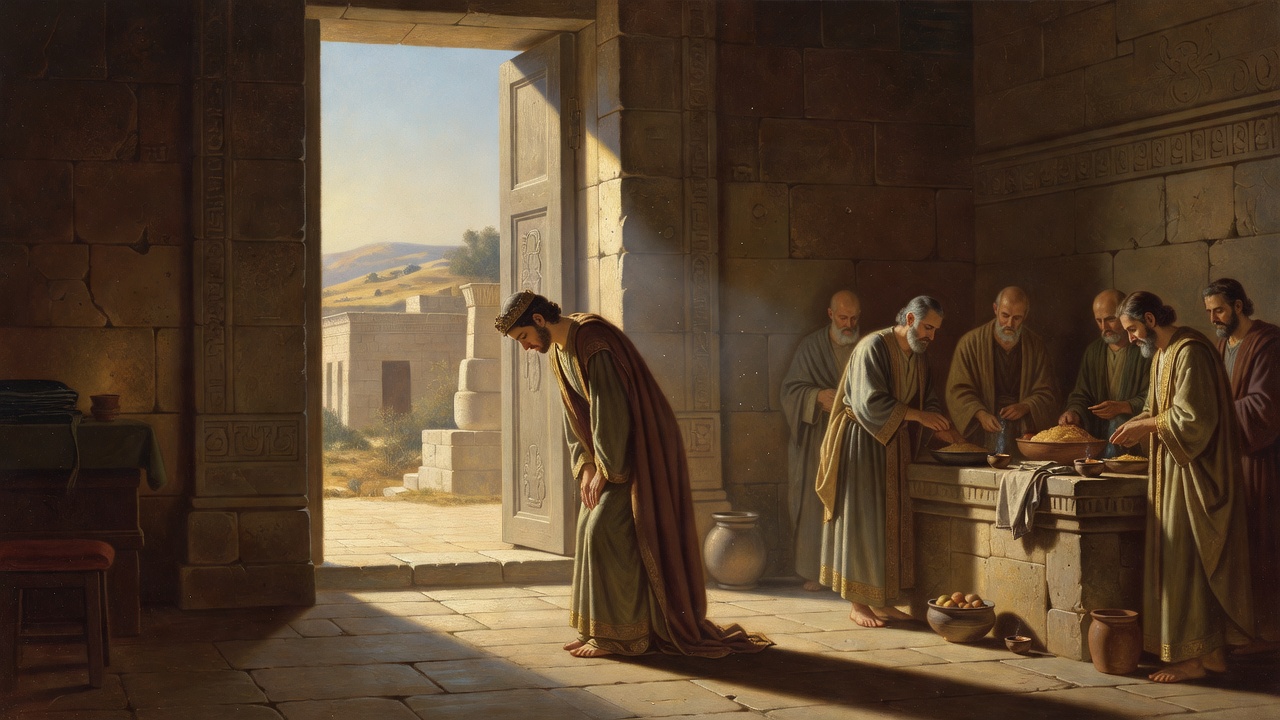
- The east inner gate of the temple was kept shut during the six working days but opened on the Sabbath and New Moon festivals. The prince was instructed to stand by the gatepost and worship at the threshold while the priests offered his sacrifices, after which the gate stayed open until evening.Sources: the Bible text itself
- To regulate worship during the appointed feasts, worshippers entering by the north gate were required to exit through the south gate, and vice versa. Furthermore, property laws strictly prevented the prince from seizing the land of the people, requiring him to provide inheritances only from his own possessions.Sources: the Bible text itself
- The vision details separate cooking areas in the temple complex: special rooms at the western end for priests to boil guilt and sin offerings to avoid transmitting sacredness to the people, and four large enclosed corner courts in the outer court used by temple ministers to cook communal sacrifices.Sources: the Bible text itself
Notes written with AI assistance from open sources (Theographic Bible Metadata, CC BY-SA 4.0; Easton’s Bible Dictionary, public domain) and reviewed before publishing.
Credits and license for this translation
Tupàn ze'eg
Bible without Deuterocanon in Guajajára (BR:gub:Guajajára)
copyright © 2007 Wycliffe Bible Translators, Inc.
Language: Guajajára
Translation by: Wycliffe Bible Translators, Inc.
Guajajára [gub], Brazil
Copyright Information
© 2007, Wycliffe Bible Translators, Inc. All rights reserved.
This translation text is made available to you under the
terms of the Creative Commons License: Attribution-Noncommercial-No Derivative Works.
( http://creativecommons.org/licenses/by-nc-nd/3.0/ )
In addition, you have permission to port the text to different file formats, as long as you
do not change any of the text or punctuation of the Bible.
You may share, copy, distribute, transmit, and extract portions
or quotations from this work, provided that you include the above copyright
information:
You must give Attribution to the work.
You do not sell this work for a profit.
You do not make any derivative works that change any of the actual words or punctuation of the Scriptures.
Permissions beyond the scope of this license may be
available if you contact
us with your request.
Printed book ISBN 9788531109713
The Bible without Deuterocanon
in Guajajára
© 2007, Wycliffe Bible Translators, Inc. All rights reserved.
This translation is made available to you under the terms of the
Creative Commons Attribution-Noncommercial-No Derivatives license 4.0.
You may share and redistribute this Bible translation or extracts from it in any format, provided that:
You include the above copyright and source information.
You do not sell this work for a profit.
You do not change any of the words or punctuation of the Scriptures.
Pictures included with Scriptures and other documents on this site are licensed just for use with those Scriptures and documents.
For other uses, please contact the respective copyright owners.
2020-03-30
Source: http://ebible.org/gubBl/ · eBible.org