Job 28
Η Παλαιά Διαθήκη κατά τη μετάφραση των εβδομήκοντα (Ο') | SEPTUAGINTA · Tap a verse to see its cross-references.
1ΕΣΤΙ γὰρ ἀργυρίῳ τόπος, ὅθεν γίνεται, τόπος δὲ χρυσίου, ὅθεν διηθεῖται. 2σίδηρος μὲν γὰρ ἐκ γῆς γίνεται, χαλκὸς δὲ ἴσα λίθῳ λατομεῖται. 3τάξιν ἔθετο σκότει, καὶ πᾶν πέρας αὐτὸς ἐξακριβάζεται, λίθος σκοτία καὶ σκιὰ θανάτου. 4διακοπὴ χειμάρρου ἀπὸ κονίας, οἱ δὲ ἐπιλανθανόμενοι ὁδὸν δικαίαν ἠσθένησαν, ἐκ βροτῶν ἐσαλεύθησαν. 5γῆ, ἐξ αὐτῆς ἐξελεύσεται ἄρτος, ὑποκάτω αὐτῆς ἐστράφη ὡσεὶ πῦρ. 6τόπος σαπφείρου οἱ λίθοι αὐτῆς, καὶ χῶμα χρυσίον αὐτῷ. 7τρίβος, οὐκ ἔγνω αὐτὴν πετεινόν, καὶ οὐ παρέβλεψεν αὐτὴν ὀφθαλμὸς γυπός· 8καὶ οὐκ ἐπάτησαν αὐτὸν υἱοὶ ἀλαζόνων, οὐ παρῆλθεν ἐπ᾿ αὐτῆς λέων. 9ἐν ἀκροτόμῳ ἐξέτεινε χεῖρα αὐτοῦ, κατέστρεψε δὲ ἐκ ριζῶν ὄρη· 10δίνας δὲ ποταμῶν διέρρηξε, πᾶν δὲ ἔντιμον εἶδέ μου ὁ ὀφθαλμός. 11βάθη δὲ ποταμῶν ἀνεκάλυψεν, ἔδειξε δὲ αὐτοῦ δύναμιν εἰς φῶς. 12ἡ δὲ σοφία πόθεν εὑρέθη; ποῖος δὲ τόπος ἐστὶ τῆς ἐπιστήμης; 13οὐκ οἶδε βροτὸς ὁδὸν αὐτῆς, οὐδὲ μὴ εὑρεθῇ ἐν ἀνθρώποις. 14ἄβυσσος εἶπεν· οὐκ ἔνεστιν ἐν ἐμοί· καὶ ἡ θάλασσα εἶπεν· οὐκ ἔστι μετ᾿ ἐμοῦ. 15οὐ δώσει συγκλεισμὸν ἀντ᾿ αὐτῆς, καὶ οὐ σταθήσεται ἀργύριον ἀντάλλαγμα αὐτῆς· 16καὶ οὐ συμβασταχθήσεται χρυσίῳ Ὠφίρ, ἐν ὄνυχι τιμίῳ καὶ σαπφείρῳ· 17οὐκ ἰσωθήσεται αὐτῇ χρυσίον καὶ ὕαλος καὶ τὸ ἄλλαγμα αὐτῆς σκεύη χρυσᾶ· 18μετέωρα καὶ γαβὶς οὐ μνησθήσεται, καὶ ἕλκυσον σοφίαν ὑπὲρ τὰ ἐσώτατα· 19οὐκ ἰσωθήσεται αὐτῇ τοπάζιον Αἰθιοπίας, χρυσίῳ καθαρῷ οὐ συμβασταχθήσεται. 20ἡ δὲ σοφία πόθεν εὑρέθη; ποῖος δὲ τόπος ἐστὶ τῆς συνέσεως; 21λέληθε πάντα ἄνθρωπον καὶ ἀπὸ πετεινῶν τοῦ οὐρανοῦ ἐκρύβη· 22ἡ ἀπώλεια καὶ ὁ θάνατος εἶπαν· ἀκηκόαμεν δὲ αὐτῆς τὸ κλέος. 23ὁ Θεὸς εὖ συνέστησεν αὐτῆς τὴν ὁδόν, αὐτὸς δὲ οἶδε τὸν τόπον αὐτῆς· 24αὐτὸς γὰρ τὴν ὑπ᾿ οὐρανὸν πᾶσαν ἐφορᾷ εἰδὼς τὰ ἐν τῇ γῇ πάντα, ἃ ἐποίησεν, 25ἀνέμων σταθμὸν ὕδατος μέτρα· 26ὅτι ἐποίησεν οὕτως, ἰδὼν ἠρίθμησε καὶ ὁδὸν ἐν τινάγματι φωνάς· 27τότε εἶδεν αὐτὴν καὶ ἐξηγήσατο αὐτήν, ἑτοιμάσας ἐξιχνίασεν. 28εἶπε δὲ ἀνθρώπῳ· ἰδοὺ ἡ θεοσέβειά ἐστι σοφία, τὸ δὲ ἀπέχεσθαι ἀπὸ κακῶν ἐστιν ἐπιστήμη.
Did you know?
The Mining of Treasures and the Value of Wisdom
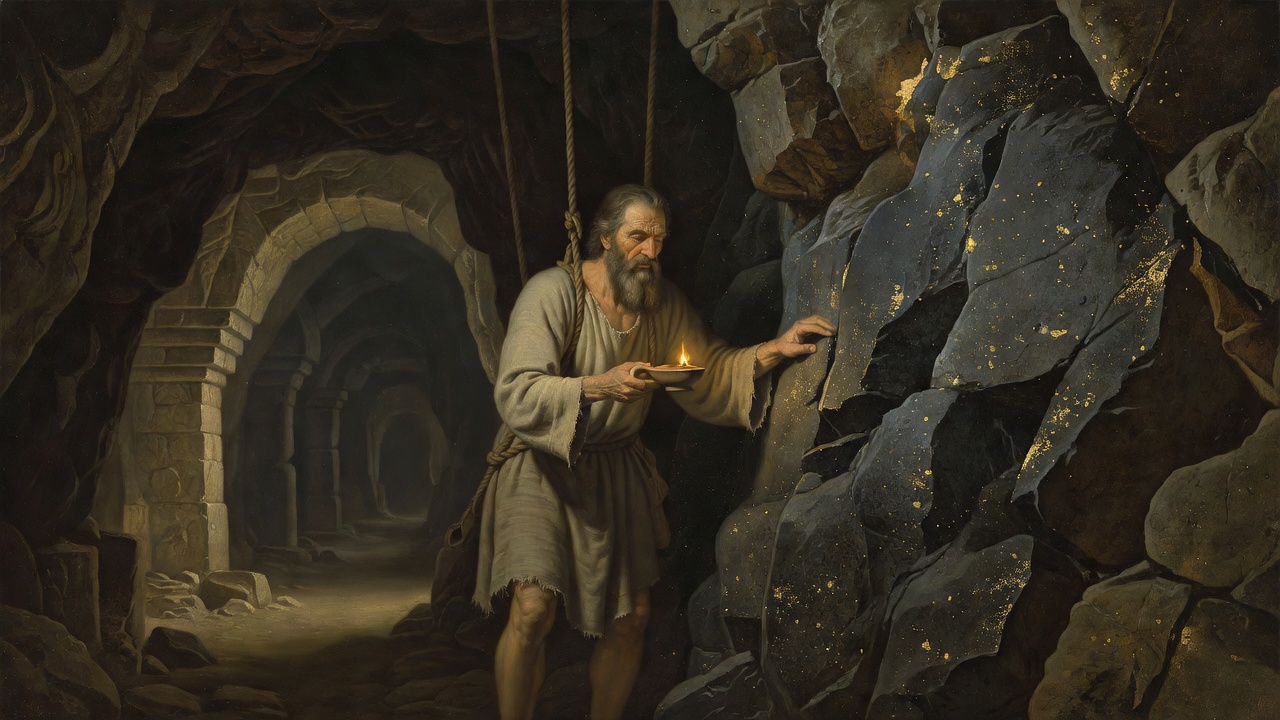
- Job 28 offers a vivid description of ancient mining practices, including digging deep shafts far from human settlements, descending on ropes, tunneling through rock, and damming underground water sources to extract copper, iron, silver, and precious stones.Sources: the Bible text itself
- To emphasize that wisdom exceeds all earthly wealth, the poem references the gold of Ophir and topaz from Cush (translated as Ethiopia in the Greek Septuagint). Ophir was a famous ancient source of pure gold often linked to Arabia or India, while Cush designated the region south of Egypt.Sources: the Bible text itself · Ophir · Ethiopia
- The poem concludes that while humans can master the subterranean world to extract buried treasures, true wisdom cannot be bought or mined. Instead, God reveals that wisdom for mortals consists in the fear of the Lord and turning away from evil.Sources: the Bible text itself
Notes written with AI assistance from open sources (Theographic Bible Metadata, CC BY-SA 4.0; Easton’s Bible Dictionary, public domain) and reviewed before publishing.
Places in this chapter
- Ethiopia · 16.935, 33.751 · verse 19
Only places identified with high confidence are shown (90% or more according to the scholarly sources compiled by OpenBible). Period map: DARE (Digital Atlas of the Roman Empire), CC BY 4.0; modern map: © OpenStreetMap contributors; places: OpenBible.info (CC BY 4.0).
Credits and license for this translation
Η Παλαιά Διαθήκη κατά τη μετάφραση των εβδομήκοντα (Ο') | SEPTUAGINTA
The Old Testament in Ancient Greek, Septuagint translation
Public Domain
℗ Orthodox Media Network
Language: Ελληνικά (Greek, Ancient)
Dialect: Koine
ORTHODOX MEDIA NETWORK-ΟΡΘΟΔΟΞΟ ΔΙΚΤΥΟ ΕΝΗΜΕΡΩΣΗΣ
A Voice from the Heart of Mount Athos to the World
Orthodox Media Network ( https://vivlos.link/DEqNY ) was founded on Mount Athos – the only monastic republic in the world – with main mission to promote the Holy Scriptures and preserve the spiritual and cultural heritage of Orthodox monasticism, using mainly the internet.
Since 2010, its founder and General Secretary, Apostolos Vavylis, has become the first person internationally to record the entire Bible in both the original ancient Greek text and its modern Greek translation. This work – unprecedented in Orthodox tradition – has reached and inspired millions:
* Over 15 million people (estimated) have listened to at least one chapter of the recorded Bible.
* Hundreds of independent accounts across nearly every digital platform, share these recordings in countless forms.
We have never claimed copyright or demanded takedowns of these reproductions — because our goal is not profit, but the free and faithful dissemination of the Word of God and the blessing it brings to the world.
We welcome anyone that would like to publicly share our work with the only condition to publish the present text as a minimum respect to our mission.
* Our vision:
To place a Bible in every Greek-speaking home, wherever it may be on earth.
There are an estimated 17 million Greeks living in nearly 100 countries.
* If you wish to support or partner with us, please contact:
* [email protected]
The Old Testament (Septuaginta)
We are a voice of Orthodoxy, a witness of the Word, and a blessing to the Nations.
2026-02-13
Source: http://ebible.org/grclxx/ · eBible.org