Genesis 32
Η Παλαιά Διαθήκη κατά τη μετάφραση των εβδομήκοντα (Ο') | SEPTUAGINTA · Tap a verse to see its cross-references.
1ΚΑΙ Ἰακὼβ ἀπῆλθεν εἰς τὴν ὁδὸν ἑαυτοῦ. καὶ ἀναβλέψας εἶδε παρεμβολὴν Θεοῦ παρεμβεβληκυῖαν, καὶ συνήντησαν αὐτῷ οἱ ἄγγελοι τοῦ Θεοῦ. 2εἶπε δὲ Ἰακώβ, ἡνίκα εἶδεν αὐτούς· παρεμβολὴ Θεοῦ αὕτη· καὶ ἐκάλεσε τὸ ὄνομα τοῦ τόπου ἐκείνου Παρεμβολαί.
3Ἀπέστειλε δὲ Ἰακὼβ ἀγγέλους ἔμπροσθεν αὐτοῦ πρὸς Ἡσαῦ τὸν ἀδελφὸν αὐτοῦ εἰς γῆν Σηείρ, εἰς χώραν Ἐδώμ. 4καὶ ἐνετείλατο αὐτοῖς λέγων· οὕτως ἐρεῖτε τῷ κυρίῳ μου Ἡσαῦ· οὕτως λέγει ὁ παῖς σου Ἰακώβ· μετὰ Λάβαν παρῴκησα, καὶ ἐχρόνισα ἕως τοῦ νῦν, 5καὶ ἐγένοντό μοι βόες καὶ ὄνοι καὶ πρόβατα καὶ παῖδες καὶ παιδίσκαι, καὶ ἀπέστειλα ἀναγγεῖλαι τῷ κυρίῳ μου Ἡσαῦ, ἵνα εὕρῃ ὁ παῖς σου χάριν ἐναντίον σου. 6καὶ ἀνέστρεψαν οἱ ἄγγελοι πρὸς Ἰακὼβ λέγοντες· ἤλθομεν πρὸς τὸν ἀδελφόν σου Ἡσαῦ, καὶ ἰδοὺ αὐτὸς ἔρχεται εἰς συνάντησίν σοι καὶ τετρακόσιοι ἄνδρες μετ᾿ αὐτοῦ. 7ἐφοβήθη δὲ Ἰακὼβ σφόδρα, καὶ ἠπορεῖτο. καὶ διεῖλε τὸν λαὸν τὸν μεθ᾿ ἑαυτοῦ καὶ τοὺς βόας καὶ τὰς καμήλους καὶ τὰ πρόβατα εἰς δύο παρεμβολάς, 8καὶ εἶπεν Ἰακώβ· ἐὰν ἔλθῃ Ἡσαῦ εἰς παρεμβολὴν μίαν καὶ κόψῃ αὐτήν, ἔσται ἡ παρεμβολὴ ἡ δευτέρα εἰς τὸ σώζεσθαι. 9εἶπε δὲ Ἰακώβ· ὁ Θεὸς τοῦ πατρός μου Ἁβραὰμ καὶ ὁ Θεὸς τοῦ πατρός μου Ἰσαάκ, Κύριε σὺ ὁ εἰπών μοι, ἀπότρεχε εἰς τὴν γῆν τῆς γενέσεώς σου καὶ εὖ σε ποιήσω, 10ἱκανούσθω μοι ἀπὸ πάσης δικαιοσύνης καὶ ἀπὸ πάσης ἀληθείας, ἧς ἐποίησας τῷ παιδί σου· ἐν γὰρ τῇ ὔράβδῳ μου ταύτῃ διέβην τὸν Ἰορδάνην τοῦτον, νυνὶ δὲ γέγονα εἰς δύο παρεμβολάς. 11ἐξελοῦ με ἐκ χειρὸς τοῦ ἀδελφοῦ μου, ἐκ χειρὸς Ἡσαῦ, ὅτι φοβοῦμαι ἐγὼ αὐτόν, μή ποτε ἐλθὼν πατάξῃ με καὶ μητέρα ἐπὶ τέκνοις. 12σὺ δὲ εἶπας· εὖ σε ποιήσω καὶ θήσω τὸ σπέρμα σου ὡς τὴν ἄμμον τῆς θαλάσσης, ἣ οὐκ ἀριθμηθήσεται ἀπὸ τοῦ πλήθους. 13καὶ ἐκοιμήθη ἐκεῖ τὴν νύκτα ἐκείνην. καὶ ἔλαβεν ὧν ἔφερε δῶρα καὶ ἐξαπέστειλεν Ἡσαῦ τῷ ἀδελφῷ αὐτοῦ, 14αἶγας διακοσίας, τράγους εἴκοσι, πρόβατα διακόσια, κριοὺς εἴκοσι, 15καμήλους θηλαζούσας, καὶ τὰ παιδία αὐτῶν τριάκοντα, βόας τεσσαράκοντα, ταύρους δέκα, ὄνους εἴκοσι καὶ πώλους δέκα. 16καὶ ἔδωκεν αὐτὰ τοῖς παισὶν αὐτοῦ ποίμνιον κατὰ μόνας. εἶπε δὲ τοῖς παισὶν αὐτοῦ· προπορεύεσθε ἔμπροσθέν μου, καὶ διάστημα ποιεῖτε ἀνὰ μέσον ποίμνης καὶ ποίμνης. 17καὶ ἐνετείλατο τῷ πρώτῳ, λέγων· ἐάν σοι συναντήσῃ Ἡσαῦ ὁ ἀδελφός μου καὶ ἐρωτᾷ σε, λέγων· τίνος εἶ καὶ ποῦ πορεύῃ, καὶ τίνος ταῦτα τὰ προπορευόμενά σου; 18ἐρεῖς· τοῦ παιδός σου Ἰακώβ· δῶρα ἀπέσταλκε τῷ κυρίῳ μου Ἡσαῦ, καὶ ἰδοὺ αὐτὸς ὀπίσω ἡμῶν. 19καὶ ἐνετείλατο τῷ πρώτῳ καὶ τῷ δευτέρῳ καὶ τῷ τρίτῳ καὶ πᾶσι τοῖς προπορευομένοις ὀπίσω τῶν ποιμνίων τούτων, λέγων· κατὰ τὸ ρῆμα τοῦτο λαλήσατε Ἡσαῦ ἐν τῷ εὑρεῖν ὑμᾶς αὐτὸν 20καὶ ἐρεῖτε· ἰδοὺ ὁ παῖς σου Ἰακὼβ παραγίνεται ὀπίσω ἡμῶν. εἶπε γάρ· ἐξιλάσομαι τὸ πρόσωπον αὐτοῦ ἐν τοῖς δώροις τοῖς προπορευομένοις αὐτοῦ, καὶ μετὰ τοῦτο ὄψομαι τὸ πρόσωπον αὐτοῦ· ἴσως γὰρ προσδέξεται τὸ πρόσωπόν μου. 21καὶ προεπορεύετο τὰ δῶρα κατὰ πρόσωπον αὐτοῦ, αὐτὸς δὲ ἐκοιμήθη τὴν νύκτα ἐκείνην ἐν τῇ παρεμβολῇ.
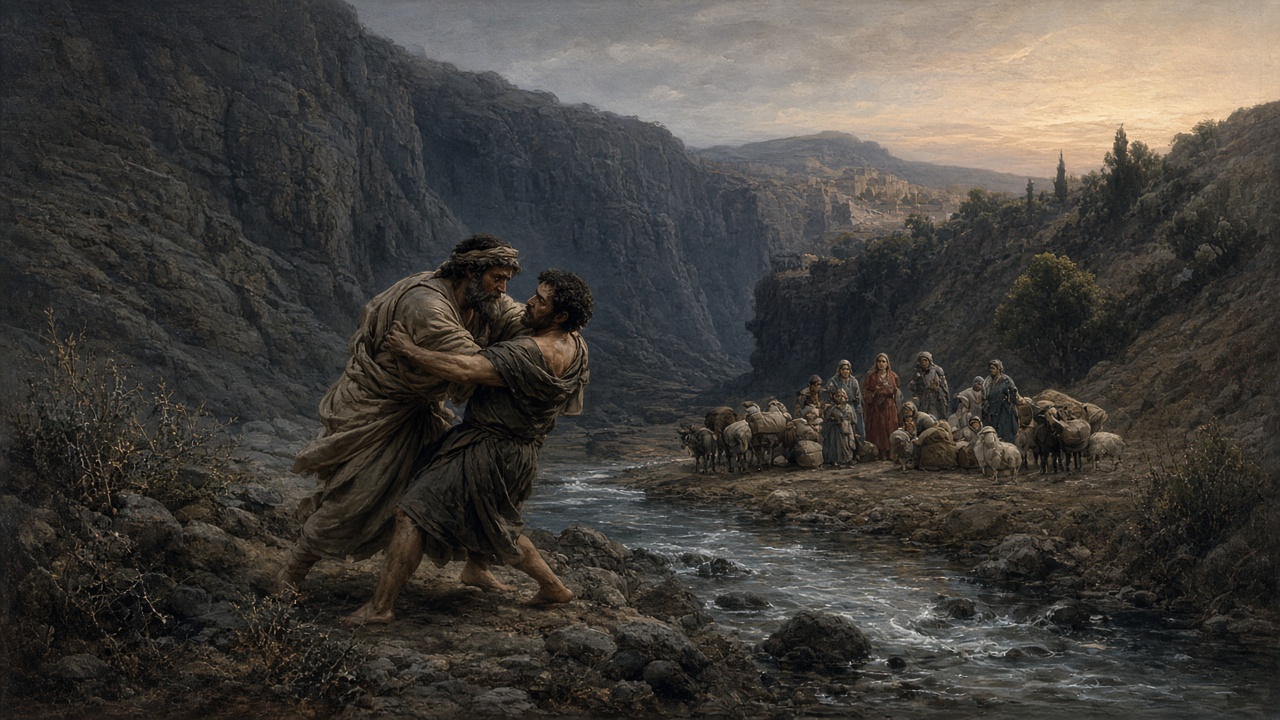
22Ἀναστὰς δὲ τὴν νύκτα ἐκείνην ἔλαβε τὰς δύο γυναῖκας καὶ τὰς δύο παιδίσκας καὶ τὰ ἕνδεκα παιδία αὐτοῦ καὶ διέβη τὴν διάβασιν τοῦ Ἰαβώκ· 23καὶ ἔλαβεν αὐτοὺς καὶ διέβη τὸν χειμάρρουν καὶ διεβίβασε πάντα τὰ αὐτοῦ. 24ὑπελείφθη δὲ Ἰακὼβ μόνος, καὶ ἐπάλαιεν ἄνθρωπος μετ᾿ αὐτοῦ ἕως πρωΐ. 25εἶδε δέ, ὅτι οὐ δύναται πρὸς αὐτόν, καὶ ἥψατο τοῦ πλάτους τοῦ μηροῦ αὐτοῦ, καὶ ἐνάρκησε τὸ πλάτος τοῦ μηροῦ Ἰακὼβ ἐν τῷ παλαίειν αὐτὸν μετ᾿ αὐτοῦ. 26καὶ εἶπεν αὐτῷ· ἀπόστειλόν με· ἀνέβη γὰρ ὁ ὄρθρος. ὁ δὲ εἶπεν· οὐ μή σε ἀποστείλω, ἐὰν μή με εὐλογήσῃς. 27εἶπε δὲ αὐτῷ· τί τὸ ὄνομά σου ἐστίν, ὁ δὲ εἶπεν· Ἰακώβ. 28καὶ εἶπεν αὐτῷ· οὐ κληθήσεται ἔτι τὸ ὄνομά σου Ἰακώβ, ἀλλ᾿ Ἰσραὴλ ἔσται τὸ ὄνομά σου, ὅτι ἐνίσχυσας μετὰ Θεοῦ, καὶ μετ᾿ ἀνθρώπων δυνατὸς ἔσῃ. 29ἠρώτησε δὲ Ἰακὼβ καὶ εἶπεν· ἀνάγγειλόν μοι τὸ ὄνομά σου. καὶ εἶπεν· ἱνατί τοῦτο ἐρωτᾶς σὺ τὸ ὄνομά μου; καὶ εὐλόγησεν αὐτὸν ἐκεῖ. 30καὶ ἐκάλεσεν Ἰακὼβ τὸ ὄνομα τοῦ τόπου ἐκείνου, Εἶδος Θεοῦ· εἶδον γὰρ Θεὸν πρόσωπον πρὸς πρόσωπον, καὶ ἐσώθη μου ἡ ψυχή. 31ἀνέτειλε δὲ αὐτῷ ὁ ἥλιος, ἡνίκα παρῆλθε τὸ εἶδος τοῦ Θεοῦ· αὐτὸς δέ ἐπέσκαζε τῷ μηρῷ αὐτοῦ· 32ἕνεκεν τούτου οὐ μὴ φάγωσιν υἱοὶ Ἰσραὴλ τὸ νεῦρον, ὃ ἐνάρκησεν, ὅ ἐστιν ἐπὶ τοῦ πλάτους τοῦ μηροῦ, ἕως τῆς ἡμέρας ταύτης, ὅτι ἥψατο τοῦ πλάτους τοῦ μηροῦ Ἰακὼβ τοῦ νεύρου, ὃ ἐνάρκησεν.
Did you know?
At the Jabbok, on the Way to Esau
- Mahanaim means “two camps.” Jacob gave that name to the place near the Jabbok, beyond the Jordan, when the angels of God met him and he said, “This is the camp of God.” There he also divided his people, flocks, herds, and camels into two camps, hoping one might escape if Esau attacked the other.Sources: Mahanaim · the Bible text itself
- The Jabbok, whose name is explained as “a pouring out, or a wrestling,” is a stream east of the Jordan. It joins the Jordan about midway between the Sea of Galilee and the Dead Sea, after a course of about 65 miles through a wild, deep ravine. At its ford Jacob sent his two wives, two maidservants, eleven sons, and all he owned across, then remained alone and wrestled with a man until daybreak.Sources: Jabbok · the Bible text itself
- Jacob sent messengers to Esau in the land of Seir, the country of Edom, calling him lord and himself a servant. Seir is a mountainous region along the east side of the Arabah, from the southeastern end of the Dead Sea toward Akabah, the eastern branch of the Red Sea; the Edomites occupied it, and it was allotted to Esau’s descendants. Esau, the firstborn twin and a hunter, had sold his birthright for red lentil stew and was also called Edom, “red,” while Jacob—whose name means “one who follows on another’s heels,” or “supplanter”—had conspired with his mother to deceive Isaac.Sources: the Bible text itself · Seir · Esau (Edom) · Jacob (Israel)
Notes written with AI assistance from open sources (Theographic Bible Metadata, CC BY-SA 4.0; Easton’s Bible Dictionary, public domain) and reviewed before publishing.
Places in this chapter
- Edom · 30.746, 35.604 · verse 3
- Jordan · Today: Jordan River · 31.761, 35.558 · verse 10
- Jabbok · Today: Zarqa River · 32.115, 35.543 · verse 22
Only places identified with high confidence are shown (90% or more according to the scholarly sources compiled by OpenBible). Period map: DARE (Digital Atlas of the Roman Empire), CC BY 4.0; modern map: © OpenStreetMap contributors; places: OpenBible.info (CC BY 4.0).
Credits and license for this translation
Η Παλαιά Διαθήκη κατά τη μετάφραση των εβδομήκοντα (Ο') | SEPTUAGINTA
The Old Testament in Ancient Greek, Septuagint translation
Public Domain
℗ Orthodox Media Network
Language: Ελληνικά (Greek, Ancient)
Dialect: Koine
ORTHODOX MEDIA NETWORK-ΟΡΘΟΔΟΞΟ ΔΙΚΤΥΟ ΕΝΗΜΕΡΩΣΗΣ
A Voice from the Heart of Mount Athos to the World
Orthodox Media Network ( https://vivlos.link/DEqNY ) was founded on Mount Athos – the only monastic republic in the world – with main mission to promote the Holy Scriptures and preserve the spiritual and cultural heritage of Orthodox monasticism, using mainly the internet.
Since 2010, its founder and General Secretary, Apostolos Vavylis, has become the first person internationally to record the entire Bible in both the original ancient Greek text and its modern Greek translation. This work – unprecedented in Orthodox tradition – has reached and inspired millions:
* Over 15 million people (estimated) have listened to at least one chapter of the recorded Bible.
* Hundreds of independent accounts across nearly every digital platform, share these recordings in countless forms.
We have never claimed copyright or demanded takedowns of these reproductions — because our goal is not profit, but the free and faithful dissemination of the Word of God and the blessing it brings to the world.
We welcome anyone that would like to publicly share our work with the only condition to publish the present text as a minimum respect to our mission.
* Our vision:
To place a Bible in every Greek-speaking home, wherever it may be on earth.
There are an estimated 17 million Greeks living in nearly 100 countries.
* If you wish to support or partner with us, please contact:
* [email protected]
The Old Testament (Septuaginta)
We are a voice of Orthodoxy, a witness of the Word, and a blessing to the Nations.
2026-02-13
Source: http://ebible.org/grclxx/ · eBible.org