Genesis 23
Η Παλαιά Διαθήκη κατά τη μετάφραση των εβδομήκοντα (Ο') | SEPTUAGINTA · Tap a verse to see its cross-references.
1ΕΓΕΝΕΤΟ δὲ ἡ ζωὴ Σάρρας ἔτη ἑκατὸν εἰκοσιεπτά. 2καὶ ἀπέθανε Σάρρα ἐν πόλει Ἀρβόκ, ἥ ἐστιν ἐν τῷ κοιλώματι (αὕτη ἐστὶ Χεβρών) ἐν τῇ γῇ Χαναάν. ἦλθε δὲ Ἁβραὰμ κόψασθαι Σάρραν καὶ πενθῆσαι. 3καὶ ἀνέστη Ἁβραὰμ ἀπὸ τοῦ νεκροῦ αὐτοῦ καὶ εἶπεν Ἁβραὰμ τοῖς υἱοῖς τοῦ Χὲτ λέγων· 4πάροικος καὶ παρεπίδημος ἐγώ εἰμι μεθ᾿ ὑμῶν· δότε μοι οὖν κτῆσιν τάφου μεθ᾿ ὑμῶν, καὶ θάψω τὸν νεκρόν μου ἀπ᾿ ἐμοῦ. 5ἀπεκρίθησαν δὲ οἱ υἱοὶ Χὲτ πρὸς Ἁβραὰμ λέγοντες· μὴ κύριε· 6ἄκουσον δὲ ἡμῶν. βασιλεὺς παρὰ Θεοῦ σὺ εἶ ἐν ἡμῖν· ἐν τοῖς ἐκλεκτοῖς μνημείοις ἡμῶν θάψον τὸν νεκρόν σου· οὐδεὶς γὰρ ἡμῶν οὐ μὴ κωλύσει τὸ μνημεῖον αὐτοῦ ἀπὸ σοῦ τοῦ θάψαι τὸν νεκρόν σου ἐκεῖ. 7ἀναστὰς δὲ Ἁβραὰμ προσεκύνησε τῷ λαῷ τῆς γῆς, τοῖς υἱοῖς τοῦ Χέτ, 8καὶ ἐλάλησε πρὸς αὐτοὺς Ἁβραὰμ λέγων· εἰ ἔχετε τῇ ψυχῇ ὑμῶν, ὥστε θάψαι τὸν νεκρόν μου ἀπὸ προσώπου μου, ἀκούσατέ μου καὶ λαλήσατε περὶ ἐμοῦ Ἐφρὼν τῷ τοῦ Σαάρ, 9καὶ δότω μοι τὸ σπήλαιον τὸ διπλοῦν, ὅ ἐστιν αὐτῷ, τὸ ὂν ἐν μέρει τοῦ ἀγροῦ αὐτοῦ· ἀργυρίου τοῦ ἀξίου δότω μοι αὐτὸ ἐν ὑμῖν εἰς κτῆσιν μνημείου. 10Ἐφρὼν δὲ ἐκάθητο ἐν μέσῳ τῶν υἱῶν Χέτ· ἀποκριθεὶς δὲ Ἐφρὼν ὁ Χετταῖος πρὸς Ἁβραὰμ εἶπεν, ἀκουόντων τῶν υἱῶν Χὲτ καὶ τῶν εἰσπορευομένων εἰς τὴν πόλιν πάντων, λέγων· 11παρ᾿ ἐμοὶ γενοῦ, κύριε, καὶ ἄκουσόν μου· τὸν ἀγρὸν καὶ τὸ σπήλαιον τὸ ἐν αὐτῷ σοὶ δίδωμι· ἐναντίον πάντων τῶν πολιτῶν μου δέδωκά σοι· θάψον τὸν νεκρόν σου· 12καὶ προσεκύνησεν Ἁβραὰμ ἐναντίον τοῦ λαοῦ τῆς γῆς 13καὶ εἶπε τῷ Ἐφρὼν εἰς τὰ ὦτα ἐναντίον τοῦ λαοῦ τῆς γῆς· ἐπειδὴ πρὸς ἐμοῦ εἶ, ἄκουσόν μου· τὸ ἀργύριον τοῦ ἀγροῦ λάβε παρ᾿ ἐμοῦ, καὶ θάψω τὸν νεκρόν μου ἐκεῖ. 14ἀπεκρίθη δὲ Ἐφρὼν τῷ Ἀβραὰμ λέγων· 15οὐχὶ κύριε, ἀκήκοα γάρ, γῆ τετρακοσίων διδράχμων ἀργυρίου, ἀλλὰ τί ἂν εἴη τοῦτο ἀνὰ μέσον ἐμοῦ καὶ σοῦ; σὺ δὲ τὸν νεκρόν σου θάψον. 16καὶ ἤκουσεν Ἁβραὰμ τοῦ Ἐφρών, καὶ ἀποκατέστησεν Ἁβραὰμ τῷ Ἐφρὼν τὸ ἀργύριον, ὃ ἐλάλησεν εἰς τὰ ὦτα τῶν υἱῶν Χέτ, τετρακόσια δίδραχμα ἀργυρίου δοκίμου ἐμπόροις. 17καὶ ἔστη ὁ ἀγρὸς Ἐφρών, ὃς ἦν ἐν τῷ διπλῷ σπηλαίῳ, ὅς ἐστι κατὰ πρόσωπον Μαμβρῆ, ὁ ἀγρὸς καὶ τὸ σπήλαιον, ὃ ἦν ἐν αὐτῷ, καὶ πᾶν δένδρον, ὃ ἦν ἐν τῷ ἀγρῷ, καὶ πᾶν ὅ ἐστιν ἐν τοῖς ὁρίοις αὐτοῦ κύκλῳ, 18τῷ Ἁβραάμ, εἰς κτῆσιν ἐναντίον τῶν υἱῶν Χὲτ καὶ πάντων τῶν εἰσπορευομένων εἰς τὴν πόλιν. 19μετὰ ταῦτα ἔθαψεν Ἁβραὰμ Σάρραν τὴν γυναῖκα αὐτοῦ ἐν τῷ σπηλαίῳ τοῦ ἀγροῦ τῷ διπλῷ, ὅ ἐστιν ἀπέναντι Μαμβρῆ (αὕτη ἐστὶ Χεβρών) ἐν τῇ γῇ Χαναάν. 20καὶ ἐκυρώθη ὁ ἀγρὸς καὶ τὸ σπήλαιον, ὃ ἦν ἐν αὐτῷ, τῷ Ἁβραὰμ εἰς κτῆσιν τάφου παρὰ τῶν υἱῶν Χέτ.
Did you know?
Sarah’s death and the cave of Machpelah
- Sarah died at the age of 127 in Kiriath-arba, that is, Hebron, in the land of Canaan. Easton's Bible Dictionary (1897) notes that this is the only place in Scripture where a woman’s age is recorded, and that her death led Abraham to buy the cave of Machpelah as a family burial place.Sources: the Bible text itself · Sarah
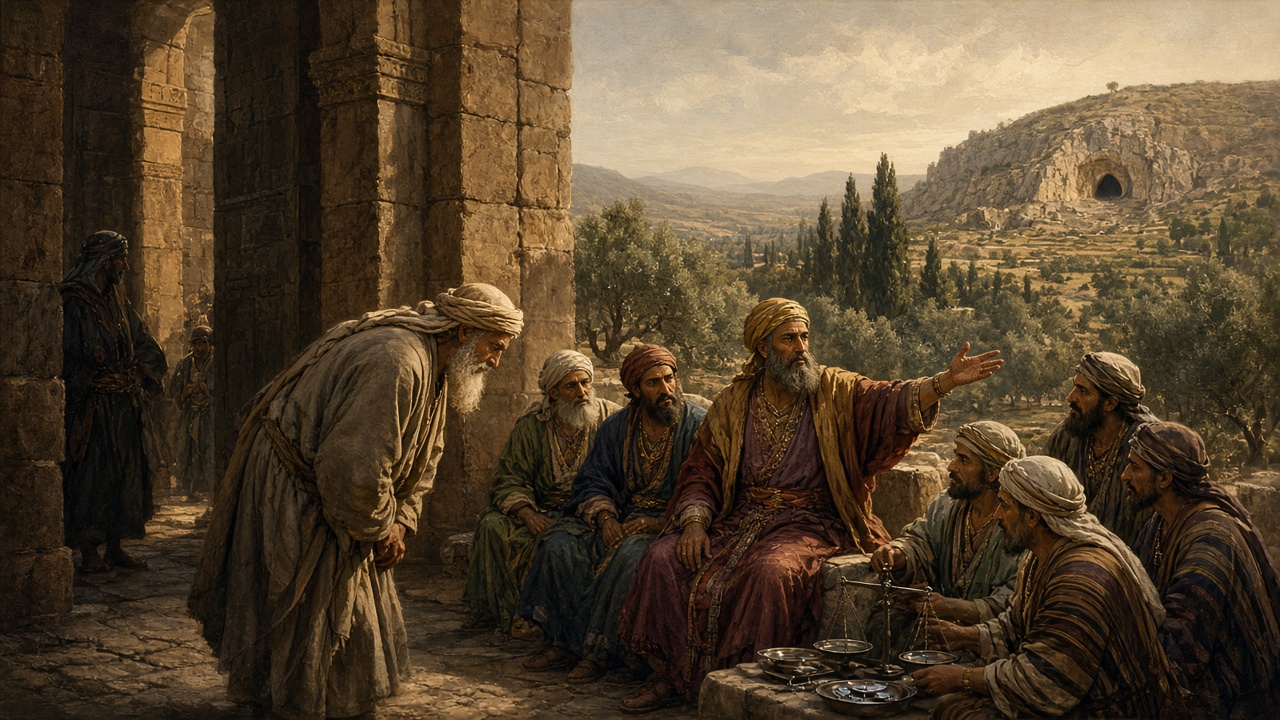
- Abraham told the sons of Heth—the Hittites, descended from Canaan through Heth and living near Hebron—that he was a foreigner among them and needed a burial site. At the city gate, before the Hittites gathered there, he bought the field and cave of Ephron son of Zohar for four hundred shekels of silver, weighed according to the merchants’ standard.Sources: the Bible text itself · Heth · Ephron
- The name Machpelah is explained as “portion” or “double cave.” The cave Abraham bought stood in Ephron’s field near Mamre, on a hillside east of Hebron, and the same place later received the bodies of Abraham and Sarah, Isaac and Rebekah, and Jacob and Leah.Sources: Machpelah · the Bible text itself
Notes written with AI assistance from open sources (Theographic Bible Metadata, CC BY-SA 4.0; Easton’s Bible Dictionary, public domain) and reviewed before publishing.
Places in this chapter
- Canaan · 32.767, 35.333 · verses 2, 19
- Hebron · Today: Tel Rumeida · 31.525, 35.102 · verses 2, 19
- Machpelah · Today: Cave of the Patriarchs · 31.525, 35.111 · verses 9, 17, 19
Only places identified with high confidence are shown (90% or more according to the scholarly sources compiled by OpenBible). Period map: DARE (Digital Atlas of the Roman Empire), CC BY 4.0; modern map: © OpenStreetMap contributors; places: OpenBible.info (CC BY 4.0).
Credits and license for this translation
Η Παλαιά Διαθήκη κατά τη μετάφραση των εβδομήκοντα (Ο') | SEPTUAGINTA
The Old Testament in Ancient Greek, Septuagint translation
Public Domain
℗ Orthodox Media Network
Language: Ελληνικά (Greek, Ancient)
Dialect: Koine
ORTHODOX MEDIA NETWORK-ΟΡΘΟΔΟΞΟ ΔΙΚΤΥΟ ΕΝΗΜΕΡΩΣΗΣ
A Voice from the Heart of Mount Athos to the World
Orthodox Media Network ( https://vivlos.link/DEqNY ) was founded on Mount Athos – the only monastic republic in the world – with main mission to promote the Holy Scriptures and preserve the spiritual and cultural heritage of Orthodox monasticism, using mainly the internet.
Since 2010, its founder and General Secretary, Apostolos Vavylis, has become the first person internationally to record the entire Bible in both the original ancient Greek text and its modern Greek translation. This work – unprecedented in Orthodox tradition – has reached and inspired millions:
* Over 15 million people (estimated) have listened to at least one chapter of the recorded Bible.
* Hundreds of independent accounts across nearly every digital platform, share these recordings in countless forms.
We have never claimed copyright or demanded takedowns of these reproductions — because our goal is not profit, but the free and faithful dissemination of the Word of God and the blessing it brings to the world.
We welcome anyone that would like to publicly share our work with the only condition to publish the present text as a minimum respect to our mission.
* Our vision:
To place a Bible in every Greek-speaking home, wherever it may be on earth.
There are an estimated 17 million Greeks living in nearly 100 countries.
* If you wish to support or partner with us, please contact:
* [email protected]
The Old Testament (Septuaginta)
We are a voice of Orthodoxy, a witness of the Word, and a blessing to the Nations.
2026-02-13
Source: http://ebible.org/grclxx/ · eBible.org