Song of Songs 7
μετάφραση των εβδομήκοντα · Tap a verse to see its cross-references.
1Ἐπίστρεφε ἐπίστρεφε ἡ Σουναμίτις· ἐπίστρεφε ἐπίστρεφε, καὶ ὀφόμεθα ἐν σοί.
Τί ὄψεσθε ἐν τῇ Σουναμίτιδι; ἡ ἐρχομένη ὡς χοροὶ τῶν παρεμβολῶν.
2Ὡραιώθησαν διαβήματά σου ἐν ὑποδήμασί σου, θύγατερ ναδάβ· ῥυθμοὶ μηρῶν ὅμοιοι ὁρμίσκοις, ἔργον τεχνίτου. 3Ὀμφαλός σου κρατὴρ τορευτὸς, μὴ ὑστερούμενος κράμα· κοιλία σου θημωνία σίτου πεφραγμένη ἐν κρίνοις. 4Δύο μαστοί σου, ὡς δύο νεβροὶ δίδυμοι δορκάδος. 5Ὁ τράχηλός σου ὡς πύργος ἐλεφάντινος· οἱ ὀφθαλμοί σου ὡς λίμναι ἐν Ἐσεβὼν, ἐν πύλαις θυγατρὸς πολλῶν· μυκτήρ σου, ὡς πύργος τοῦ Λιβάνου σκοπεύων πρόσωπον Δαμασκοῦ. 6Κεφαλή σου ἐπὶ σὲ ὡς Κάρμηλος, καὶ πλόκιον κεφαλῆς σου ὡς πορφύρα· βασιλεὺς δεδεμένος ἐν παραδρομαῖς. 7Τί ὡραιώθης, καὶ τί ἡδύνθης ἀγάπη; 8ἐν τρυφαῖς σου τοῦτο μέγεθός σου· ὡμοιώθης τῷ φοίνικι, καὶ οἱ μαστοί σου τοῖς βότρυσιν. 9Εἶπα, ἀναβήσομαι ἐπὶ τῷ φοίνικι, κρατήσω τῶν ὕψεων αὐτοῦ· καὶ ἔσονται δὴ μαστοί σου ὡς βότρυες τῆς ἀμπέλου, καὶ ὀσμὴ ῥινός σου ὡς μῆλα, 10καὶ ὁ λάρυγξ σου ὡς οἶνος ὁ ἀγαθὸς, πορευόμενος τῷ ἀδελφιδῷ μου εἰς εὐθύτητα, ἱκανούμενος χείλεσί μου καὶ ὀδοῦσιν.
11Ἐγὼ τῷ ἀδελφιδῷ μου, καὶ ἐπʼ ἐμὲ ἡ ἐπιστροφὴ αὐτοῦ. 12Ἐλθὲ ἀδελφιδέ μου, ἐξέλθωμεν εἰς ἀγρὸν, αὐλισθῶμεν ἐν κώμαις. 13Ὀρθρίσωμεν εἰς ἀμπελῶνας· ἴδωμεν εἰ ἤνθησεν ἡ ἄμπελος, ἤνθησεν ὁ κυπρισμὸς, ἤνθησν αἱ ῥοαί· ἐκεῖ δώσω τοὺς μαστούς μου σοί. 14Οἱ μανδραγόραι ἔδωκαν ὀσμήν· καὶ ἐπὶ θύραις ἡμῶν πάντα ἀκρόδρυα νέα πρὸς παλαιὰ, ἀδελφιδέ μου, ἐτήρησά σοι.
Did you know?
Poetry of Love and Landscape
- The poem describes the woman's beauty using prominent landmarks of the region. Her eyes are compared to the calm pools of Heshbon near the gate of Bath-rabbim east of the Jordan, while her profile is likened to a majestic tower in the mountain range of Lebanon overlooking Damascus.Sources: the Bible text itself · Heshbon · Bath-rabbim · Lebanon
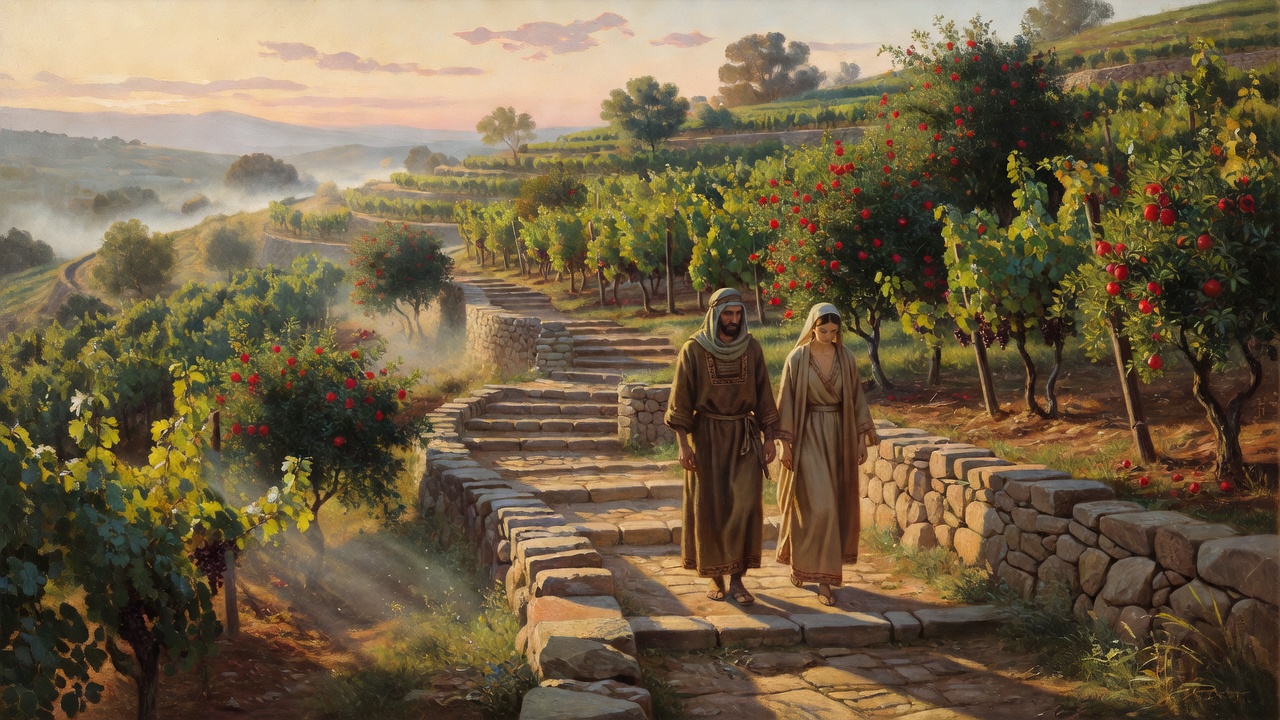
- The chapter concludes with an invitation to the countryside during the renewal of spring. The lovers seek out budding grapevines, blooming pomegranates, and fragrant mandrakes, reflecting the close connection in ancient Hebrew poetry between romantic intimacy and the vitality of the natural world.Sources: the Bible text itself
Notes written with AI assistance from open sources (Theographic Bible Metadata, CC BY-SA 4.0; Easton’s Bible Dictionary, public domain) and reviewed before publishing.
Places in this chapter
- Bath-rabbim · Today: in Tell Hesban · 31.801, 35.809 · verse 4
- Damascus · 33.511, 36.306 · verse 4
- Lebanon · 33.540, 35.584 · verse 4
- Mount Carmel · 32.672, 35.023 · verse 5
Only places identified with high confidence are shown (90% or more according to the scholarly sources compiled by OpenBible). Period map: DARE (Digital Atlas of the Roman Empire), CC BY 4.0; modern map: © OpenStreetMap contributors; places: OpenBible.info (CC BY 4.0).
Credits and license for this translation
μετάφραση των εβδομήκοντα
The Greek Septuagint with Apocrypha, compiled by Sir Lancelot C. L. Brenton
Public Domain
Language: Ἑλληνική (Greek, Ancient)
Dialect: Koine
2026-04-08
Source: http://ebible.org/grcbrent/ · eBible.org