Job 28
Kitaaba Woyyuu · Tap a verse to see its cross-references.
Wolaloo Marroo Qarumma'aa
1«Dhuguma boolli meetii keessaa qotanee baasanu,
addeen worqii itti baqsiisanu jirti.
2Sibiilli lafa keessaa dhaggama;
sibiilli diimaalle biyyee albuudaa keessaa
baqisiifamee dhaggama.
3Namooti qilee lafaa keessa seenanee
dukkana dimmaa keessa lixanee
biyyee albuudaa barbaadan.
4Isaan lafa nami le'u irraa fagaatanee,
addee miilli namaa ijjattee hin beenne geyan.
Achitti boolla qilee qotanee
wodaroo irratti rarra'aa
nama irraa fagaatanee qofuu ifii hujan.
5Latti midhaan sagalee te'u baattu,
keessi isi'ii ammoo ibiddaan baqee garagaggala.
6Rassaa isi'ii keessaa
dhakaan gatii guddo'oo
ka ‹Safiiros› jedhamu dhaggama;
biyyee isi'ii keessalle'ee worqiin hin dhagganti.
7Karaa gara albuudaa geessu san risaan hin beeku;
ilti jajju'uulle hin dhaggine.
8Bineensi hamaan addee san hin ijjanne;
neenqille karaa san hin dabarre.
9Harki nama albuuda qotuu
rassaa jabaa hin caccassa;
gaarotalle hundee irraa garaggaggalcha.
10Isaan rassaa dhoosanee karaa hin baasan;
ilti isaaniille waan gatii guddo'oo hin dhaggiti.
11Madda lagaa hin kiphan;
waan lafa keessatti dhokatelle ifatti hin baasan.
12«Ammoo qarummaan eessatti dhagganti?
Addeen hubanti'ii eessa jirti?
13Qarummaan lafa nami le'u keessatti hin dhaggantu;
namille gatii isi'ii hin beeku.
14Qileen abbaaya'aa,
‹Qarummaan na keessa hin jirtu› jetti;
abbaayaalle, ‹Qarummaan na bira hin jirtu› jetti.
15Qarummaan worqii qullu'uun hin bitantu;
gatiin isi'iille meeti'iin hin madaalantu.
16Gatiin isi'ii worqii gatii guddo'ootiin,
dhakaa ‹Sardoniikis› jedhamuun
yookiin dhakaa, ‹Safiiros› jedhamuun wol hin qixxawu.
17Worqi'ii fi daaw'itiille'een
wol hin qixxoottu.
Dooqa worqii qullu'uulle'een
hin jijjiirantu.
18Gatiin qarumma'aa dooqa gatii guddo'ootii fi
dhakaa gatii gudda'ootiin wol hin qixxoottu;
elellaan diintuulle caalti.
19Qarummaan dhakaa gatii guddo'oo ka Itoophiya'aa,
ka ‹Xophaaziyon› jedhamuun wol hin qixxoottu;
worqii qulluu gatii guddo'oolle'een wol hin qixxoottu.
20«Eegasuu qarummaan eessaa dhutti ree?
Addeen hubantiin jirtu eessa ree?
21Isiin ila dada maraa duraa dhokatteerti;
sinbirrootaayyuu dhokatteerti.
22Badi'ii fi duuti,
‹Nuuti oduu isi'ii qofa
gurra keennaan dhageenne› jedhan.
23Waaqi karaa gara qarumma'aa geessu hin hubata;
addee isiin jirtulle isa qofattuu beeka.
24Inni qaccee lafaa duudii waan dhagguuf,
waan ol-gubba'aan jala jiru mara dhagga.
25Waaqi yennaa qilleensaaf hunna kenne,
haga bisaaniille yennaa mike,
26Bokkeyaaf seera,
balaqqeetti'iifille karaa yennaa baase,
27achiin duuba qarummaa ilaalee,
gatii isi'ii murteesse;
inni isii qorqoree jabeessee isii dhaabe.
28Achiin duuba inni namaan,
‹Kunoo, Mootii Waan Maraa sodaatiis qarumma'a;
waan hantuu irraa goriisille hubanti'i› jedhe» jedhe.
Did you know?
The Mining of Treasures and the Value of Wisdom
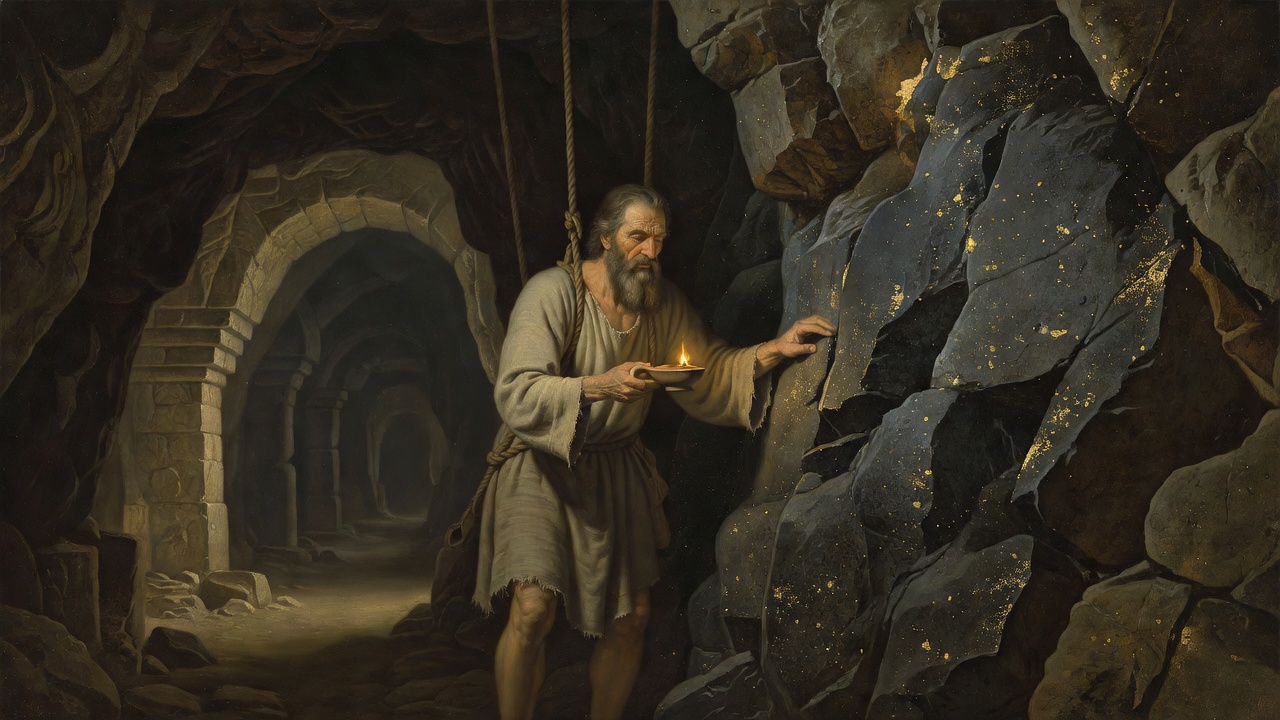
- Job 28 offers a vivid description of ancient mining practices, including digging deep shafts far from human settlements, descending on ropes, tunneling through rock, and damming underground water sources to extract copper, iron, silver, and precious stones.Sources: the Bible text itself
- To emphasize that wisdom exceeds all earthly wealth, the poem references the gold of Ophir and topaz from Cush (translated as Ethiopia in the Greek Septuagint). Ophir was a famous ancient source of pure gold often linked to Arabia or India, while Cush designated the region south of Egypt.Sources: the Bible text itself · Ophir · Ethiopia
- The poem concludes that while humans can master the subterranean world to extract buried treasures, true wisdom cannot be bought or mined. Instead, God reveals that wisdom for mortals consists in the fear of the Lord and turning away from evil.Sources: the Bible text itself
Notes written with AI assistance from open sources (Theographic Bible Metadata, CC BY-SA 4.0; Easton’s Bible Dictionary, public domain) and reviewed before publishing.
Places in this chapter
- Ethiopia · 16.935, 33.751 · verse 19
Only places identified with high confidence are shown (90% or more according to the scholarly sources compiled by OpenBible). Period map: DARE (Digital Atlas of the Roman Empire), CC BY 4.0; modern map: © OpenStreetMap contributors; places: OpenBible.info (CC BY 4.0).
Credits and license for this translation
Kitaaba Woyyuu
Oromo, Borana-Arsi-Guji: Kitaaba Woyyuu (Bible)
copyright © 2025 The Word for the World International
Language: gujii
Contributor: Bible Society of Ethiopia
This translation is made available to you under the terms of the
Creative Commons Attribution Share-Alike license 4.0.
You have permission to share and redistribute this Bible translation in any format and to make reasonable revisions and adaptations of this translation, provided that:
You include the above copyright and source information.
If you make any changes to the text, you must indicate that you did so in a way that makes it clear that the original licensor is not necessarily endorsing your changes.
If you redistribute this text, you must distribute your contributions under the same license as the original.
Pictures included with Scriptures and other documents on this site are licensed just for use with those Scriptures and documents.
For other uses, please contact the respective copyright owners.
Note that in addition to the rules above, revising and adapting God's Word involves a great responsibility to be true to God's Word. See Revelation 22:18-19.
2025-05-02
Source: http://ebible.org/gax/ · eBible.org