Zephaniah 1
Sainte Bible néo-Crampon Libre · Tap a verse to see its cross-references.
About this book
About Zephaniah
- Easton's Bible Dictionary (1897) presents Zephaniah, whose name it explains as "Jehovah has concealed" or "Jehovah of darkness," as the son of Cushi and great-grandson of Hezekiah, and as the ninth of the minor prophets. It dates his prophecy to the reign of Josiah, king of Judah (641–610 B.C.), and says he was contemporary with Jeremiah, with whom he had much in common.Sources: Easton: Zephaniah · Zephaniah · Cushi
- Amon, Josiah's father, restored idolatry in Judah, and Easton reads Zephaniah 1:4 and 3:4, 11 as referring to that reign. The same dictionary links Zephaniah 1:4–6 with the worship of Baal and Zephaniah 1:5 with Malcham, described as the national idol of the Ammonites. Josiah, who came to the throne at eight, is presented as later acting against the idolatry that prevailed.Sources: Amon · Josiah · Baal · Malcham
- Easton's Bible Dictionary outlines the book as an introduction announcing judgment on the world and on Israel because of their transgressions (1:1–6), a description of the judgment (1:7–18), an exhortation to seek God while there is still time (2:1–3), judgment on other peoples (2:4–15), what it calls the hopeless misery of Jerusalem (3:1–7), and a promise of salvation (3:8–20).Sources: Easton: Zephaniah
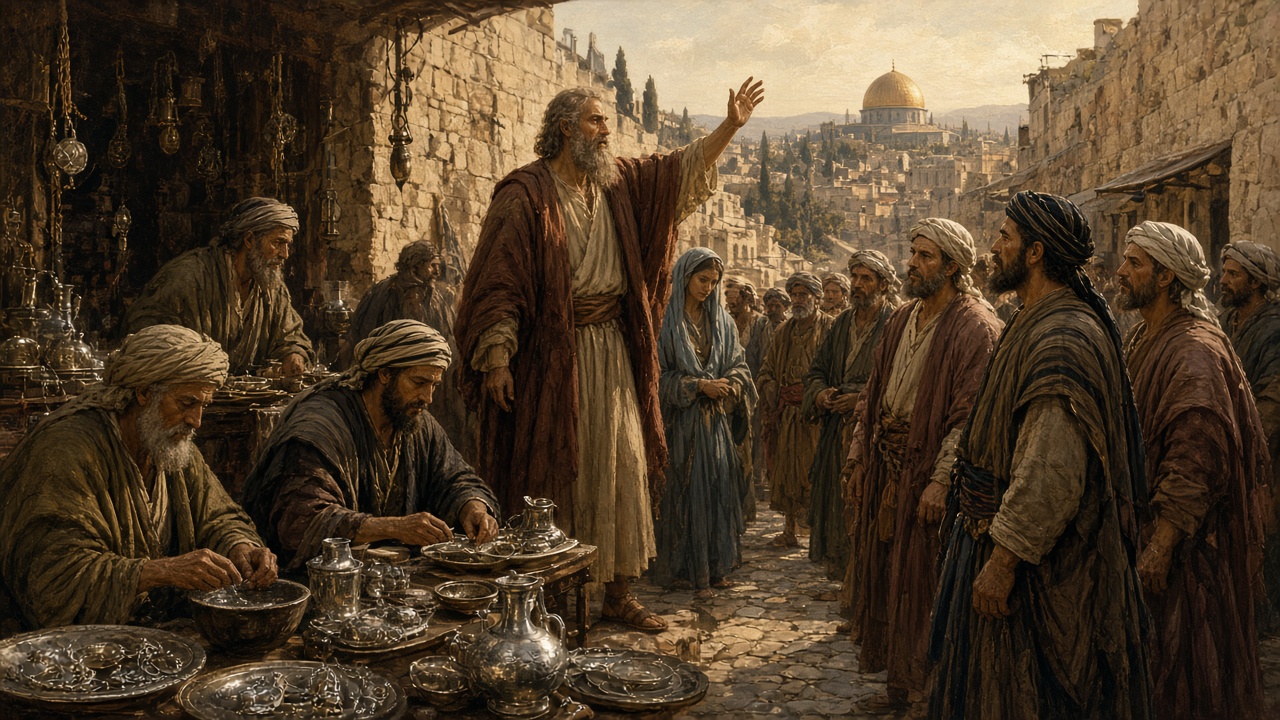
- Zephaniah 1:11 names the Mortar, a place in or near Jerusalem inhabited by silver merchants. It has been conjectured that this was the Phoenician quarter of the city, where traders of that nation lived.Sources: Mortar
Notes written with AI assistance from open sources (Theographic Bible Metadata, CC BY-SA 4.0; Easton’s Bible Dictionary, public domain) and reviewed before publishing.
1La parole de Yahweh qui fut adressée à Sophonie, fils de Chusi, fils de Godolias, fils d’Amarias, fils d’Ezéchias, dans les jours de Josias, fils d’Amon, roi de Juda.
2J’enlèverai tout de dessus la face de la terre, — oracle de Yahweh ; 3j’enlèverai les hommes et les bêtes, j’enlèverai les oiseaux du ciel et les poissons de la mer, et les scandales avec les impies, et j’exterminerai l’homme de dessus la face de la terre, — oracle de Yahweh.
4Et j’étendrai ma main sur Juda, et sur tous les habitants de Jérusalem, et j’exterminerai de ce lieu le reste de Baal, le nom de ses ministres en même temps que les prêtres ; 5et ceux qui se prosternent sur les toits, devant l’armée des cieux ; et ceux qui se prosternent en faisant serment à Yahweh, tout en jurant par leur roi ; 6et ceux qui se détournent de Yahweh, qui ne cherchent pas Yahweh, et ne se soucient pas de lui.
7Silence devant le Seigneur Yahweh ! Car le jour de Yahweh est proche ; car Yahweh a préparé un sacrifice, il a consacré ses invités. 8Et il arrivera : Au jour du sacrifice de Yahweh, je châtierai les princes, et les fils de roi, et tous ceux qui revêtent des vêtements étrangers. 9Et je châtierai en ce jour-là tous ceux qui sautent par-dessus le seuil, qui remplissent de violence et de fraude la maison de leur maître.
10Et il arrivera en ce jour-là, — oracle de Yahweh : De la porte des poissons retentiront des cris, de la seconde ville des gémissements, et des collines un grand fracas. 11Gémissez, habitants du Mortier, car tout le peuple chananéen est anéanti, tous ceux qui sont chargés d’argent sont exterminés.
12Et il arrivera en ce temps-là : Je fouillerai Jérusalem avec des lanternes, et je châtierai les hommes figés sur leur lie, qui disent en leur cœur : « Yahweh ne fait ni bien ni mal ! » 13Leurs biens seront livrés au pillage, et leurs maisons à la dévastation ; ils bâtiront des maisons, et ils n’y habiteront point ; ils planteront des vignes, et ils n’en boiront pas le vin.
14Il est proche le grand jour de Yahweh, il est proche, il vient en toute hâte ! On l’entend venir, le jour de Yahweh ! L’homme brave y poussera des cris amers. 15C’est un jour de fureur que ce jour-là, un jour d’angoisse et d’affliction, un jour de désolation et de ruine, un jour de ténèbres et d’obscurité, un jour de nuages et d’épais brouillards, 16un jour de trompette et d’alarme, sur les villes fortes et les créneaux élevés.
17Je mettrai les hommes dans la détresse, et ils marcheront comme des aveugles, parce qu’ils ont péché contre Yahweh ; leur sang sera répandu comme la poussière ; et leur chair comme du fumier. 18Ni leur argent, ni leur or ne pourront les délivrer ; au jour de la fureur de Yahweh ; par le feu de sa jalousie, toute la terre sera dévorée ; car il fera une destruction totale, une ruine soudaine, de tous les habitants de la terre.
Did you know?
The Day of the LORD and Judgment on Idolatry
- Zephaniah traces his lineage back four generations to Hezekiah, dating his prophetic ministry to the reign of King Josiah of Judah. Josiah came to power after his father, King Amon, had restored idolatry across Judah before being assassinated by his own servants.Sources: the Bible text itself · Josiah · Amon · Hizkiah
- The chapter denounces religious syncretism in Jerusalem, where people bowed on rooftops to the host of heaven and combined their devotion to the LORD with oaths to Baal and Malcham, the national idol of the Ammonites.Sources: the Bible text itself · Baal · Malcham
- The prophecy specifies landmarks in Jerusalem that would experience turmoil, including the Fish Gate and the Mortar (or Hollow), a district inhabited by merchants who weighed out silver.Sources: the Bible text itself · Fish Gate · Mortar
Notes written with AI assistance from open sources (Theographic Bible Metadata, CC BY-SA 4.0; Easton’s Bible Dictionary, public domain) and reviewed before publishing.
Places in this chapter
- Jerusalem · 31.777, 35.234 · verses 4, 12
- Fish Gate · Today: in Jerusalem · 31.777, 35.234 · verse 10
- Second Quarter · Today: in Jerusalem · 31.777, 35.234 · verse 10
- Canaan · 32.767, 35.333 · verse 11
- Mortar · Today: in Jerusalem · 31.777, 35.234 · verse 11
Only places identified with high confidence are shown (90% or more according to the scholarly sources compiled by OpenBible). Period map: DARE (Digital Atlas of the Roman Empire), CC BY 4.0; modern map: © OpenStreetMap contributors; places: OpenBible.info (CC BY 4.0).
Credits and license for this translation
Sainte Bible néo-Crampon Libre
The Holy Bible in French, néo-Crampon Libre translation
Sainte Bible néo-Crampon Libre, une modernisation de la traduction catholique française de Crampon
copyright © 2022 Fraternité de Tibériade
Language: français (French)
Une modernisation de la traduction catholique française de Crampon
This translation is made available to you under the terms of the
Creative Commons Attribution Share-Alike license 4.0.
You have permission to share and redistribute this Bible translation in any format and to make reasonable revisions and adaptations of this translation, provided that:
You include the above copyright and source information.
If you make any changes to the text, you must indicate that you did so in a way that makes it clear that the original licensor is not necessarily endorsing your changes.
If you redistribute this text, you must distribute your contributions under the same license as the original.
Pictures included with Scriptures and other documents on this site are licensed just for use with those Scriptures and documents.
For other uses, please contact the respective copyright owners.
Note that in addition to the rules above, revising and adapting God's Word involves a great responsibility to be true to God's Word. See Revelation 22:18-19.
2026-09-28
Source: http://eBible.org/francl/ · eBible.org