1 Chronicles 24
Sainte Bible néo-Crampon Libre · Tap a verse to see its cross-references.
1Quant aux fils d’Aaron, voici leurs classes :
Fils d’Aaron : Nadab, Abiu, Eléazar et Ithamar. 2Nadab et Abiu moururent avant leur père, sans avoir de fils, et Eléazar et Ithamar remplirent les fonctions du sacerdoce.
3David, Sadoc, de la descendance d’Eléazar, et Achimélech, de la descendance d’Ithamar, répartirent les fils d’Aaron par classes selon leur service. 4On trouva parmi les fils d’Eléazar plus de chefs que parmi les fils d’Ithamar, et on les répartit ainsi : pour les fils d’Eléazar, seize chefs de famille, et, pour les fils d’Ithamar, huit chefs de famille. 5On les répartit par le sort, les uns comme les autres, car il se trouvait des princes du sanctuaire et des princes de Dieu aussi bien parmi les fils d’Eléazar que parmi les fils d’Ithamar. 6Séméïas, fils de Nathanaël, le secrétaire, un des lévites, les inscrivit devant le roi et les princes, devant Sadoc le grand prêtre, et Achimélech, fils d’Abiathar, et devant les chefs de familles sacerdotales et lévitiques, une famille étant tirée au sort pour Eléazar, puis une famille pour Ithamar.
7Le premier sort échut à Joïarib, le deuxième à Jédéï, 8le troisième à Harim, le quatrième à Séorim, 9le cinquième à Melchia, le sixième à Maïman, 10le septième à Accos, le huitième à Abia, 11le neuvième à Jésua, le dixième à Séchénia, 12le onzième a Eliasib, le douzième à Jacim, 13le treizième à Hoppha, le quatorzième à Isbaab, 14le quinzième à Belga, le seizième à Emmer, 15le dix-septième à Hézir, le dix-huitième à Aphsès, 16le dix-neuvième à Phétéïa, le vingtième à Hézéchiel, 17le vingt et unième à Jachin, le vingt-deuxième à Gamul, 18le vingt-troisième à Dalaiaü, le vingt-quatrième à Mazziaü.
19Telles furent leurs classes selon leur service, afin qu’ils vinssent à la maison de Yahweh, selon le règlement qu’ils avaient reçu par l’organe d’Aaron, leur père, comme le lui avait ordonné Yahweh, le Dieu d’Israël.
20Voici les chefs du reste des lévites : des fils d’Amram : Subaël ; des fils de Subaël : Jéhédéïa ; 21de Rohobia, des fils de Rohobia : le chef Jésias. 22Des Isaarites : Salémoth ; des fils de Salémoth : Jahath. 23Fils d’Hébron : Jériaü le premier, Amarias le deuxième, Jahaziel le troisième, Jecmaan le quatrième. 24Fils d’Oziel : Micha ; des fils de Micha : Samir ; 25frère de Micha : Jésia ; fils de Jésia : Zacharias. — 26Fils de Mérari : Moholi et Musi. 27Fils de Mérari, par Oziaü, son fils : Saam, Zachur et Hébri. 28De Moholi : Eléazar, qui n’eut pas de fils ; 29de Cis, les fils de Cis ; Jéraméel. 30Fils de Musi : Moholi, Eder et Jérimoth.
31Ce sont là les fils de Lévi, selon leurs familles. Eux aussi, comme leurs frères, les fils d’Aaron, ils tirèrent le sort devant le roi David, devant Sadoc et Achimélech, et devant les chefs de famille sacerdotales et lévitiques, les plus anciens étant sur le même pied que les plus jeunes.
Did you know?
Organization of the Priests and Levites
- Because Aaron's two eldest sons, Nadab and Abihu, died without children after offering unauthorized fire, only the lines of Eleazar and Ithamar continued the priesthood. King David organized these descendants into twenty-four rotational divisions, sixteen from Eleazar and eight from Ithamar, to manage sanctuary duties.Sources: the Bible text itself · Eleazar · Ithamar · Nadab
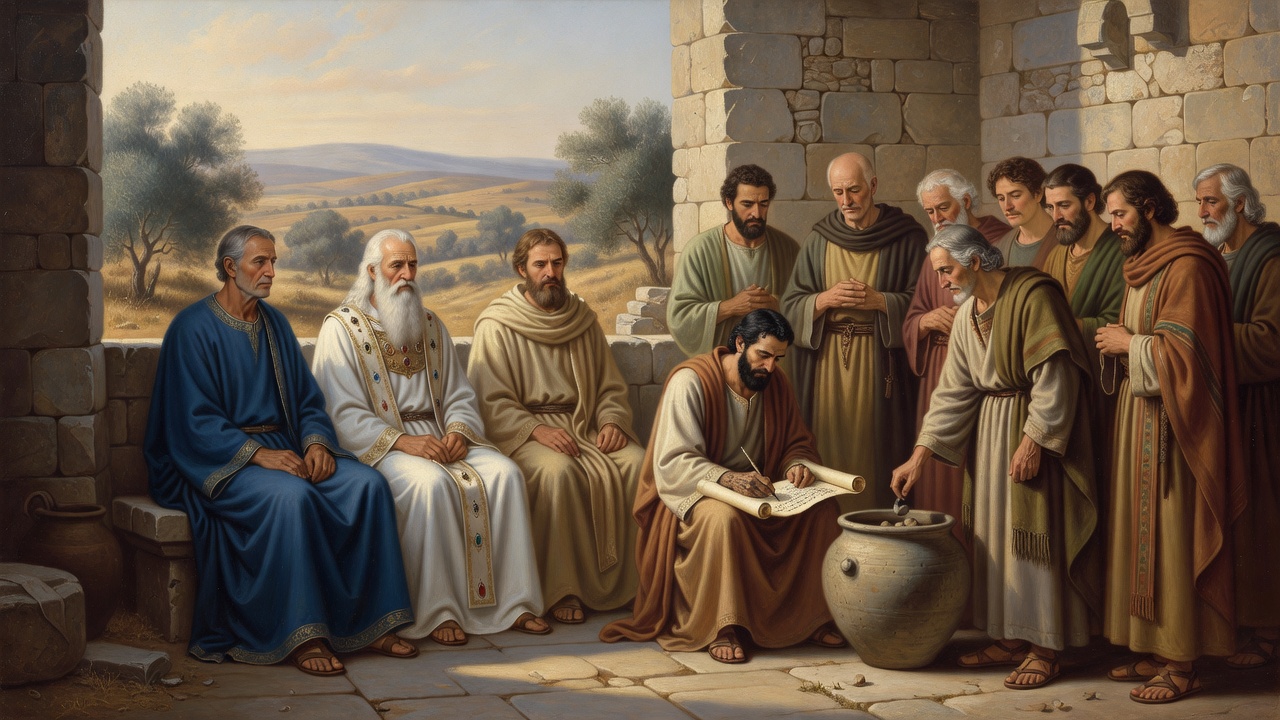
- To ensure fairness between the two ancestral lines, the order of service was determined by casting lots in the presence of King David, Zadok, and Ahimelech. The scribe Shemaiah, a Levite, recorded the name of each family as their lot was drawn.Sources: the Bible text itself · Zadok · Ahimelech
- The remaining Levite clans, including descendants of Kohath and Merari, were also assigned their responsibilities by casting lots. The selection was conducted without regard to age or rank, treating family heads and their younger brothers equally.Sources: the Bible text itself · Merari
Notes written with AI assistance from open sources (Theographic Bible Metadata, CC BY-SA 4.0; Easton’s Bible Dictionary, public domain) and reviewed before publishing.
Places in this chapter
- Holy Place · Today: on Mount Moriah · 31.778, 35.236 · verse 5
Only places identified with high confidence are shown (90% or more according to the scholarly sources compiled by OpenBible). Period map: DARE (Digital Atlas of the Roman Empire), CC BY 4.0; modern map: © OpenStreetMap contributors; places: OpenBible.info (CC BY 4.0).
Credits and license for this translation
Sainte Bible néo-Crampon Libre
The Holy Bible in French, néo-Crampon Libre translation
Sainte Bible néo-Crampon Libre, une modernisation de la traduction catholique française de Crampon
copyright © 2022 Fraternité de Tibériade
Language: français (French)
Une modernisation de la traduction catholique française de Crampon
This translation is made available to you under the terms of the
Creative Commons Attribution Share-Alike license 4.0.
You have permission to share and redistribute this Bible translation in any format and to make reasonable revisions and adaptations of this translation, provided that:
You include the above copyright and source information.
If you make any changes to the text, you must indicate that you did so in a way that makes it clear that the original licensor is not necessarily endorsing your changes.
If you redistribute this text, you must distribute your contributions under the same license as the original.
Pictures included with Scriptures and other documents on this site are licensed just for use with those Scriptures and documents.
For other uses, please contact the respective copyright owners.
Note that in addition to the rules above, revising and adapting God's Word involves a great responsibility to be true to God's Word. See Revelation 22:18-19.
2026-09-28
Source: http://eBible.org/francl/ · eBible.org