Malachi 1
Bible J.N. Darby · Tap a verse to see its cross-references.
About this book
About Malachi
- Easton's Bible Dictionary (1897) presents Malachi, a name meaning "messenger" or "angel," as the last of the minor prophets and the writer of the last book of the Old Testament canon. Nothing is known of him beyond what is contained in his book of prophecies.Sources: Easton: Malachi · Malachi
- Some have supposed that the name is simply a title for a messenger of Jehovah, not a proper name. Easton's Bible Dictionary (1897) concludes, however, that there is reason to regard Malachi as the prophet's ordinary name.Sources: Easton: Malachi · Malachi
- Easton's Bible Dictionary (1897) dates the prophecies to about 420 B.C., after Nehemiah's second return from Persia, or possibly before that return. Because Ezra does not mention him and he does not mention the restoration of the temple, the dictionary infers that he prophesied after Haggai and Zechariah.Sources: Easton: Malachi
- Easton's Bible Dictionary (1897) treats Malachi as a contemporary of Nehemiah, comparing Malachi 2:8 with Nehemiah 13:15 and Malachi 2:10-16 with Nehemiah 13:23. It also notes that the temple services were still in existence, citing Malachi 1:10, 3:1 and 3:10.Sources: Easton: Malachi
Notes written with AI assistance from open sources (Theographic Bible Metadata, CC BY-SA 4.0; Easton’s Bible Dictionary, public domain) and reviewed before publishing.
1L’oracle de la parole de l’ Éternel à Israël par Malachie.
2Je vous ai aimés, dit l’ Éternel ; et vous dites : En quoi nous as-tu aimés ? Ésaü n’était-il pas frère de Jacob ? dit l’ Éternel ; et j’ai aimé Jacob ; 3et j’ai haï Ésaü, et j’ai fait de ses montagnes une désolation, et [j’ai livré] son héritage aux chacals du désert. 4Si Édom dit : Nous sommes détruits, mais nous rebâtirons ce qui est ruiné, – ainsi dit l’ Éternel des armées : Ils bâtiront, mais moi, je renverserai, et on les appellera contrée de méchanceté, et le peuple contre lequel l’ Éternel est indigné à toujours. 5Et vos yeux le verront, et vous direz : L’ Éternel sera magnifié par-delà les confins d’Israël.
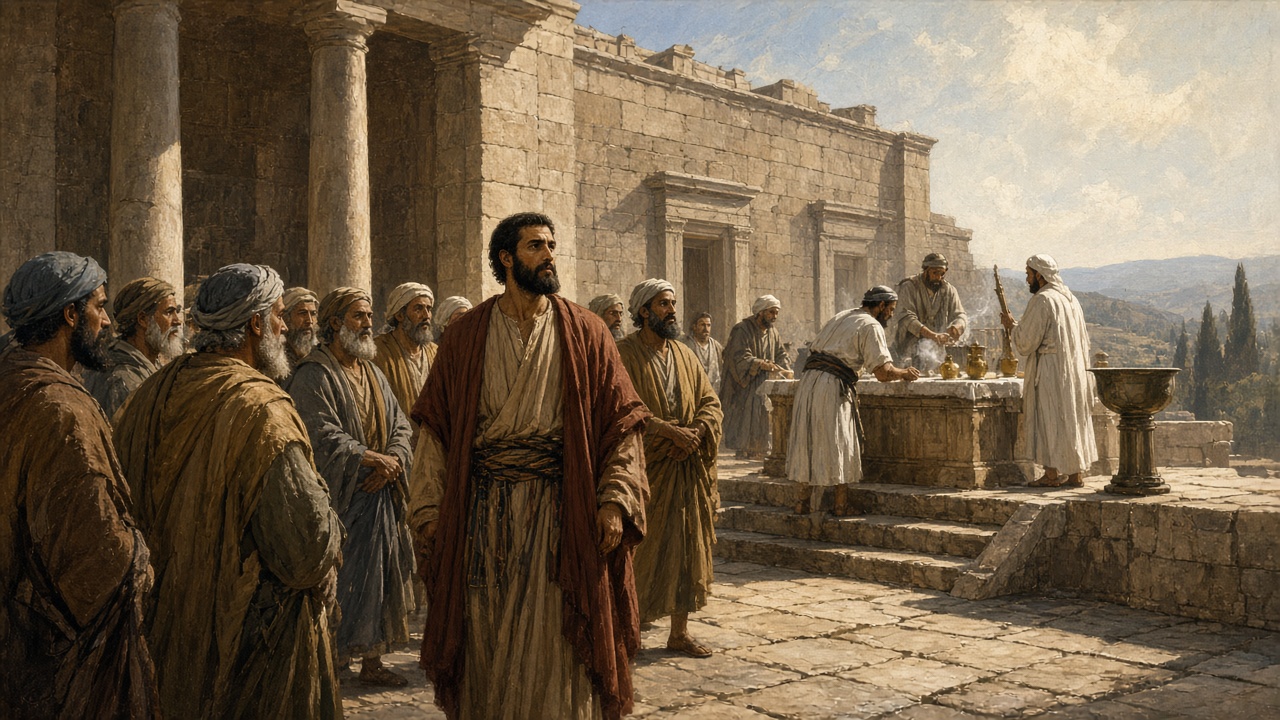
6Un fils honore son père, et un serviteur, son maître. Si donc je suis père, où est mon honneur ? et si je suis maître, où est la crainte qui m’est due ? dit l’ Éternel des armées, à vous, sacrificateurs, qui méprisez mon nom. Et vous dites : En quoi avons-nous méprisé ton nom ? 7Vous présentez sur mon autel du pain souillé, et vous dites : En quoi t’avons-nous profané ? En ce que vous dites : La table de l’ Éternel est méprisable. 8Et si vous présentez une [bête] aveugle en sacrifice, n’est-ce pas mal ? et si vous [en] présentez une boiteuse et malade, n’est-ce pas mal ? Offre-la donc à ton gouverneur : t’agréera-t-il, ou te recevra-t-il avec faveur ? dit l’ Éternel des armées. 9Et maintenant, implorez donc ✶Dieu, afin qu’il use de grâce envers nous. C’est par vos mains que cela a eu lieu : vous recevra-t-il avec faveur ? dit l’ Éternel des armées. 10Qui même d’entre vous fermerait les portes ? et vous n’allumeriez pas [le feu] sur mon autel pour rien ! Je ne prends pas plaisir en vous, dit l’ Éternel des armées, et l’offrande, je ne l’agréerai pas de vos mains.
11Car, du soleil levant jusqu’au soleil couchant, mon nom sera grand parmi les nations, et, en tout lieu, l’encens sera brûlé à mon nom, et une offrande pure sera présentée, car mon nom sera grand parmi les nations, dit l’ Éternel des armées. 12Mais vous, vous le profanez, en ce que vous dites : La table du Seigneur est souillée ; et ce qu’elle fournit, sa nourriture, est méprisable. 13Et vous dites : Voilà, quel ennui ! et vous soufflez dessus, dit l’ Éternel des armées, et vous apportez ce qui a été déchiré, et la [bête] boiteuse, et la malade ; c’est ainsi que vous apportez l’offrande. Agréerais-je cela de votre main ? dit l’ Éternel. 14Et maudit est celui qui trompe, et qui a dans son troupeau un mâle, et fait un vœu et sacrifie au Seigneur ce qui est corrompu ; car je suis un grand roi, dit l’ Éternel des armées, et mon nom est terrible parmi les nations.
Did you know?
Honoring God and Defective Offerings
- The name Malachi means messenger or angel. While some have suggested it was a title rather than a proper name, scholars and traditions widely treat it as the prophet's personal name, placing his ministry during the period of Nehemiah, after Haggai and Zechariah.Sources: Malachi
- The opening dispute recalls the twin brothers Jacob and Esau, the ancestors of Israel and Edom. The text contrasts God's covenant love for Israel with the judgment and desolation coming upon the mountainous region of Edom.Sources: Esau (Edom) · Jacob (Israel) · Edom · the Bible text itself
- The priests are rebuked for offering blind, lame, and diseased animals on the altar rather than unblemished livestock. Malachi exposes their disrespect by asking whether a civil governor would accept such inferior gifts.Sources: the Bible text itself
Notes written with AI assistance from open sources (Theographic Bible Metadata, CC BY-SA 4.0; Easton’s Bible Dictionary, public domain) and reviewed before publishing.
Places in this chapter
- Edom · 30.746, 35.604 · verse 4
Only places identified with high confidence are shown (90% or more according to the scholarly sources compiled by OpenBible). Period map: DARE (Digital Atlas of the Roman Empire), CC BY 4.0; modern map: © OpenStreetMap contributors; places: OpenBible.info (CC BY 4.0).
Credits and license for this translation
Bible J.N. Darby
French: Bible J.N. Darby
Public Domain
Language: Français (French)
Contributor: Bibles et Publications Chrétiennes
La version J.N. Darby est une traduction littérale, considérée comme une des traductions françaises les plus proches du texte original.
Première édition de la Bible complète en 1885, rééditée en 1916, puis en 2024. La numérotation des versets de cette édition de 2024 suit celle de la Bible hébraïque.
Texte dans le domaine public.
Source : éditeur BPC , Bibles et Publications Chrétiennes (révision JND v2.0)
2025-05-02
Source: http://ebible.org/frajnd/ · eBible.org