Song of Songs 7
Louis Segond 1910 · Tap a verse to see its cross-references.
1Reviens, reviens, Sulamithe!
Reviens, reviens, afin que nous te regardions.
Qu’avez-vous à regarder la Sulamithe
Comme une danse de deux chœurs?
2Que tes pieds sont beaux dans ta chaussure, fille de prince!
Les contours de ta hanche sont comme des colliers,
Œuvre des mains d’un artiste.
3Ton sein est une coupe arrondie,
Où le vin parfumé ne manque pas;
Ton corps est un tas de froment,
Entouré de lis.
4Tes deux seins sont comme deux faons,
Comme les jumeaux d’une gazelle.
5Ton cou est comme une tour d’ivoire;
Tes yeux sont comme les étangs de Hesbon,
Près de la porte de Bath-Rabbim;
Ton nez est comme la tour du Liban,
Qui regarde du côté de Damas.
6Ta tête est élevée comme le Carmel,
Et les cheveux de ta tête sont comme la pourpre;
Un roi est enchaîné par des boucles!…
7Que tu es belle, que tu es agréable,
O mon amour, au milieu des délices!
8Ta taille ressemble au palmier,
Et tes seins à des grappes.
9Je me dis: Je monterai sur le palmier,
J’en saisirai les rameaux!
Que tes seins soient comme les grappes de la vigne,
Le parfum de ton souffle comme celui des pommes,
10Et ta bouche comme un vin excellent,…
Qui coule aisément pour mon bien-aimé,
Et glisse sur les lèvres de ceux qui s’endorment!
11Je suis à mon bien-aimé,
Et ses désirs se portent vers moi.
12Viens, mon bien-aimé, sortons dans les champs,
Demeurons dans les villages!
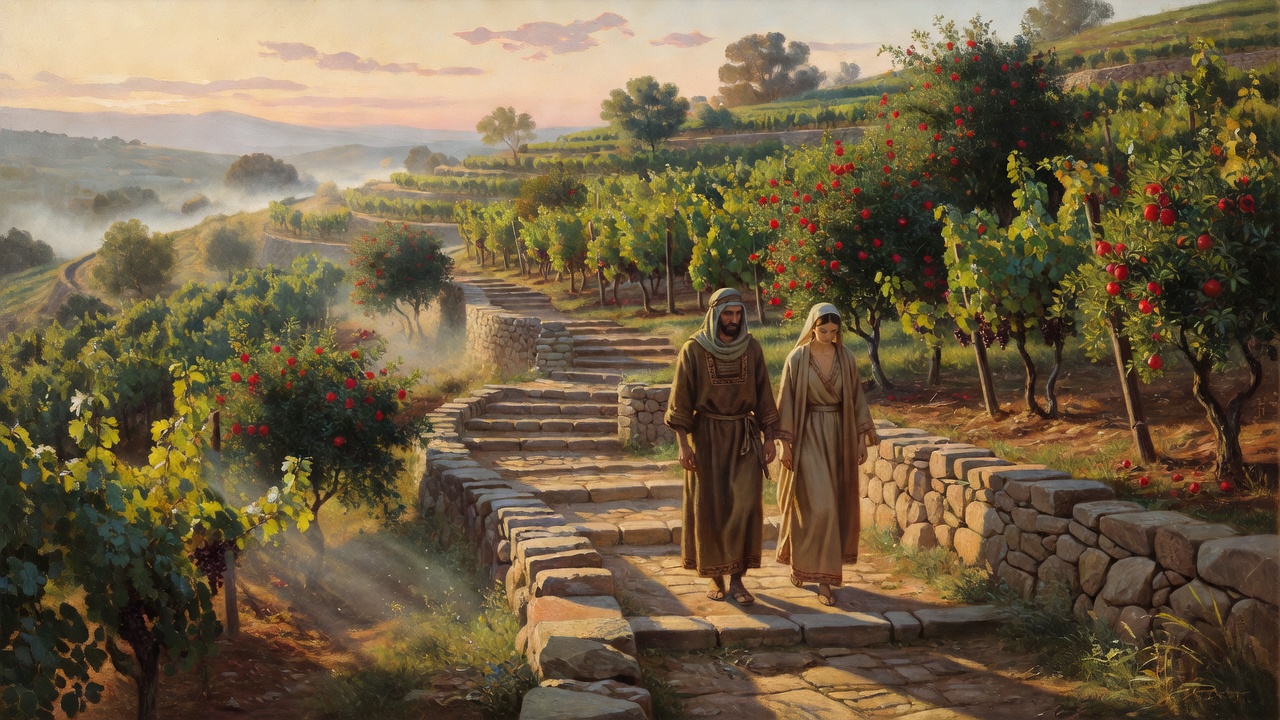
13Dès le matin nous irons aux vignes,
Nous verrons si la vigne pousse, si la fleur s’ouvre,
Si les grenadiers fleurissent.
Là je te donnerai mon amour.
14Les mandragores répandent leur parfum,
Et nous avons à nos portes tous les meilleurs fruits,
Nouveaux et anciens:
Mon bien-aimé, je les ai gardés pour toi.
Did you know?
Poetry of Love and Landscape
- The poem describes the woman's beauty using prominent landmarks of the region. Her eyes are compared to the calm pools of Heshbon near the gate of Bath-rabbim east of the Jordan, while her profile is likened to a majestic tower in the mountain range of Lebanon overlooking Damascus.Sources: the Bible text itself · Heshbon · Bath-rabbim · Lebanon
- The chapter concludes with an invitation to the countryside during the renewal of spring. The lovers seek out budding grapevines, blooming pomegranates, and fragrant mandrakes, reflecting the close connection in ancient Hebrew poetry between romantic intimacy and the vitality of the natural world.Sources: the Bible text itself
Notes written with AI assistance from open sources (Theographic Bible Metadata, CC BY-SA 4.0; Easton’s Bible Dictionary, public domain) and reviewed before publishing.
Places in this chapter
- Bath-rabbim · Today: in Tell Hesban · 31.801, 35.809 · verse 4
- Damascus · 33.511, 36.306 · verse 4
- Lebanon · 33.540, 35.584 · verse 4
- Mount Carmel · 32.672, 35.023 · verse 5
Only places identified with high confidence are shown (90% or more according to the scholarly sources compiled by OpenBible). Period map: DARE (Digital Atlas of the Roman Empire), CC BY 4.0; modern map: © OpenStreetMap contributors; places: OpenBible.info (CC BY 4.0).
Credits and license for this translation
Louis Segond 1910
The Holy Bible in French, Louis Segond version of 1910
Public Domain
Language: français (French)
Translation by: Louis Segond
Contributor: Public Domain
The first edition of the Bible Segond was published in 1910
Cette Bible est dans le domaine public. Il n'est pas protégé par copyright.
This Bible is in the Public Domain. It is not copyrighted.
2026-10-03
Source: http://ebible.org/fraLSG/ · eBible.org