Song of Songs 7
Young's Literal Translation · Tap a verse to see its cross-references.
Admiration by the Bridegroom
1As the chorus of 'Mahanaim.' How beautiful were thy feet with sandals, O daughter of Nadib. The turnings of thy sides [are] as ornaments, Work of the hands of an artificer. 2Thy waist [is] a basin of roundness, It lacketh not the mixture, Thy body a heap of wheat, fenced with lilies, 3Thy two breasts as two young ones, twins of a roe, 4Thy neck as a tower of the ivory, Thine eyes pools in Heshbon, near the gate of Bath-Rabbim, Thy face as a tower of Lebanon looking to Damascus, 5Thy head upon thee as Carmel, And the locks of thy head as purple, The king is bound with the flowings! 6How fair and how pleasant hast thou been, O love, in delights. 7This thy stature hath been like to a palm, And thy breasts to clusters. 8I said, 'Let me go up on the palm, Let me lay hold on its boughs, Yea, let thy breasts be, I pray thee, as clusters of the vine, And the fragrance of thy face as citrons, 9And thy palate as the good wine — 'Flowing to my beloved in uprightness, Strengthening the lips of the aged!
The Bride
10I [am] my beloved's, and on me [is] his desire. 11Come, my beloved, we go forth to the field, 12We lodge in the villages, we go early to the vineyards, We see if the vine hath flourished, The sweet smelling-flower hath opened. The pomegranates have blossomed, There do I give to thee my loves; 13The mandrakes have given fragrance, And at our openings all pleasant things, New, yea, old, my beloved, I laid up for thee!
Did you know?
Poetry of Love and Landscape
- The poem describes the woman's beauty using prominent landmarks of the region. Her eyes are compared to the calm pools of Heshbon near the gate of Bath-rabbim east of the Jordan, while her profile is likened to a majestic tower in the mountain range of Lebanon overlooking Damascus.Sources: the Bible text itself · Heshbon · Bath-rabbim · Lebanon
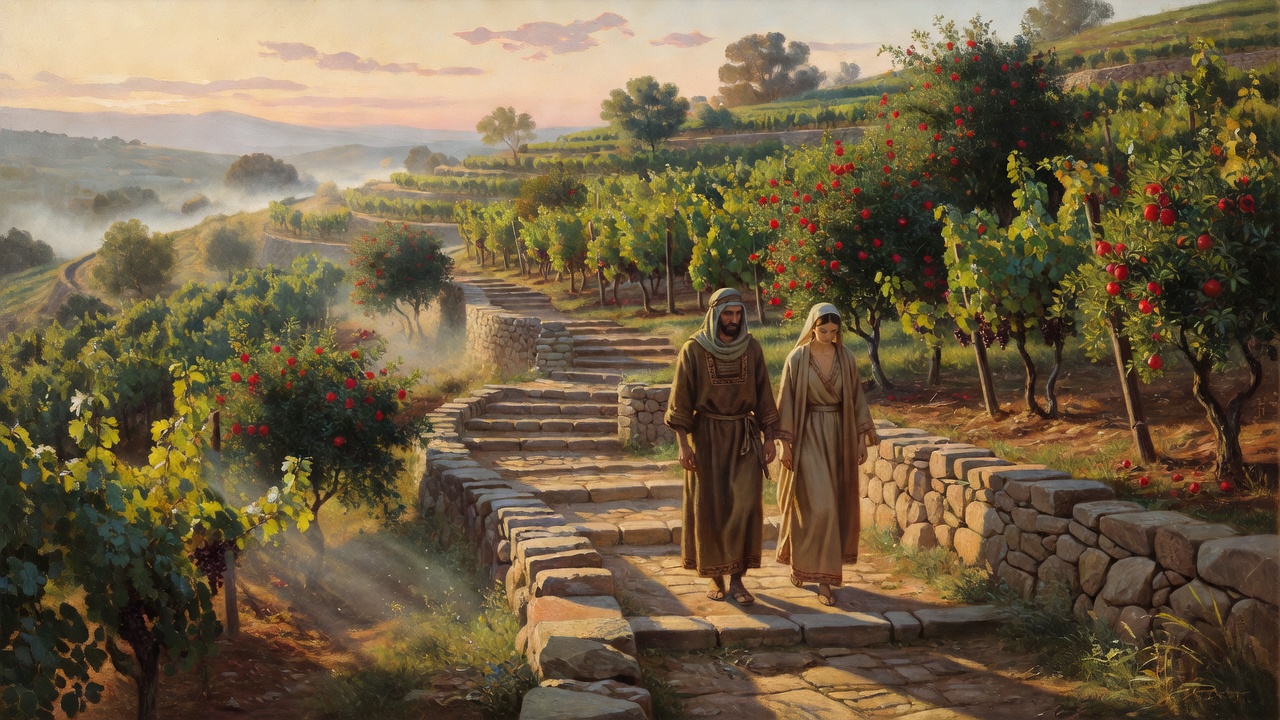
- The chapter concludes with an invitation to the countryside during the renewal of spring. The lovers seek out budding grapevines, blooming pomegranates, and fragrant mandrakes, reflecting the close connection in ancient Hebrew poetry between romantic intimacy and the vitality of the natural world.Sources: the Bible text itself
Notes written with AI assistance from open sources (Theographic Bible Metadata, CC BY-SA 4.0; Easton’s Bible Dictionary, public domain) and reviewed before publishing.
Places in this chapter
- Bath-rabbim · Today: in Tell Hesban · 31.801, 35.809 · verse 4
- Damascus · 33.511, 36.306 · verse 4
- Lebanon · 33.540, 35.584 · verse 4
- Mount Carmel · 32.672, 35.023 · verse 5
Only places identified with high confidence are shown (90% or more according to the scholarly sources compiled by OpenBible). Period map: DARE (Digital Atlas of the Roman Empire), CC BY 4.0; modern map: © OpenStreetMap contributors; places: OpenBible.info (CC BY 4.0).
Credits and license for this translation
Young's Literal Translation
Young's Literal Translation of the Holy Bible
Public Domain
Language: ENGLISH (English)
Dialect: archaic British
Translation by: Robert Young
This public domain Bible translation is brought to you courtesy of eBible.org.
If you would like to make a donation to help keep free Bible access like this going, please visit https://eBible.org/give.php .
2019-10-20
Section headings adapted from the Berean Standard Bible (public domain); they are not part of this translation’s text.
Source: http://ebible.org/engylt/ · eBible.org