Song of Songs 2
Young's Literal Translation · Tap a verse to see its cross-references.
The Bride’s Admiration
The Bride
1As a lily among the thorns,
The Bridegroom
2So [is] my friend among the daughters!
The Bride
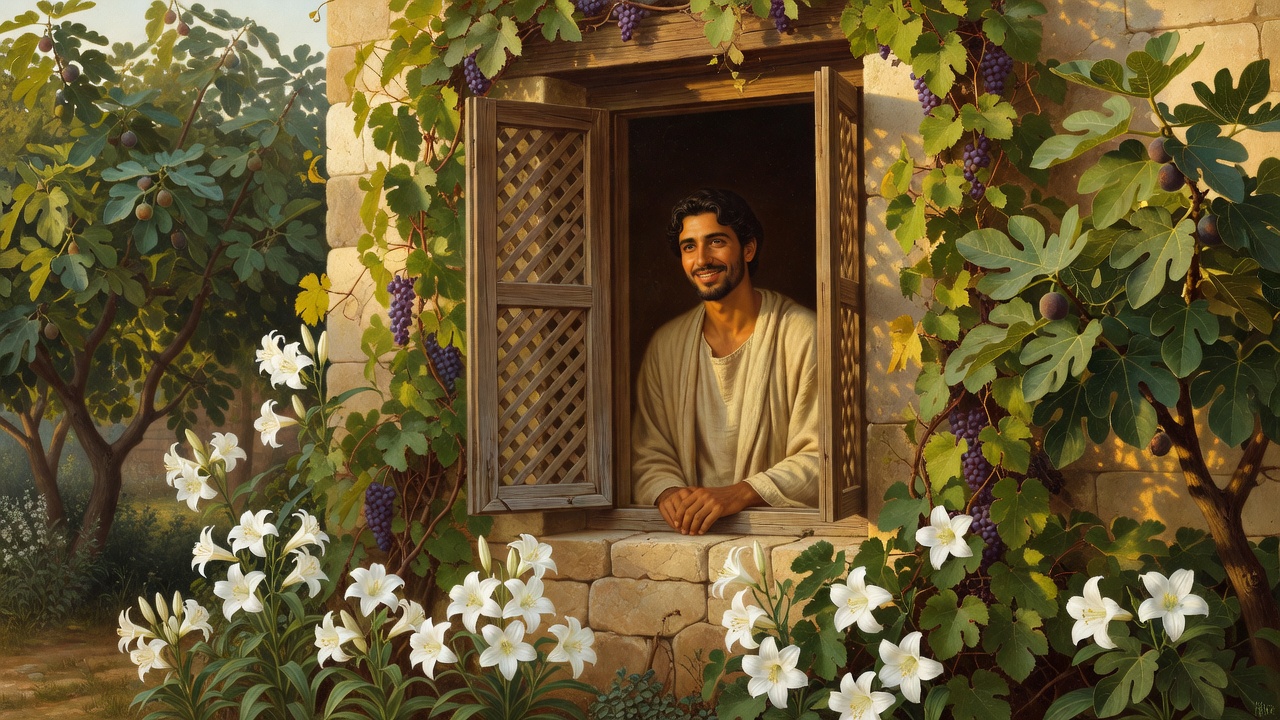
3As a citron among trees of the forest, So [is] my beloved among the sons, In his shade I delighted, and sat down, And his fruit [is] sweet to my palate. 4He hath brought me in unto a house of wine, And his banner over me [is] love, 5Sustain me with grape-cakes, Support me with citrons, for I [am] sick with love. 6His left hand [is] under my head, And his right doth embrace me. 7I have adjured you, daughters of Jerusalem, By the roes or by the hinds of the field, Stir not up nor wake the love till she please! 8The voice of my beloved! lo, this — he is coming, Leaping on the mountains, skipping on the hills. 9My beloved [is] like to a roe, Or to a young one of the harts. Lo, this — he is standing behind our wall, Looking from the windows, Blooming from the lattice. 10My beloved hath answered and said to me, 'Rise up, my friend, my fair one, and come away, 11For lo, the winter hath passed by, The rain hath passed away — it hath gone. 12The flowers have appeared in the earth, The time of the singing hath come, And the voice of the turtle was heard in our land, 13The fig-tree hath ripened her green figs, And the sweet-smelling vines have given forth fragrance, Rise, come, my friend, my fair one, yea, come away.
The Bridegroom
14My dove, in clefts of the rock, In a secret place of the ascent, Cause me to see thine appearance, Cause me to hear thy voice, For thy voice [is] sweet, and thy appearance comely.
The Friends
15Seize ye for us foxes, Little foxes — destroyers of vineyards, Even our sweet-smelling vineyards.
The Bride
16My beloved [is] mine, and I [am] his, Who is delighting among the lilies, 17Till the day doth break forth, And the shadows have fled away, Turn, be like, my beloved, To a roe, or to a young one of the harts, On the mountains of separation!
Did you know?
Springtime and Awakening Love
- Sharon was a fertile coastal plain stretching between the Mediterranean Sea and the hill country west of Jerusalem, celebrated for its beauty and vegetation, which gave rise to imagery like the rose of Sharon.Sources: Saron · the Bible text itself
- The poem marks the arrival of spring through natural changes in the countryside, such as the end of winter rains, the cooing of turtledoves, ripening fig trees, and flowering grapevines that needed protection from foraging foxes.Sources: the Bible text itself
- The speaker repeatedly appeals to the daughters of Jerusalem, framing her cautions about love around wild animals of the open hills, such as gazelles and does of the field.Sources: Jerusalem · the Bible text itself
Notes written with AI assistance from open sources (Theographic Bible Metadata, CC BY-SA 4.0; Easton’s Bible Dictionary, public domain) and reviewed before publishing.
Places in this chapter
Only places identified with high confidence are shown (90% or more according to the scholarly sources compiled by OpenBible). Period map: DARE (Digital Atlas of the Roman Empire), CC BY 4.0; modern map: © OpenStreetMap contributors; places: OpenBible.info (CC BY 4.0).
Credits and license for this translation
Young's Literal Translation
Young's Literal Translation of the Holy Bible
Public Domain
Language: ENGLISH (English)
Dialect: archaic British
Translation by: Robert Young
This public domain Bible translation is brought to you courtesy of eBible.org.
If you would like to make a donation to help keep free Bible access like this going, please visit https://eBible.org/give.php .
2019-10-20
Section headings adapted from the Berean Standard Bible (public domain); they are not part of this translation’s text.
Source: http://ebible.org/engylt/ · eBible.org