Psalms 48
Young's Literal Translation · Tap a verse to see its cross-references.
Broken Bondage
1A Song, a Psalm, by sons of Korah. Great [is] Jehovah, and praised greatly, In the city of our God — His holy hill. 2Beautiful [for] elevation, A joy of all the land, [is] Mount Zion, The sides of the north, the city of a great king. 3God in her high places is known for a tower. 4For, lo, the kings met, they passed by together, 5They have seen — so they have marvelled, They have been troubled, they were hastened away. 6Trembling hath seized them there, Pain, as of a travailing woman. 7By an east wind Thou shiverest ships of Tarshish. 8As we have heard, so we have seen, In the city of Jehovah of hosts, In the city of our God, God doth establish her — to the age. Selah. 9We have thought, O God, of Thy kindness, In the midst of Thy temple, 10As [is] Thy name, O God, so [is] Thy praise, Over the ends of the earth, Righteousness hath filled Thy right hand. 11Rejoice doth Mount Zion, The daughters of Judah are joyful, For the sake of Thy judgments. 12Compass Zion, and go round her, count her towers, 13Set your heart to her bulwark, Consider her high places, So that ye recount to a later generation, 14That this God [is] our God — To the age and for ever, He — he doth lead us over death!
Did you know?
Zion, the City of the Great King
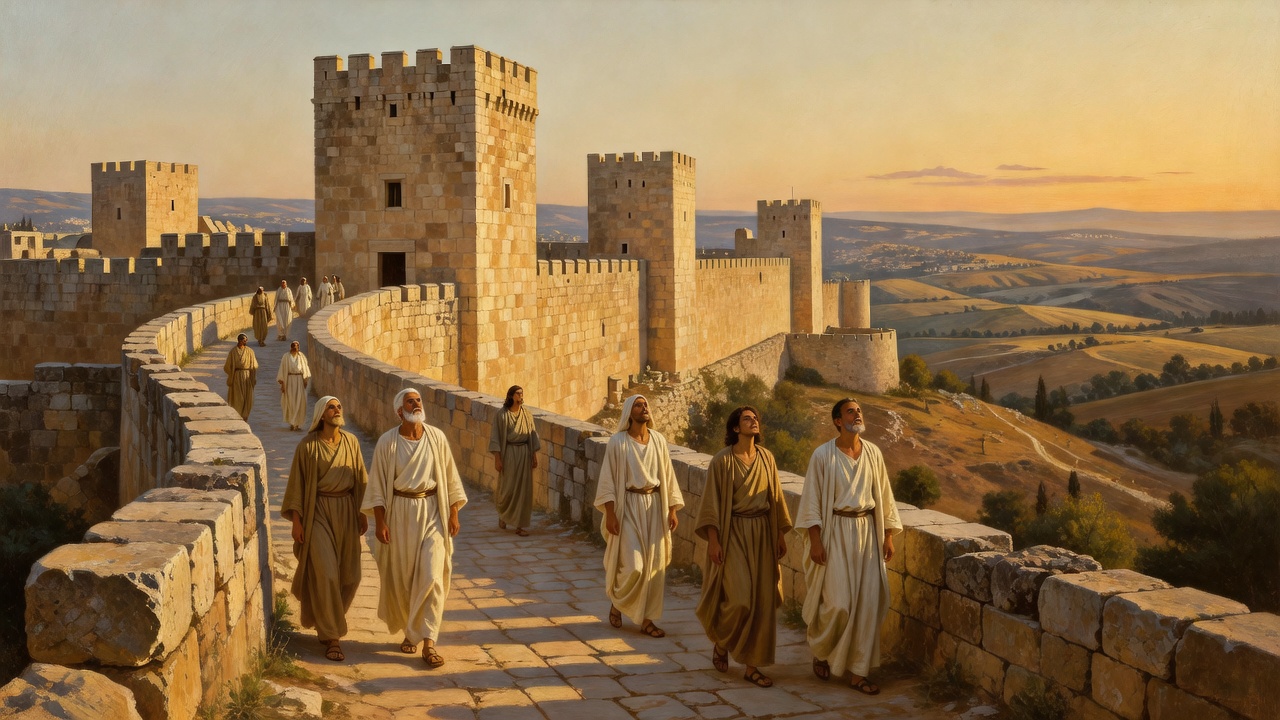
- Mount Zion, originally the fortified southeastern hill of Jerusalem captured by David from the Jebusites, became known as the City of David and the site of his citadel. In Psalm 48, it is celebrated as God's holy mountain, elevated and fortified against advancing enemy kings.Sources: the Bible text itself · Mount Zion · Zion
- The psalm depicts God's power shattering enemy forces like an east wind wrecking the ships of Tarshish. Many scholars identify Tarshish with a distant Phoenician trading port in southwestern Spain, while other ancient traditions proposed locations such as Carthage or ports in the east.Sources: the Bible text itself · Tarshish
- Worshippers are invited to walk around the perimeter of Zion to inspect its ramparts, count its towers, and view its citadels. This survey of the city's defenses was meant to be recounted to future generations as a witness of God's steadfast protection.Sources: the Bible text itself
Notes written with AI assistance from open sources (Theographic Bible Metadata, CC BY-SA 4.0; Easton’s Bible Dictionary, public domain) and reviewed before publishing.
Places in this chapter
- Mount Zion · 31.772, 35.229 · verses 2, 11
- Zaphon · Today: Jebel Aqra · 35.953, 35.969 · verse 2
- Jerusalem · 31.777, 35.234 · verse 3
- Zion · Today: Jerusalem · 31.777, 35.234 · verse 12
Only places identified with high confidence are shown (90% or more according to the scholarly sources compiled by OpenBible). Period map: DARE (Digital Atlas of the Roman Empire), CC BY 4.0; modern map: © OpenStreetMap contributors; places: OpenBible.info (CC BY 4.0).
Credits and license for this translation
Young's Literal Translation
Young's Literal Translation of the Holy Bible
Public Domain
Language: ENGLISH (English)
Dialect: archaic British
Translation by: Robert Young
This public domain Bible translation is brought to you courtesy of eBible.org.
If you would like to make a donation to help keep free Bible access like this going, please visit https://eBible.org/give.php .
2019-10-20
Section headings adapted from the Berean Standard Bible (public domain); they are not part of this translation’s text.
Source: http://ebible.org/engylt/ · eBible.org