Song of Songs 6
Wycliffe's Bible with Modern Spelling (Enhanced) · Tap a verse to see its cross-references.
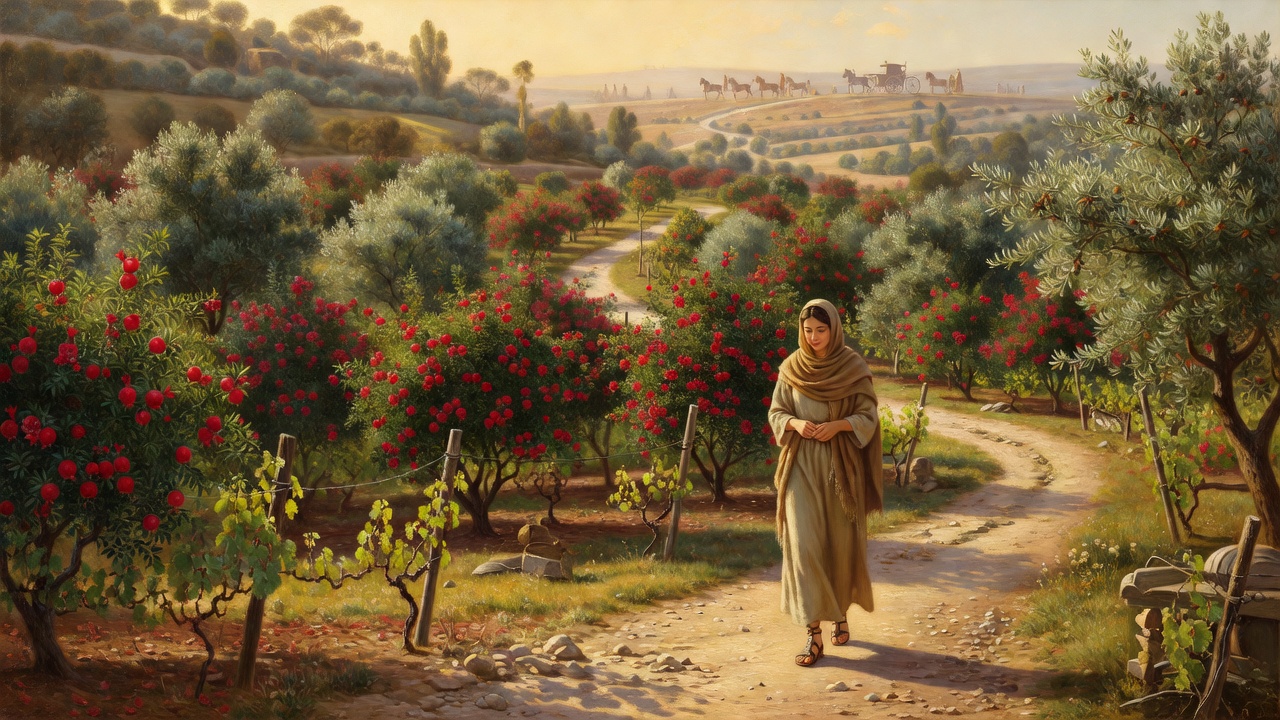
Together in the Garden
The Friends
1Thou fairest of women, whither went [away] thy darling? whither bowed [down] thy darling? and we shall seek him with thee. (O most beautiful of women, where did thy darling go? where did thy darling lie down? yea, we shall seek him with thee.)
The Bride
2My darling went down into his orchard, to the garden of sweet smelling spices, that he be fed there in [the] orchards, and gather lilies.
3I to my darling; and my darling, that is fed among the lilies, be to me. (I am for my darling; and my darling, he who is fed among the lilies, is for me.)
The Bridegroom
4My love, thou art fair, sweet and shapely as Jerusalem, thou art fearedful as the battle array of hosts set in good order. (My love, thou art as beautiful as Tirzah, and as lovely as Jerusalem, and thou art as awesome as the battle array of armies set in good order.)
5Turn away thine eyes from me, for they made me to flee away; thine hairs be as the flocks of goats, that appeared from Gilead, (or thy hair is like the flocks of goats, that appeared from Gilead).
6Thy teeth be as a flock of sheep, that went up from [the] washing; all be with double lambs, either twins, and no barren there is among them. (Thy teeth be like a flock of sheep, that went up from the washing; all of them be with double lambs, or with twins, and there is no barren among them.)
7As the rind of a pomegranate, so be thy cheeks, without thy privates. (Like the rind of a pomegranate, so be thy cheeks, behind thy veil.)
8Sixty be queens, and eighty be secondary wives; and of young damsels is none number. (There be sixty queens, and eighty concubines, and of young women, or of maidens, there is no number.)
9One is my culver, my perfect spousess, one is to her mother, and is the chosen of her mother; the daughters of Zion saw her, and preached her most blessed; queens, and secondary wives, praised her. (But only one is my dove, my perfect spousess, the only daughter of her mother, yea, the chosen of her mother; the daughters of Zion saw her, and proclaimed her most blessed; queens, and concubines, praised her.)
The Friends
10Who is this, that goeth forth, as the morrowtide rising, fair as the moon, chosen as the sun, fearedful as the battle array of hosts set in good order? (Who is this, who goeth forth, like daybreak, beautiful as the moon, chosen as the sun, as awesome as the battle array of armies set in good order?)
The Bridegroom
11I came down into mine orchard, to see the apples of (the) great valleys, and to behold, if vineries had flowered, (or and to see, if the vines had flowered), and if the pomegranate trees had burgeoned.
12I knew not; my soul troubled me, for the chariots of Amminadib. (But I knew not anything for sure; and my soul troubled me, like the chariots of Amminadib.)
The Friends
13Turn again, turn again, thou Shulamite; turn again, turn again, that we behold thee. What shalt thou see in the Shulamite, but companies of hosts? (Return, yea, return, O Shulamite; return, yea, return, so that we can see thee. How all of thee love to behold the Shulamite, as she danceth before thee!)
Did you know?
Beauty and Royal Splendor
- The poem praises the woman's beauty by comparing her to Tirzah and Jerusalem, two prominent royal centers. Tirzah was an ancient Canaanite city celebrated for its charm that later served as an early capital of the northern kingdom of Israel, while Jerusalem stood as the mountain capital of Judah.Sources: Tirzah · Jerusalem · the Bible text itself
- The description of hair streaming down like a flock of goats from Gilead evokes the rugged, mountainous territory east of the Jordan River, where herds grazed along the steep slopes.Sources: Gilead · the Bible text itself
Notes written with AI assistance from open sources (Theographic Bible Metadata, CC BY-SA 4.0; Easton’s Bible Dictionary, public domain) and reviewed before publishing.
Places in this chapter
Only places identified with high confidence are shown (90% or more according to the scholarly sources compiled by OpenBible). Period map: DARE (Digital Atlas of the Roman Empire), CC BY 4.0; modern map: © OpenStreetMap contributors; places: OpenBible.info (CC BY 4.0).
Credits and license for this translation
Wycliffe's Bible with Modern Spelling (Enhanced)
English: Wycliffe's Bible Modern Spelling (Enhanced) (with Deuterocanon)
Copyright © 2001,2010,2011,2012,2013,2015 Terry Noble
Language: English
Dialect: Archaic
Translation by: Terry Noble
Wycliffe's Bible with Modern Spelling (Enhanced)
Wycliffe’s Bible with Modern Spelling (Enhanced) is a composite of my Wycliffe’s Bible, a modern-spelling version of the 14th century Middle English translation, consisting of Wycliffe’s Old Testament and Wycliffe’s New Testament, and my modern-spelling version of Wycliffe’s Apocrypha. These books contain literally tens of thousands of rewritten verses, presented in parentheses “( ) “, to provide help in comprehending the 14th century Middle English vocabulary and grammar. Wycliffe’s Apocrypha also includes the books of the Apocrypha from the 1st edition of the King James Version of the Bible.
This translation is made available to you under the terms of the
Creative Commons Attribution-Noncommercial-No Derivatives license 4.0.
You may share and redistribute this Bible translation or extracts from it in any format, provided that:
You include the above copyright and source information.
You do not sell this work for a profit.
You do not change any of the words or punctuation of the Scriptures.
Pictures included with Scriptures and other documents on this site are licensed just for use with those Scriptures and documents.
For other uses, please contact the respective copyright owners.
2019-09-25
Section headings adapted from the Berean Standard Bible (public domain); they are not part of this translation’s text.
Source: http://ebible.org/engwyc2018/ · eBible.org