Song of Songs 2
Wycliffe's Bible with Modern Spelling (Enhanced) · Tap a verse to see its cross-references.
The Bride’s Admiration
The Bride
1I am a flower of the field, and a lily of great valleys. (I am a flower of Sharon, and a lily of the great valley.)
The Bridegroom
2As a lily among thorns, so is my friendess among daughters. (Like a lily among the thorns, is my friendess among the daughters.)
The Bride
3As an apple tree among the trees of woods, so ( is) my darling among (the) sons. I sat under the shadow of him, whom I desired; and his fruit was sweet to my throat. (Like an apple tree among the trees of the woods, is my darling among the sons of men. I sat under his shadow, yea, he whom I desired; and his fruit was sweet to my taste.)
4The king led me into the wine cellar; he ordained charity in me (or he ordained his love upon me).
5Beset ye me with flowers, compass ye me with apples; for I am sick for love. (Put ye flowers about me, yea, surround ye me with apple blossoms; for I am weak, or I faint, because of love.)
6His left hand is under mine head; and his right hand shall embrace me.
7Ye daughters of Jerusalem, I charge you greatly, by caprets, and harts of fields, that ye raise not, neither make to awake the dearworthy spousess, till she will. (Ye daughters of Jerusalem, I strongly command you, by the gazelles, and the harts of the fields, that ye raise not up, nor awaken the dearworthy spousess, until she desireth it.)
8The voice of my darling; lo! this darling cometh leaping in mountains, and skipping over little hills. (The voice of my darling; behold! my (darling) cometh leaping over the mountains, and skipping over the little hills.)
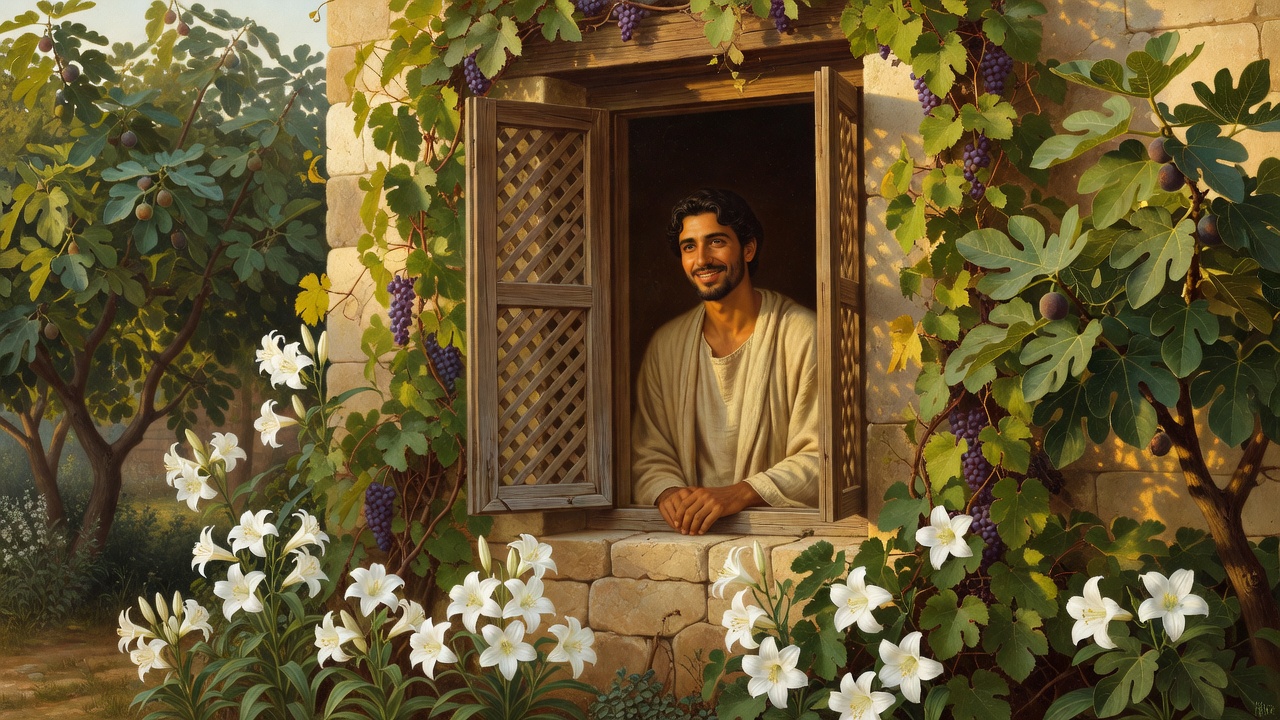
9My darling is like a capret, and a calf of harts; lo! he standeth behind our wall, and beholdeth by the windows, and looketh through the lattice. (My darling is like a gazelle, or like a hart calf; behold! he standeth behind our wall, and seeth in through the windows, and looketh through the lattice.)
10Lo! my darling speaketh to me, My love, my culver, my fair spousess, rise thou, haste thou, and come thou; (Behold! my darling speaketh to me, and saith, My love, my dove, my beautiful (spousess), rise thou up, hasten thou, and come thou away;)
11for winter is passed now, rain is gone, and is departed away. (for the winter is now passed, the rains have gone away, yea, they have departed at last.)
12Flowers have appeared in our land, and the time of cutting is come; the voice of a turtle is heard in our land (or the song of a turtledove is heard in our land),
13the fig tree hath brought forth his buds; the vineries flowering have given their odour. My love, my fair spousess, rise thou, haste thou, and come thou. (the fig tree hath brought forth its buds; the flowering vines have given forth their aroma. My love, my beautiful spousess, rise thou up, hasten thou, and come thou away.)
The Bridegroom
14My culver is in the holes of [the] stone, in the chink of a wall without mortar. Show thy face to me, thy voice sound in mine ears; for thy voice is sweet, and thy face is fair. (My dove is in the holes of the stone, in the chink of a wall made without mortar. Show thy face to me, let thy voice sound in my ears; for thy voice is sweet, and thy face is so beautiful.)
The Friends
15Catch ye little foxes to us, that destroy the vineries; for our vinery hath flowered. (Catch ye for us the little foxes, that destroy the vineyards; for our vines have flowered.)
The Bride
16My darling is to me, and I am to him, which is fed among lilies; (My darling is for me, and I am for him, who is fed among the lilies;)
17till the day spring, and shadows be bowed down. My darling, turn thou again; be thou like a capret, and a calf of harts, on the hills of Bether. (until the day spring forth, and the shadows be bowed down. My darling, return thou; be thou like a gazelle, or a hart calf, on the hills of Bether or upon the rugged hills.)
Did you know?
Springtime and Awakening Love
- Sharon was a fertile coastal plain stretching between the Mediterranean Sea and the hill country west of Jerusalem, celebrated for its beauty and vegetation, which gave rise to imagery like the rose of Sharon.Sources: Saron · the Bible text itself
- The poem marks the arrival of spring through natural changes in the countryside, such as the end of winter rains, the cooing of turtledoves, ripening fig trees, and flowering grapevines that needed protection from foraging foxes.Sources: the Bible text itself
- The speaker repeatedly appeals to the daughters of Jerusalem, framing her cautions about love around wild animals of the open hills, such as gazelles and does of the field.Sources: Jerusalem · the Bible text itself
Notes written with AI assistance from open sources (Theographic Bible Metadata, CC BY-SA 4.0; Easton’s Bible Dictionary, public domain) and reviewed before publishing.
Places in this chapter
Only places identified with high confidence are shown (90% or more according to the scholarly sources compiled by OpenBible). Period map: DARE (Digital Atlas of the Roman Empire), CC BY 4.0; modern map: © OpenStreetMap contributors; places: OpenBible.info (CC BY 4.0).
Credits and license for this translation
Wycliffe's Bible with Modern Spelling (Enhanced)
English: Wycliffe's Bible Modern Spelling (Enhanced) (with Deuterocanon)
Copyright © 2001,2010,2011,2012,2013,2015 Terry Noble
Language: English
Dialect: Archaic
Translation by: Terry Noble
Wycliffe's Bible with Modern Spelling (Enhanced)
Wycliffe’s Bible with Modern Spelling (Enhanced) is a composite of my Wycliffe’s Bible, a modern-spelling version of the 14th century Middle English translation, consisting of Wycliffe’s Old Testament and Wycliffe’s New Testament, and my modern-spelling version of Wycliffe’s Apocrypha. These books contain literally tens of thousands of rewritten verses, presented in parentheses “( ) “, to provide help in comprehending the 14th century Middle English vocabulary and grammar. Wycliffe’s Apocrypha also includes the books of the Apocrypha from the 1st edition of the King James Version of the Bible.
This translation is made available to you under the terms of the
Creative Commons Attribution-Noncommercial-No Derivatives license 4.0.
You may share and redistribute this Bible translation or extracts from it in any format, provided that:
You include the above copyright and source information.
You do not sell this work for a profit.
You do not change any of the words or punctuation of the Scriptures.
Pictures included with Scriptures and other documents on this site are licensed just for use with those Scriptures and documents.
For other uses, please contact the respective copyright owners.
2019-09-25
Section headings adapted from the Berean Standard Bible (public domain); they are not part of this translation’s text.
Source: http://ebible.org/engwyc2018/ · eBible.org