Psalms 80
Wycliffe's Bible with Modern Spelling (Enhanced) · Tap a verse to see its cross-references.
Hear Us, O Shepherd of Israel
1To victory; this psalm is the witnessing of Asaph for lilies. Thou that governest Israel, give attention; that leadest forth Joseph as a sheep. Thou that sittest on cherubim, be showed ( For the choirmaster, to the tune of ‘The lilies of the testimony’, a song by Asaph. Thou who governest Israel, take heed; thou who leadest forth Joseph like a flock of sheep. Thou who sittest upon cherubim, show thyself)
2before Ephraim, Benjamin, and Manasseh. Stir thy power, and come thou, that thou make us safe. (to Ephraim, Benjamin, and Manasseh. Stir up thy power, and come thou, and save us.)
3God of virtues, turn thou us (again); and show thy face, and we shall be safe. (God of hosts, bring us back; and shine thy face upon us, and we shall be saved.)
4Lord God of virtues, how long shalt thou be wroth on the prayer of thy servant (s)? (Lord God of hosts, how long shalt thou be angry with thy people’s prayers?)
5How long shalt thou feed us with the bread of tears; and shalt give drink to us with tears in (great) measure? ( How long shalt thou feed us with tears, instead of bread? and for drink, give us more tears, or even greater sorrow?)
6Thou hast set us into against-saying to our neighbours; and our enemies have scorned us. (Thou hast made our neighbours to speak out against us; and our enemies have mocked us.)
7God of virtues, turn thou us (again); and show thy face, and we shall be safe. (God of hosts, bring us back; and shine thy face upon us, and we shall be saved.)
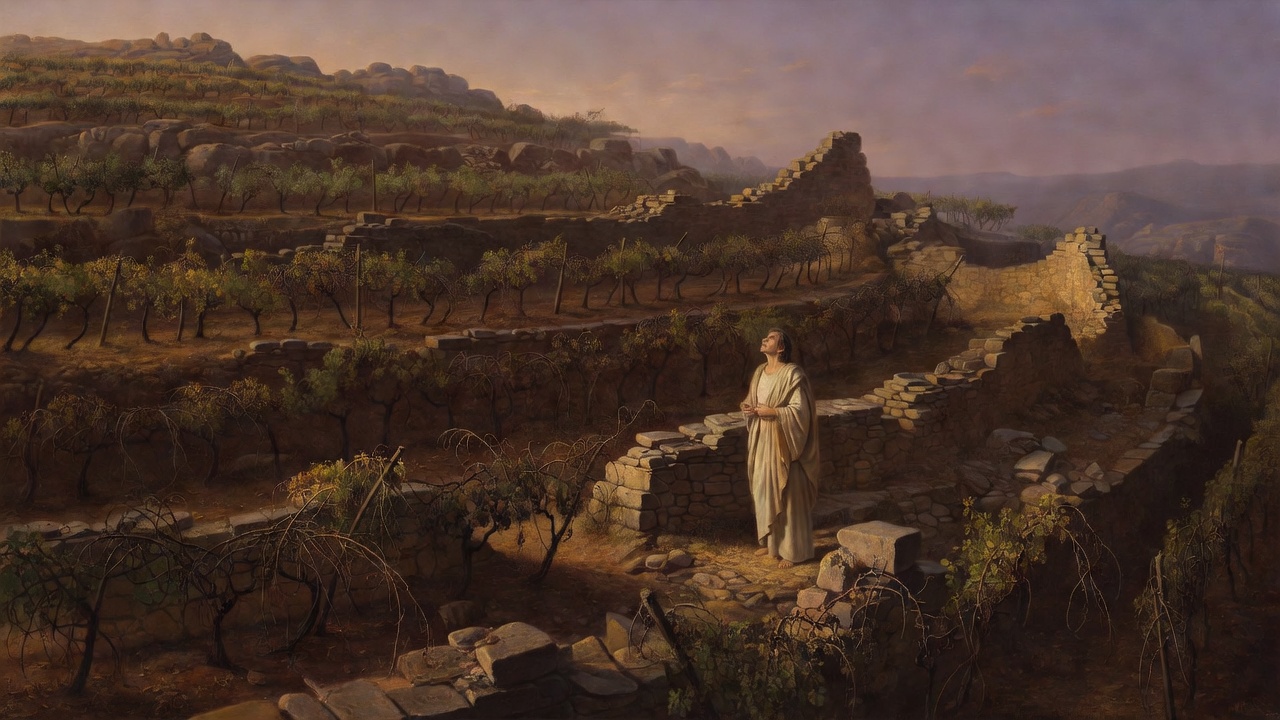
8Thou translatedest a vine from Egypt; thou castedest out heathen men, and plantedest it. (Thou broughtest up a vine out of Egypt; thou threwest out the heathen, and then thou plantedest that vine, that is, us.)
9Thou were leader of the way in the sight thereof; and thou plantedest the roots thereof, and it filled the land. (Thou madest a place for it on the way; and it planted its roots, and it filled the land.)
10The shadow thereof covered hills; and the branches thereof filled the cedars of God. (Its shadow covered the hills; and its branches were thick, like the cedars of God.)
11It stretched forth his scions till to the sea, and the generations thereof till to the flood. (It stretched out its branches unto the Mediterranean Sea, and as far as the Euphrates River.)
12Why hast thou destroyed the wall thereof; and all men that go forth by the way, gather away the grapes thereof? (But why hast thou destroyed the wall around it? so that now all those who go forth by the way, can gather up, or take away, all of its grapes?)
13A boar (out) of the wood destroyed it; and a singular wild beast devoured it.
14God of virtues, be thou turned (again to us); behold from heaven, and see, and visit this vine. (God of hosts, turn thou again to us; look down from heaven, and see us in dire straits, and help us or and care for this vine.)
15And make thou it perfect, which thy right hand planted; and behold thou on the son of man, which thou hast confirmed to thee. (And make thou perfect what thy right hand hath planted; yea, look thou upon the son of man, whom thou hast made strong for thyself, or yea, look thou upon the branch, that thou hast made strong for thyself.)
16(These) Things (were) burnt with fire, and undermined; (they who did this thing) shall perish for the blaming of thy cheer. (For our enemies have burned it with fire, and have cut it down; but they shall die from the look of blame on thy face.)
17Thine hand be made on the man of thy right hand; and on the son of man, whom thou hast confirmed to thee. (Let thy hand rest upon the man at thy right hand; yea, upon the son of the man whom thou hast made strong for thy service.)
18And we departed not from thee; thou shalt quicken us, and we shall inwardly call thy name. (And we shall never leave thee; so grant thou us new life, and we shall call upon thy name.)
19Lord God of virtues, turn thou us (again); and show thy face, and we shall be safe. (Lord God of hosts, bring us back; and shine thy face upon us, and we shall be saved.)
Did you know?
A Prayer for the Uprooted Vine
- The psalm specifically mentions Ephraim, Benjamin, and Manasseh, tribes closely linked by descent from Rachel through Joseph and Benjamin. During Israel's wilderness wanderings, these three tribes were assigned to camp and march together on the western side of the tabernacle.Sources: Benjamin (patriarch) · Manasseh (son of Joseph) · the Bible text itself
- The author uses an extended allegory comparing the nation of Israel to a grapevine brought out of Egypt and replanted in Canaan. The song laments that God had torn down the protective vineyard walls, leaving the fruitful vine exposed to wild beasts and passersby.Sources: Egypt · the Bible text itself
- This poem is part of a distinct collection spanning Psalms 73 through 83 attributed to Asaph. The biblical record describes Asaph as a leading Levite musician in the time of King David whose musical guild or descendants continued his tradition in temple worship.Sources: Asaph (Levite) · the Bible text itself
Notes written with AI assistance from open sources (Theographic Bible Metadata, CC BY-SA 4.0; Easton’s Bible Dictionary, public domain) and reviewed before publishing.
Places in this chapter
- Egypt · 30.129, 31.308 · verse 8
- Euphrates · Today: Euphrates River · 31.004, 47.442 · verse 11
- Great Sea · Today: Mediterranean Sea · 31.805, 34.170 · verse 11
Only places identified with high confidence are shown (90% or more according to the scholarly sources compiled by OpenBible). Period map: DARE (Digital Atlas of the Roman Empire), CC BY 4.0; modern map: © OpenStreetMap contributors; places: OpenBible.info (CC BY 4.0).
Credits and license for this translation
Wycliffe's Bible with Modern Spelling (Enhanced)
English: Wycliffe's Bible Modern Spelling (Enhanced) (with Deuterocanon)
Copyright © 2001,2010,2011,2012,2013,2015 Terry Noble
Language: English
Dialect: Archaic
Translation by: Terry Noble
Wycliffe's Bible with Modern Spelling (Enhanced)
Wycliffe’s Bible with Modern Spelling (Enhanced) is a composite of my Wycliffe’s Bible, a modern-spelling version of the 14th century Middle English translation, consisting of Wycliffe’s Old Testament and Wycliffe’s New Testament, and my modern-spelling version of Wycliffe’s Apocrypha. These books contain literally tens of thousands of rewritten verses, presented in parentheses “( ) “, to provide help in comprehending the 14th century Middle English vocabulary and grammar. Wycliffe’s Apocrypha also includes the books of the Apocrypha from the 1st edition of the King James Version of the Bible.
This translation is made available to you under the terms of the
Creative Commons Attribution-Noncommercial-No Derivatives license 4.0.
You may share and redistribute this Bible translation or extracts from it in any format, provided that:
You include the above copyright and source information.
You do not sell this work for a profit.
You do not change any of the words or punctuation of the Scriptures.
Pictures included with Scriptures and other documents on this site are licensed just for use with those Scriptures and documents.
For other uses, please contact the respective copyright owners.
2019-09-25
Section headings adapted from the Berean Standard Bible (public domain); they are not part of this translation’s text.
Source: http://ebible.org/engwyc2018/ · eBible.org