Proverbs 27
Wycliffe's Bible with Modern Spelling (Enhanced) · Tap a verse to see its cross-references.
Do Not Boast about Tomorrow
1Have thou not glory of the morrow, that knowest not what thing the day coming shall bring forth. (Do not thou have glory over, or boast about, tomorrow, for thou knowest not what the coming day shall bring.)
2Another man (or Let another person), and not thy (own) mouth praise thee; a stranger, and not thy lips.
3A stone is heavy, and gravel is chargeous (or and gravel is burdensome); but the ire of a fool is heavier than ever either.
4Ire hath no mercy, and strong vengeance breaking out hath no mercy; and who may suffer the fierceness of a spirit stirred? (or and who can survive the fierceness of a stirred up, or a jealous, spirit?)
5Better is open reproving, than a love hid. [Better is open amending, than hid love.] (Better be open rebukes, than hidden love.)
6Better be the wounds of him that loveth, than the guileful kisses of him that hateth. (Better be the wounds of him who loveth, than the deceitful kisses of him who hateth.)
7A man filled shall despise an honeycomb (or A full person shall despise an honeycomb); but an hungry man shall take, yea, bitter thing for sweet.
8As a bird passing over from his nest, so is a man that forsaketh his place. (Like a bird passing over its own nest, is a man who is far from his own home.)
9The heart delighteth in ointment, and diverse odours; and a soul is made sweet by the good counsels of a friend.
10Forsake thou not thy friend, and the friend of thy father; and enter thou not into the house of thy brother, in the day of thy torment. Better is a neighbour nigh, than a brother afar. (Desert thou not thy friend, or thy father’s friend; and enter thou not into the house of thy brother, on the day of thy torment. For a friend close-by is better, than thy own brother far away.)
11My son, study thou about wisdom, and make thou glad mine heart; that thou mayest answer a word to a despiser (or so that I can have an answer for any despiser, or for any mocker).
12A fell man seeing evil was hid; little men of wit passing forth suffered harms. (A clever person, seeing evil approach, was hidden; but people of little wit, or of low intelligence, pass forth, or continue on, and suffer harm.)
13Take thou away his cloth, that promised for a stranger; and take thou away a wed from him for an alien man. (Take thou away his cloak, who hath promised for a stranger; and take thou away a pledge from him for an unknown person.)
14He that blesseth his neighbour with [a] great voice; and riseth by night, shall be like him that curseth (him). (He who blesseth his neighbour with a great voice, when he riseth at night, shall be likened to him who curseth him.)
15Roofs dropping in the day of cold, and a woman full of chiding, be likened together. (Roofs dripping rain on a cold day, and a woman full of arguments, or of bickering, be quite similar.)
16He that withholdeth her, (is) as if he holdeth (the) wind; and voideth the oil (out) of his right hand. (He who trieth to hold her, is like him who trieth to hold the wind; and like him who trieth to pick up oil with his fingers.)
17Iron is whetted by iron; and a man whetteth the face of his friend. (Iron is sharpened by iron; and a man sharpeneth his friend’s mind.)
18He that keepeth a fig tree (safe), shall eat the fruits thereof; and he that is a keeper of his lord, shall be glorified. (He who keepeth a fig tree safe, shall eat its fruits; and he who keepeth his lord safe, shall be honoured.)
19As the cheers of men beholding (themselves) shine in waters; so the hearts of men be open to prudent men. (Like the faces of people beholding themselves shine in the water; so people’s hearts be open to prudent people.)
20Hell and perdition shall not be filled; so and the eyes of men be not able to be (ful)filled. (Sheol, or the land of the dead, and perdition, or Hell and perdition, shall never be filled full; and the eyes, or the appetites, of people shall never be fulfilled, or satisfied.)
21As silver is proved in a welling place, and gold is proved in a furnace; so a man is proved by the mouth of his praisers (or so a person is proved, or assayed, by the words of his praisers).
22Though thou poundedest a fool in a mortar, as with a pestle smiting above dried barley (or like pounding dried barley with a pestle), his folly shall not be done away from him.
23Know thou diligently the cheer of thy beast; and behold thou thy flocks. (Diligently know the faces of thy beasts; and keep watch thou over thy flocks.)
24For thou shalt not have power continually; but a crown shall be given to thee in generation and into generation. (For thou shalt not have wealth forever; nor shall a crown endure for generations and generations.)
25Meadows be opened, and green herbs appeared; and hay is gathered from [the] hills (or and the grass is gathered from the hills).
26Lambs be to thy clothing; and kids be to the price of the field. (Lambs be for thy clothing; and goat kids be worth the price of a field.)
27The milk of goats suffice to thee for thy meats; into the necessary things of thine house, and to lifelode of thine handmaidens. (Goats? milk suffice for thee for thy food; yea, for the necessities of thy house, and for the sustenance of thy handmaids, or of thy servantesses.)
Did you know?
Friendship, Prudence, and Daily Diligence
- Proverbs 27 places a strong emphasis on authentic relationships, contrasting the deceitful kisses of an enemy with the faithful wounds of a friend. It famously describes constructive interpersonal interaction with the metaphor of iron sharpening iron, while also advising reliance on a nearby neighbor over a distant relative in times of crisis.Sources: the Bible text itself
- The chapter draws on practical illustrations from ancient daily crafts and domestic life, such as refining silver and gold in a crucible and furnace, grinding grain with a mortar and pestle, and observing one's reflection in water.Sources: the Bible text itself
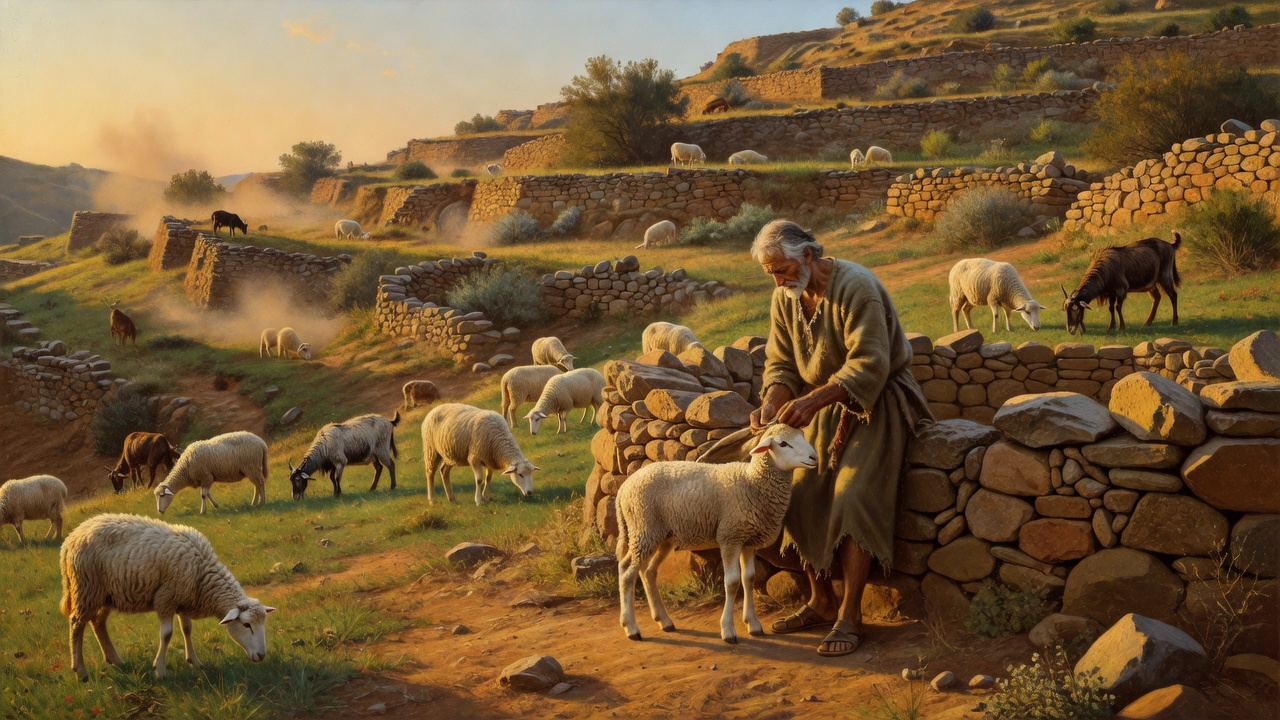
- The closing section outlines the seasonal realities of an agrarian and pastoral economy. It urges careful oversight of flocks and herds, noting that wealth and political crowns are fleeting, while diligent care of livestock and land reliably provides food, goat milk, and wool for the household.Sources: the Bible text itself
Notes written with AI assistance from open sources (Theographic Bible Metadata, CC BY-SA 4.0; Easton’s Bible Dictionary, public domain) and reviewed before publishing.
Credits and license for this translation
Wycliffe's Bible with Modern Spelling (Enhanced)
English: Wycliffe's Bible Modern Spelling (Enhanced) (with Deuterocanon)
Copyright © 2001,2010,2011,2012,2013,2015 Terry Noble
Language: English
Dialect: Archaic
Translation by: Terry Noble
Wycliffe's Bible with Modern Spelling (Enhanced)
Wycliffe’s Bible with Modern Spelling (Enhanced) is a composite of my Wycliffe’s Bible, a modern-spelling version of the 14th century Middle English translation, consisting of Wycliffe’s Old Testament and Wycliffe’s New Testament, and my modern-spelling version of Wycliffe’s Apocrypha. These books contain literally tens of thousands of rewritten verses, presented in parentheses “( ) “, to provide help in comprehending the 14th century Middle English vocabulary and grammar. Wycliffe’s Apocrypha also includes the books of the Apocrypha from the 1st edition of the King James Version of the Bible.
This translation is made available to you under the terms of the
Creative Commons Attribution-Noncommercial-No Derivatives license 4.0.
You may share and redistribute this Bible translation or extracts from it in any format, provided that:
You include the above copyright and source information.
You do not sell this work for a profit.
You do not change any of the words or punctuation of the Scriptures.
Pictures included with Scriptures and other documents on this site are licensed just for use with those Scriptures and documents.
For other uses, please contact the respective copyright owners.
2019-09-25
Section headings adapted from the Berean Standard Bible (public domain); they are not part of this translation’s text.
Source: http://ebible.org/engwyc2018/ · eBible.org