Numbers 35
Wycliffe's Bible with Modern Spelling (Enhanced) · Tap a verse to see its cross-references.
Forty-Eight Cities for the Levites
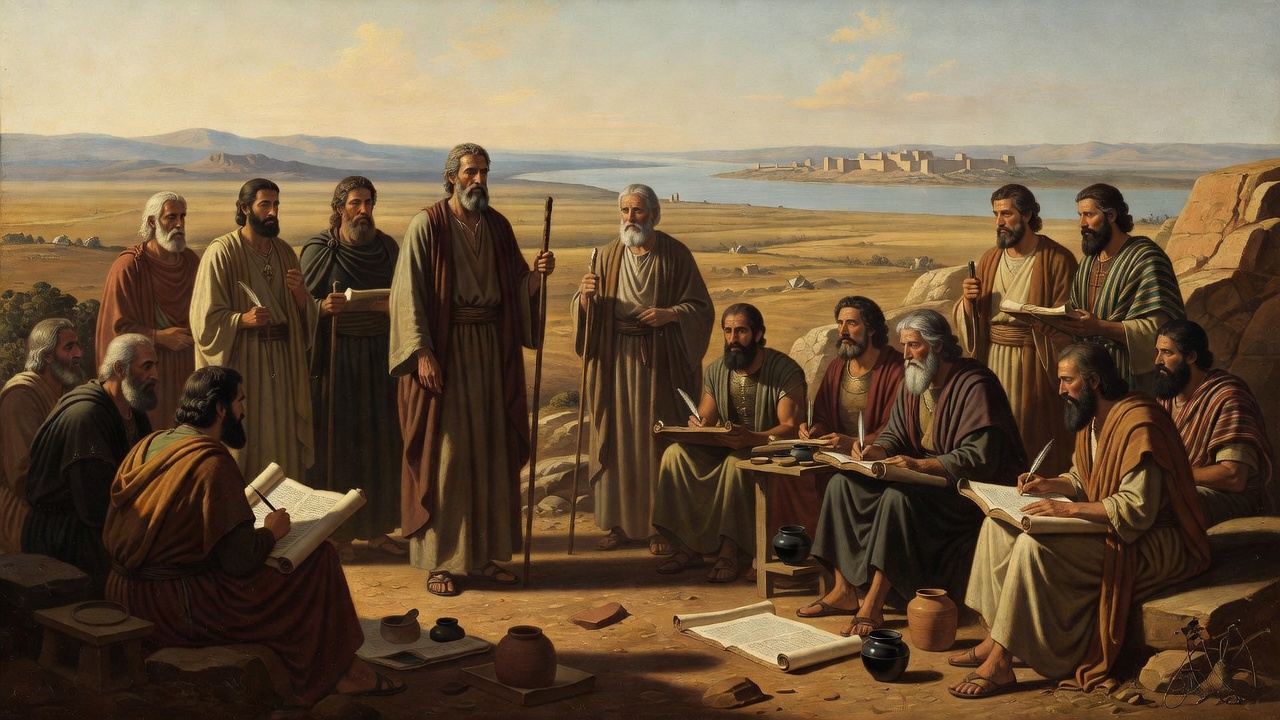
1And the Lord spake these things to Moses, in the field places of Moab, above Jordan, against Jericho, (And the Lord spoke these things to Moses, on the plains of Moab, across the Jordan River, opposite Jericho,)
2Command thou to the sons of Israel, that they give to the deacons, of their possessions, cities to dwell in, and the suburbs of those by compass, (Command thou to the Israelites, that they give to the Levites, out of their possessions, cities to live in, and the suburbs around them,)
3that they dwell in the cities, and the suburbs be to beasts, and work beasts; (so that they can live in those cities, and that the suburbs can be for their beasts, and their work beasts;)
4which suburbs shall be stretched forth from the walls of the cities withoutforth by compass, in the space of a thousand paces;
5against the east coast shall be two thousand cubits, and against the south in like manner shall be two thousand cubits, and at the sea that beholdeth to the west shall be the same measure, and the north coast shall be ended by even term. And the cities shall be in the midst, and the suburbs withoutforth. (that is, the eastern border shall be two thousand cubits out from the city, and the southern border shall also be two thousand cubits out, and the western border shall be the same measure out, as shall be the northern border. And the cities shall be in the midst, and the suburbs shall be all around them.)
6Forsooth of those cities which ye shall give to [the] deacons, six shall be separated into [the] helps of fugitives, either of fleeing men, that he that shedded blood, flee to those; (And of the cities which ye shall give to the Levites, six shall be set apart for fugitives, or for those who flee, so that anyone who sheddeth out blood, can flee to them;)
7and besides these six cities, ye shall give to the deacons (or ye shall give to the Levites), (an)other two and forty cities, that is, altogether eight and forty, with their suburbs.
8And (of) those cities that shall be given (out) of the possession of the sons of Israel, more cities shall be taken away from them that have more, and fewer from them that have less; all the sons of Israel by themselves shall give by the measure of their heritage, cities to the deacons, (or each tribe of the Israelites shall give cities to the Levites, according to the size of their inheritance).
Six Cities of Refuge
9(And) The Lord said to Moses,
10Speak thou to the sons of Israel, and thou shalt say to them, When ye have passed [over] Jordan (or When we have crossed over the Jordan River), in [to] the land of Canaan,
11deem ye which cities ought to be into the helps of fugitives which not willfully have shed blood. (decide ye which cities ought to be for the help of those who flee, who have not intentionally shed blood.)
12In which cities when the fleer hath fled, the kinsman of him that is slain, shall not be able to slay him, till he stand in the sight of the multitude, and the cause of him be deemed. (In which cities to where a fleer hath fled, the next-of-kin of him who is killed, shall not be able to kill the one who fleeth, until he standeth before the multitude, and his case is tried.)
13Forsooth of those cities that be separated to the helps of fugitives, (And of those cities that shall be set apart for the help of fleeing men,)
14three shall be beyond (the) Jordan, ( that is, on the eastern side of the river), and three in the land of Canaan;
15as well to the sons of Israel as to comelings, and pilgrims; that he flee to those cities, that shedded blood not willfully. (for the Israelites, as well as for newcomers, and foreigners, or strangers; so that anyone, who did not intentionally shed blood, can flee to one of those cities.)
16If any man smiteth a man with (a thing of) iron, and he that is smitten is dead, the smiter shall be guilty of manslaying, and he shall die. (If anyone striketh someone with a thing of iron, and he who is struck dieth, the striker shall be guilty of manslaughter, and he must be put to death.)
17If he casteth a stone, and a man is dead by the stroke thereof, the caster shall be punished in like manner. (If anyone throweth a stone, and someone dieth by the stroke of it, the stone-thrower must be put to death.)
18If a man smitten with a staff dieth, he shall be venged by the blood of the smiter. (If someone struck with a staff dieth, he shall be avenged by the death of the person who struck him.)
19The nigh kinsman of him that is slain shall slay the manslayer; anon as he taketh (hold of) the manslayer, he shall slay him. (The next-of-kin of him who is killed, shall kill the man-killer; as soon as he catcheth the man-killer, he shall kill him.)
20If by hatred a man hurtleth, either shoveth, a man, either casteth anything into him by ambushings, (If in hatred anyone hurtleth, or pusheth, someone, or intentionally throweth something into him,)
21either when he was enemy to him, smite him with his hand, and he is dead, the smiter shall be guilty of manslaying. The kinsman of him that is slain, anon as he findeth him, that is, the slayer, shall slay him. (or when he was an enemy to him, he striketh him with his hand, and he dieth, the striker shall be guilty of manslaughter. The next-of-kin of him who is killed, as soon as he findeth the killer, shall kill him.)
22That if by sudden case, and without hatred and enmities, a man doeth anything of these; (But if, on the spur of the moment, or by accident, and without any hatred or enmities, someone doeth any of these things;)
23(This verse is omitted in the original text.)
24and this is proved, the people hearing, (or and this is proven before the people), and the question of the blood, or death, is discussed betwixt the smiter and the kinsman of him that is slain,
25the innocent (man) shall be delivered from the hand of the venger (of the blood), and by sentence of judges he shall be led again into the city, to which he fled, and he shall dwell there, till the great priest die, which is anointed with [holy] oil. (the guiltless person, that is, he who killed unintentionally, shall be rescued from the hand of the avenger of the blood, and by the sentence of the judges he shall be brought again to the city, to which he fled, and he shall live there until the High Priest, who is anointed with holy oil, hath died.)
26If the slayer is found without the coasts of the cities that be assigned to exiled men, (But if the killer is found anywhere outside the cities of refuge,)
27and he is slain of him that is venger [of the blood], he that slayeth him shall be without guilt; (and he is killed by him who is the avenger of the blood, he who killeth him shall be without guilt;)
28for the exiled man ought (to) sit in the city till to the death of the bishop; forsooth after that that bishop is dead, the manslayer shall turn again into his land. (for the exiled person ought to remain in the city until the death of the High Priest; but after that the High Priest is dead, the man-killer can return to his own land.)
29These shall be everlasting and lawful things in all your dwellings. (These shall be everlasting laws wherever you shall live.)
30A manslayer shall be punished under witnesses; no man shall be condemned at the witnessing of one man. (A man-killer shall be found guilty, and put to death, only after the testimony of two or more witnesses; no one shall be put to death after the testimony of only one person.)
31Ye shall not take price of him which is guilty of blood, or death, anon and he shall die. (Ye shall not take payment from anyone who is guilty of murder, so that he can live, but he must be put to death at once.)
32Men exiled, and fugitives, shall not be able to turn again in any manner into their cities, before the death of the bishop, (Exiled people, and fugitives, shall not be able to return to their own cities, for any reason, before the death of the High Priest,)
33lest ye defoul the land of your habitation, which is defouled by the (shedding of the) blood of innocent men; and it may not be cleansed in (any) other manner, no but by the blood of him, that shedded the blood of another man.
34And so your possession shall be cleansed, for I shall dwell with you; for I am the Lord, that dwell among the sons of Israel. (And so the land, in which I live with you, shall be made clean, or purified; for I am the Lord, who liveth among the Israelites.)
Did you know?
Levitical Towns and Cities of Refuge
- Unlike the other tribes, the Levites were not allotted a continuous territory. Instead, the Israelites were instructed to provide them with forty-eight cities along with surrounding pasturelands, contributed by each tribe in proportion to the size of its tribal inheritance.Sources: the Bible text itself
- Six of the forty-eight Levitical towns were designated as cities of refuge, with three located east of the Jordan and three in the land of Canaan. These sanctuaries offered legal protection for Israelites and resident foreigners who caused an accidental death, sheltering them from the avenger of blood until a formal trial could take place.Sources: the Bible text itself · Canaan · Jordan
- The law strictly distinguished between intentional murder and accidental manslaughter, requiring multiple witnesses before carrying out capital punishment. Furthermore, financial ransoms were forbidden either to spare a convicted murderer or to release an accidental killer from their city of refuge before the death of the high priest.Sources: the Bible text itself
Notes written with AI assistance from open sources (Theographic Bible Metadata, CC BY-SA 4.0; Easton’s Bible Dictionary, public domain) and reviewed before publishing.
Places in this chapter
- Jericho · Today: Tell es Sultan · 31.872, 35.445 · verse 1
- Jordan · Today: Jordan River · 31.761, 35.558 · verses 1, 10, 14
- Moab · Today: Moab 2 · 31.840, 35.674 · verse 1
- Canaan · 32.767, 35.333 · verses 10, 14
Only places identified with high confidence are shown (90% or more according to the scholarly sources compiled by OpenBible). Period map: DARE (Digital Atlas of the Roman Empire), CC BY 4.0; modern map: © OpenStreetMap contributors; places: OpenBible.info (CC BY 4.0).
Credits and license for this translation
Wycliffe's Bible with Modern Spelling (Enhanced)
English: Wycliffe's Bible Modern Spelling (Enhanced) (with Deuterocanon)
Copyright © 2001,2010,2011,2012,2013,2015 Terry Noble
Language: English
Dialect: Archaic
Translation by: Terry Noble
Wycliffe's Bible with Modern Spelling (Enhanced)
Wycliffe’s Bible with Modern Spelling (Enhanced) is a composite of my Wycliffe’s Bible, a modern-spelling version of the 14th century Middle English translation, consisting of Wycliffe’s Old Testament and Wycliffe’s New Testament, and my modern-spelling version of Wycliffe’s Apocrypha. These books contain literally tens of thousands of rewritten verses, presented in parentheses “( ) “, to provide help in comprehending the 14th century Middle English vocabulary and grammar. Wycliffe’s Apocrypha also includes the books of the Apocrypha from the 1st edition of the King James Version of the Bible.
This translation is made available to you under the terms of the
Creative Commons Attribution-Noncommercial-No Derivatives license 4.0.
You may share and redistribute this Bible translation or extracts from it in any format, provided that:
You include the above copyright and source information.
You do not sell this work for a profit.
You do not change any of the words or punctuation of the Scriptures.
Pictures included with Scriptures and other documents on this site are licensed just for use with those Scriptures and documents.
For other uses, please contact the respective copyright owners.
2019-09-25
Section headings adapted from the Berean Standard Bible (public domain); they are not part of this translation’s text.
Source: http://ebible.org/engwyc2018/ · eBible.org